• TalkBass has been independent since 1998. Add your voice.
    Create a free account to reply to discussions, view embedded media, and browse with fewer display ads.
    Join freeLog in
    Want zero display ads or expanded classifieds tools? Compare plans.

Ampeg V4 Debug

father of fires

Commercial User
Nov 29, 2006
5,362
4,766
BALTIMORE CITY
Disclosures
Chief of Medicine at Damnation Audio
I was given an Ampeg master volume VT22 (not a Distortion Model) that was put in a head case. I was told that it was broken but the guy didn't know what what wrong. The only tube it came with was one 6K11 (lucky break!). I pulled the tubes from a working V4 just to see if it would fire up. Well, it did but it had sort of a gated fuzz sound and it was ultra quiet. It'll be a couple of days before I can open her up to see if anything is blown and several weeks before I can buy my own tubes for it.

I know there are a million reasons why a tube amp might not be working right but I thought I would throw this out there and ask you guys what are the first things I should look for in these old V4's?

I've built an amp before (Fender Deluxe) and have been toying with diy tube preamps and effects for a while but to be honest my debugging skills are quite lacking.

Any tips or advice would be most appreciated.

Thanks!

P.S. I am aware of the deadly voltages present. I have a tool I made up for deenergizing filter caps and I've shocked myself enough to know how dangerous this can be. If I can not figure it out or if it goes over my head I have a trusted tech but I want to try and work this out myself as a learning experience.

 
I suggest cleaning all the tube sockets, checking the grid resistors, and replacing the filter caps (not fun - try the fliptops web store), in that order. My VT-22 is very sensitive to power tube bias, too.

Jess Oliver was a mad scientist!
 
Check all voltages in the power supply against the schematic values (including the bias voltage). They should be within say 10% of those values, otherwise something is wrong. I had a similar problem with my V4 but it was intermittent. Volume would fade and get very low with distortion. Turned out to be a screen dropping resistor in the power supply. Voltage would drift from over 500 volts down to 100 something or so (don't remember exactly). Replacing the resistor fixed the problem. Mine was an older version (no master volume).

As always, be extremely careful if you poke around. Best way is to use some sort of clip to clip meter leads on to test points before you plug it in. And do the filter cap de-energizing before you clip on the probe. If you're not comfortable doing this, take it to a tech.
 
i had a V4 that had the same problem. if all of the tubes that you installed in it are known to be good, and the components (i.e. resisitors, caps, pots, sockets etc) all test okay, then start looking at the output transformer. i replaced the output tranny in one of mine with one from fliptops.net and after that, it worked perfectly and sounded great.
 
i had a V4 that had the same problem. if all of the tubes that you installed in it are known to be good, and the components (i.e. resisitors, caps, pots, sockets etc) all test okay, then start looking at the output transformer. i replaced the output tranny in one of mine with one from fliptops.net and after that, it worked perfectly and sounded great.

This is the one thing I was afraid to here. I hope it doesn't go that far!

Regardless, thanks for the tips guys.
 
B-string said:
My VT-22/V4 schematic shows 540 plates and 530 screens. I think your schematic is in error?

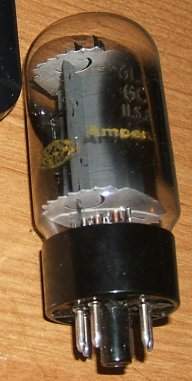
It's the one glued to the chassis. I may gave read it wrong. The V4 I borrowed the tubes from apparently had 6L6's in it so that may be part of the problem if my VT22 wasn't modded to accept them. Gonna wait on some 7027's before I go any further.
 
John's right. 6L6GC and 7027a are practically the same tube. Current production are exactly the same tube except for a minor pinout difference. 7027's have the sceen grid going to both pins 1 and 4, while the 6L6 has the screen going to only pin 4. Doesn't matter in the V4 series of amps. Only difference is if you get hold of some NOS 7027a's. They have I believe 35 watts plate dissipation max vs 30 watts on the 6L6GC. Look at the JJ datasheets for instance.

Before buying any tubes, check a few more voltages, particularly the screen grid voltages (pin 4) and the bias voltage.
 
Well I found out there are 2 voltages listed in various sections. I guess the lower ones are for testing with a variac?

Nope, the only spot there are "2 voltages" shown on the schematic would be on the primary side of the PT.

Perhaps it may be best to take this to a tech? If you aren't familiar with the way the plate voltages are distributed and lowered through an amp, the V4 is not exactly the kind of amp to learn on. (Not knocking you, but the fact is, the plate voltage inside this amp has enough current to KILL you if you are not careful)
 
Well I found out there are 2 voltages listed in various sections. I guess the lower ones are for testing with a variac?

I know there are a few minor variants of schematics out there, but I've never come across one with two voltages listed. Here's the best one I can find with everything labeled pretty clearly:

Invalid Link Removed

Output plate voltage 545V, screen 530V, bias -62V.


Does this look like yours? The one's with the master volume are later, like late 1970's I think and don't have a 6K11. Something like this:

http://www.ampegv4.com/images/VT22_Schem2.jpg

The power supply is slightly different with a separate screen supply (and corresponding lower screen voltage and bias voltage).
 
This is the schematic I'm using.

ForumRunner_20120428_100544.png

I downloaded this from the Ampeg V4 website. I couldn't post a link with my phone so I tried to upload it. I'm not sure you can zoom in but if you go to that website and look at the master volume VT22 schematic you'll see what I was talking about. The smaller voltages are inside boxes so they stand out and they were the first numbers I noticed.