• TalkBass has been independent since 1998. Add your voice.
    Create a free account to reply to discussions, view embedded media, and browse with fewer display ads.
    Join freeLog in
    Want zero display ads or expanded classifieds tools? Compare plans.

Ampeg V4 Debug

Incidentally, the original complaint was that it was very quiet and fuzzy.

Did you plug the speaker cable (when using one speaker cable) into the correct jack ? It's the bottom speaker jack, NOT the top jack that's labelled "ext spkr" !!!!! Even though they are indeed in parallel, the bottom jack is a shorting jack and that is the one to use if there is only one speaker cable being plugged in.

Plugging into the top jack (only) will sound quiet and fuzzy. (I've done it by mistake)
 
nashvillebill said:
Incidentally, the original complaint was that it was very quiet and fuzzy.

Did you plug the speaker cable (when using one speaker cable) into the correct jack ? It's the bottom speaker jack, NOT the top jack that's labelled "ext spkr" !!!!! Even though they are indeed in parallel, the bottom jack is a shorting jack and that is the one to use if there is only one speaker cable being plugged in.

Plugging into the top jack (only) will sound quiet and fuzzy. (I've done it by mistake)

Well actually the top jack had fallen inside the amp. It doesn't appear to be touching anything. Maybe I should find a washer and nut to fix that as well.
 
I can't read that schematic, but it is indeed a variation I haven't seen. There may be voltages shown in rectangular boxes, which are likely voltages under certain test conditions--but NOT using a variac.

Using a Variac is not a good idea on a tube amp. It will lower the heater voltages and likely screw up the bias. A dim bulb tester, OK. A current meter, OK.

The most likely scenario would be a sine wave input at a certain voltage, with the amp plugged into a dummy load.
 
nashvillebill said:
I can't read that schematic, but it is indeed a variation I haven't seen. There may be voltages shown in rectangular boxes, which are likely voltages under certain test conditions--but NOT using a variac.

Using a Variac is not a good idea on a tube amp. It will lower the heater voltages and likely screw up the bias. A dim bulb tester, OK. A current meter, OK.

The most likely scenario would be a sine wave input at a certain voltage, with the amp plugged into a dummy load.

Fair enough. I thought techs used variacs when working on amps.
 
Fair enough. I thought techs used variacs when working on amps.

Not really. There are some uses in SS amps but even then IMHO they are of somewhat limited value.

I don't claim to be an "expert" amp tech, but I've been fiddling with amps for many years, and while I've got a lot of test gear, I have not yet had a need for a Variac.

(The dim bulb tester on the other hand, THAT's useful.)
 
Not really. There are some uses in SS amps but even then IMHO they are of somewhat limited value.

I don't claim to be an "expert" amp tech, but I've been fiddling with amps for many years, and while I've got a lot of test gear, I have not yet had a need for a Variac.

i use a variac when i form capacitors in tube amps, but that's when there are no tubes in it. or i also use one when i have an old tube amp that hasn't been run in along time to make it easier on the filter caps. i also find it useful that its amp meter quickly lets me know how much current the amp is pulling at idle and at different output levels.
 
johnk_10 said:
the one that Gerry mentioned looks like the one that you're using:

Invalid Link Removed

and it says 540V and 530V for the plates and screens.

Oh yeah, I've got the correct voltages now. I was just trying to show how I got confused. The plates and screens check out just fine.
 
Incidentally, the original complaint was that it was very quiet and fuzzy.

Did you plug the speaker cable (when using one speaker cable) into the correct jack ? It's the bottom speaker jack, NOT the top jack that's labelled "ext spkr" !!!!! Even though they are indeed in parallel, the bottom jack is a shorting jack and that is the one to use if there is only one speaker cable being plugged in.

Plugging into the top jack (only) will sound quiet and fuzzy. (I've done it by mistake)

that's a great tip right there! (i've done that before too :ninja:) ;)
 
This is the schematic I'm using.

View attachment 264236

I downloaded this from the Ampeg V4 website. I couldn't post a link with my phone so I tried to upload it. I'm not sure you can zoom in but if you go to that website and look at the master volume VT22 schematic you'll see what I was talking about. The smaller voltages are inside boxes so they stand out and they were the first numbers I noticed.

OK. Found it here:

http://www.ampegv4.com/images/schematics/Ampeg_VT-22_1977.jpg

I believe the voltages in boxes are AC sinewave signal voltages under some specific test conditions, probably with an audio oscillator feeding the input at that level. Looking at the very input from R1 into the first 12AX7 looks like 0.3V or 300mv. That's a fairly nominal value representative of the output of a passive instrument. Following through the stages it generally gets bigger until the output tube plates where it says 250 volts. That would be 250 Volts RMS (or about 353 volts peak) imposed upon the DC plate voltage of 540 Volts. If one were to scope the plate with that signal, the plate would swing from about 190V to 893 volts (yes, that's above the power supply voltage and is due to energy storage in the output transformer).

But I digress :smug:. Ignore those values. Just look at the DC values, the ones not in the boxes. With no signal into the amp, all the values in the boxes would go to zero.
 
If you are connecting to the ext jack you will get very little, almost zero output. As stated the speaker jack shorts the output. It's an easy mistake to make - I've done it myself!!!

Edit: I'm glad I'm not the only one!!! :D

A little tip if I may. Before you power any amp up, look and see if there are any loose components. That speaker jack should have been the first thing to get your attention.

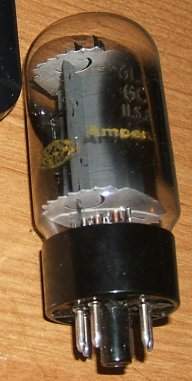
When replacing output tube the bias HAS to be checked to see if it is suitable for the "new" tubes. Neg 62V is pretty cold for a 6L6GC, it should be closer to neg 45V.