

Enjoy the benefits of a premium membership!
Upgrade Account
-
TalkBass has been independent since 1998. Add your voice.
Create a free account to reply to discussions, view embedded media, and browse with fewer display ads.
Join free Log in
Want zero display ads or expanded classifieds tools? Compare plans.
You are using an out of date browser. It may not display this or other websites correctly.
You should upgrade or use an alternative browser.
You should upgrade or use an alternative browser.
An Impedance-reducing Resistor?
- Thread starter domjohnson
- Start date
More options
Who Replied?
Nothing but another cab will make any more sound.
Say I say I will give you 100 dollars to feed 10 homeless people but you can only find five, so you rope in five MacDonalds employees on the sly. End result is five homeless get fed.
Say I say I will give you 100 dollars to feed 10 homeless people but you can only find five, so you rope in five MacDonalds employees on the sly. End result is five homeless get fed.
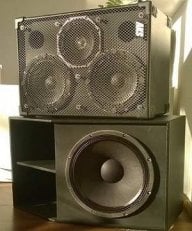
Link Removed from Glockenklang is rated for 600 watts max.
HAha, if you want to schlep some extra weight, this is it!
Serious, adding a parallel resistor to convert 8 into 4ohms will only create some extra heat and puts the amp under more stress. Stick to 8ohms or hook up a 2nd cab.
A speaker IS a resistor, anything with wire in it has a resistance, so it doesn't act like one it is one.
You could made a load box but the power has to go somewhere...... Depends on the cab you might be able to change the components inside but i wouldn't mess with it if it works
You could made a load box but the power has to go somewhere...... Depends on the cab you might be able to change the components inside but i wouldn't mess with it if it works
My understanding is that when you plug two cabs into an amp head, the impedance is reduced because you get the same effect of resistors in parallel - In other words, the speaker itself is acting as a resistor, with the added (and desired) effect of outputting sound - and so the overall volume is increased not only because of the extra speakers, but also the reduction in impedance. However, I can't really afford a second cab, nor would I be able to get a second one up to a gig.
So, my question is: is there a product that is basically a great big high power resistor that gets hooked up to the other output on the head that will therefore reduce the impedance of the stack?
Cheers,
Dom.
Yes, there is, but it won't give you more volume.
If you want more volume, you have a few options:
1. You may be able to rewire your existing cab (if it has more than one driver of the right impedence AND they can handle the extra power)
2. Replace your cab (with a lower impedence, higher power one)
3. Replace your head (assuming your current cab can handle more power)
4. Add another cab.
IMHO, adding another identical cab is usually the best option. Just save up until you can afford it.
Thanks everyone for your input - the first couple of posts would have been enough to answer the question, of course extra energy can't just "appear".
Anyway...
I would disagree with that statement. Yes, everything with a wire in it has resistance - of course it would, otherwise current wouldn't flow. However, that doesn't make it a resistor. A resistor is a component that is designed to have a constant resistance regardless of the current and voltage, in other words its IV "curve" would be straight. So, I'm talking about an ohmic resistor, not just any device that resists the current.
/Splitting hairs.
Anyway...
A speaker IS a resistor, anything with wire in it has a resistance, so it doesn't act like one it is one.
I would disagree with that statement. Yes, everything with a wire in it has resistance - of course it would, otherwise current wouldn't flow. However, that doesn't make it a resistor. A resistor is a component that is designed to have a constant resistance regardless of the current and voltage, in other words its IV "curve" would be straight. So, I'm talking about an ohmic resistor, not just any device that resists the current.
/Splitting hairs.

You are correct a speaker has DCR (Direct Current Resistance) but the AC impedance of a speaker varies widely. A non-inductive resistor does NOT have a AC impedance curve, it presents the same resistance to current flow regardless of frequency.
Speakers can NOT be thought of as resistors.
Speakers can NOT be thought of as resistors.
Just to circle bck to something said above a couple of times, to the OP. If you have an 8 ohm cab and you put an 8 ohm resistor in parallel with it, let's assume you have a "perfect amp" so total output power from the amp doubles (it will less than double in the real world).
Where does that double power go? Half of it goes to the speaker, so it's still exactly as loud as it was before. Half of it goes into a resistor which makes no sound at all. You've added stress to your amp, theoretically, without gaining anything at all in terms of volume output, and probably limited max SPL a bit . . .
although technically, because the speaker cabinet's impedance varies with frequency the actual split of power between cab and resistor will vary with frequency. Which is to say it may mess up your EQ while wasting power and making your cab quieter.
Other than that, it's a great idea . . .
Where does that double power go? Half of it goes to the speaker, so it's still exactly as loud as it was before. Half of it goes into a resistor which makes no sound at all. You've added stress to your amp, theoretically, without gaining anything at all in terms of volume output, and probably limited max SPL a bit . . .
although technically, because the speaker cabinet's impedance varies with frequency the actual split of power between cab and resistor will vary with frequency. Which is to say it may mess up your EQ while wasting power and making your cab quieter.
Other than that, it's a great idea . . .

- Aug 21, 2008
- 10,386
- 252
- 68
- Disclosures
- Owner, SGD Music Products
You are correct a speaker has DCR (Direct Current Resistance) but the AC impedance of a speaker varies widely. A non-inductive resistor does NOT have a AC impedance curve, it presents the same resistance to current flow regardless of frequency.
Speakers can NOT be thought of as resistors.
+1
That's why I said impedance and resistance were two different things.
AC resistance increases with frequency. DC resistance does not.

Thanks everyone for your input - the first couple of posts would have been enough to answer the question
They aren't listening to you.
AC resistance increases with frequency
Depending on whether it's inductive or capacitive

Even IF it worked ...
300 watts @ 4 ohms, 200 watts @ 8 ohms.
If you ad a "magic resistant", you will get 300 watts @ 4 ohms.
BUT the "magic resistant" will take "half of the watts" (and turn it into heat).
This means the cab itself gets 150 watts > 50 watts less.
There is an easyier way to feed your cab with 150 watts. Don't turn the amp up to max, but 3/4 of it ... (I know - physically wrong, but everyone knows what I want to say)
The "reducting restistor" would always demand it's part of the power.
This means that the speaker will in any way get less of the power than working alone.
The resistor would only make sense at a tube power amplifier to avoid missmatching. It is no benefit to solid-state amplifiers at all ...
300 watts @ 4 ohms, 200 watts @ 8 ohms.
If you ad a "magic resistant", you will get 300 watts @ 4 ohms.
BUT the "magic resistant" will take "half of the watts" (and turn it into heat).
This means the cab itself gets 150 watts > 50 watts less.
There is an easyier way to feed your cab with 150 watts. Don't turn the amp up to max, but 3/4 of it ... (I know - physically wrong, but everyone knows what I want to say)
The "reducting restistor" would always demand it's part of the power.
This means that the speaker will in any way get less of the power than working alone.
The resistor would only make sense at a tube power amplifier to avoid missmatching. It is no benefit to solid-state amplifiers at all ...
+1
That's why I said impedance and resistance were two different things.
AC resistance increases with frequency.
DC resistance does not.
sorry, A/C resistance does not increase with frequency and DC is direct current meaning no frequency so the second statement is also incorrect.
If you have an A/C circuit containing capacitors or inductors it goes like this:
for an inductor, reactance(X-L) is directly proportional to inductance(L).
X-L = 2*pi*f*L
for an capacitor, reactance(X-C) is inversely proportional to capacitance(C).
X-C = 1/ ( 2*pi*f*C)

You are correct a speaker has DCR (Direct Current Resistance) but the AC impedance of a speaker varies widely. A non-inductive resistor does NOT have a AC impedance curve, it presents the same resistance to current flow regardless of frequency.
Of course, the problem is that non-inductive resistors don't actually exist in the real world.
Of course, the problem is that non-inductive resistors don't actually exist in the real world.
Really??
Invalid Link Removed
Of course, the problem is that non-inductive resistors don't actually exist in the real world.
Really??
Invalid Link Removed
Yes this is an example. So for any overly anal out there let me qualify with "For use in the average range of audible frequencies that humans deem as Audio use".


Depending on whether it's inductive or capacitive
OK, how about if we agree that 'resistance to AC varies with frequency'?
Actually, since the inductance of a resistor is directly related to the rate of change in current:
v= L* di/dt
I treat a typical axial resistor as a purely resistive element in audio frequency circuit design as its impact is so miniscule to the overall circuit design.
As the frequency goes up (way up actually, as in microwave power amplification) then it becomes more important to calculate for its effect on the circuit.
v= L* di/dt
I treat a typical axial resistor as a purely resistive element in audio frequency circuit design as its impact is so miniscule to the overall circuit design.
As the frequency goes up (way up actually, as in microwave power amplification) then it becomes more important to calculate for its effect on the circuit.

So OP, lots of different ways of telling you the sad news: putting a resistor in parallel with your speaker will not produce more volume. Any extra power your amp would generate from the reduced load will simply be spent heating up the resistor, not making more sound. In fact, I can't think of a real-world example where you won't actually wind up being just a bit quieter (because amps usually don't fully double wattage on halving of impedance).
OK, how about if we agree that 'resistance to AC varies with frequency'?
A better generalization would be that every component in an A/C circuit varies with frequency.
Not a very useful formula for working out issues though.


