• TalkBass has been independent since 1998. Add your voice.
    Create a free account to reply to discussions, view embedded media, and browse with fewer display ads.
    Join freeLog in
    Want zero display ads or expanded classifieds tools? Compare plans.

Angled pickups: why?

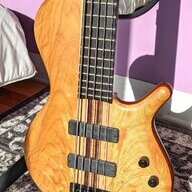
I often see these in the wild. I wonder what problem is being solved by angling the pickups?
Is it a pole piece / string spacing compensation? A desire to get more overtones on lower vs upper strings? Why do builders choose this?


xaifj8rspzb0skmuh8rt.jpg
warwick-thumb-nt-body-620x318-jpg.3039494
[Invalid or Expired Link Removed]
 
TBH, I think it's mostly "marketecture" - that is, for visual effect, trying to look "cool" or "edgy". I theory, it should have some effect on the distribution of tonal differences between strings, but I'm guessing that effect is so tiny as to be inaudible.
 
I often see these in the wild. I wonder what problem is being solved by angling the pickups?
Is it a pole piece / string spacing compensation? A desire to get more overtones on lower vs upper strings? Why do builders choose this?


xaifj8rspzb0skmuh8rt.jpg
warwick-thumb-nt-body-620x318-jpg.3039494
[Invalid or Expired Link Removed]
I'm a Fender fan, but I think Warwick got it right, much like a reversed P, I'd rather get more "body" out the D & G strings. They certainly don't need any extra "plink" to the tone.
 
Yeah, I have no idea why Fender angled the P that way. It makes sense to angle them in reverse orientation. It doesn't make a huge difference in the neck/middle position, unless you're after that last few % of tonal difference it does make.

It matters a whole lot more in the bridge position, what I presume Warwick was after - get tighter sounding low strings, and meatier sounding high strings.
 
A reverse slant of the neck PU will usually even out the bottom end, being firmer on the lower strings, and fuller on the higher.

The problem is a flat PU under the curvature of the strings, some being closer and thus louder than others. Lowering the PU helps dilute that but at the loss of output.

The reverse split P can equalise the output under each string.

The ideal would be a flat PU with adjustable pole pieces IMO.
 
  • Like
Reactions: DJ Bebop
A reverse slant of the neck PU will usually even out the bottom end, being firmer on the lower strings, and fuller on the higher.

The problem is a flat PU under the curvature of the strings, some being closer and thus louder than others. Lowering the PU helps dilute that but at the loss of output.

The reverse split P can equalise the output under each string.

The ideal would be a flat PU with adjustable pole pieces IMO.

Or a flat fretboard.

I make mine with a 20” radius. Flat-topped pickups work great.
 
I'm a Fender fan, but I think Warwick got it right, much like a reversed P, I'd rather get more "body" out the D & G strings. They certainly don't need any extra "plink" to the tone.

A reverse slant of the neck PU will usually even out the bottom end, being firmer on the lower strings, and fuller on the higher.

The problem is a flat PU under the curvature of the strings, some being closer and thus louder than others. Lowering the PU helps dilute that but at the loss of output.

The reverse split P can equalise the output under each string.

The ideal would be a flat PU with adjustable pole pieces IMO.


For some its this, there may other that do it for the visual…some maybe for both?
 
Pickup position makes a larger tonal shift then you'd think. As to Fenders take on the angle with the boxer its gonna be abit more treble forward and agressive tonally then angling the opposite direction so I'm thinking this was more geared towards heavy metal and punk players of the time that wanted more grit clank and bite possibly I could be wrong tho.
 
The position of the pickup is THE most effective way of completely changing the tone of a bass. Slanting the pickups like that will have a VERY noticeable effect on the tone. Whether you like it or not is a matter of taste.

Most basses with slanted pickups are designed that way for tonal reasons of course, not to make a pickup work with a strings spacing it isn't designed for. If you're slanting a pickup ONLY to make it work with a string spacing it isn't designed for you could end up with a very poor tonal balanced across the strings. It might turn out ok but it would be blind luck.
 
Speculation about what it really does is a guess? I haven't taken the time to research it so I'm a zero right now when it comes to an actual advantage. Is there really an advantage other than aesthetic's?

Advantage? That depends on whether you like how it affects the tone. And it does affect the tone, considerably! That's that whole point of doing it.
 
It's all about moving the higher strings to a more bridge (brighter) sound, and away from the rounder neck pickup sound.

For a fanfret (mulitscale) build, to me it's a must. I find it also evens up the tone as well. It's my belief that it's also about the harmonics, which for a slanted bridge or individuals, you need the same distance from the bridge to pickup the same harmonic position.

If you think it doesn't affect the tone, then you aren't hearing a difference between your neck pickup and bridge pickup?
It's the same idea.
 
  • Like
Reactions: stevensivak