
This is true for most things.the real answer is more complicated

Enjoy the benefits of a premium membership!
Upgrade Account
-
TalkBass has been independent since 1998. Add your voice.
Create a free account to reply to discussions, view embedded media, and browse with fewer display ads.
Join free Log in
Want zero display ads or expanded classifieds tools? Compare plans.
You are using an out of date browser. It may not display this or other websites correctly.
You should upgrade or use an alternative browser.
You should upgrade or use an alternative browser.
Another nail in the Tonewood Coffin?
- Thread starter Gilmourisgod
- Start date
More options
Who Replied?
Kinda cool though, as the bark beetles hatch and start crawling out of your bass on stage as you're playing?Aww, hell no. Every time I watch one of those idiot things my YouTube channel gets flooded with videos of every bozo on the planet making guitars outta' pallet wood.

Ultimately it's the player that makes something sound good or bad. I didn't care for the sound of the bass in this video, but give it to Les Claypool and he'd make a whole album out of it that people would love.

Ahhh, perhaps there's nothing negative about the sonics of a plywood bass..............ahhh, but what's the advantage?
Out of curiosity, I did a Google search on the % of basses made from alder. Interesting! IMHO.....It's pretty tuff to beat woods that have proved themselves.
Google.......................
While there is no exact industry-wide census, alder is the single most common tonewood used for electric bass guitar bodies, making up an estimated 35% to 50% of all production basses.
Out of curiosity, I did a Google search on the % of basses made from alder. Interesting! IMHO.....It's pretty tuff to beat woods that have proved themselves.
Google.......................
While there is no exact industry-wide census, alder is the single most common tonewood used for electric bass guitar bodies, making up an estimated 35% to 50% of all production basses.

Not good sounding the attack is too mushy -- zero punch as if processing's it with tons of compression or passing it through a digital synth pedal ( for the purpose of softening or delaying the attack) , Sorry no tone wood nail here. How much is he really saving by using plywood. Light solid wood is plentiful and so are heavy versions of plywood. Not sure how much he saved by using ply
All endless Tonewood debates aside, I can see how Plywood could be a real PITA from a construction perspective, a lot of it has voids on the edges that would have to be filled if it's exposed, or even if it's painted. That was true of the Plywood mockup I built, but I didn't care because I never intended it to be anything more than a test-bed to make sure everything fit, roughly how it would balance, etc. I guess you could use the void-free "aircraft" grade plywood some speaker box builders use, but it wouldn't be a cost-savings over good old alder. And don't get me wrong... I like solid wood  .
.
.
3 pages of discussion and nothing gained.
I've got to get back to work.
I've got to get back to work.

I'm pretty sure @ThaCoast has built several basses out of common plywood, and just filled the voids, etc. Not sure about the weight!All endless Tonewood debates aside, I can see how Plywood could be a real PITA from a construction perspective, a lot of it has voids on the edges that would have to be filled if it's exposed, or even if it's painted. That was true of the Plywood mockup I built, but I didn't care because I never intended it to be anything more than a test-bed to make sure everything fit, roughly how it would balance, etc. I guess you could use the void-free "aircraft" grade plywood some speaker box builders use, but it wouldn't be a cost-savings over good old alder. And don't get me wrong... I like solid wood
Two points:
While I strongly agree that the audience / recording generally cannot differentiate materials of construction of an electric bass guitar vs electronics / setup, I can quite definitely “feel” differences between different materials of construction in same model instruments. Those differences can and do quite definitely affect my performance choices / concentration.
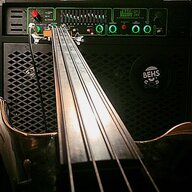
Second, if materials of construction 100% do not matter in an electric bass guitar, why does this instrument sound distinctly different from a similarly constructed wood version fretless bass?
IMHO, this is a silly discussion. Materials of construction do matter to the player. Audiences, however, can not and do not generally discriminate. Both can be true at the same time; which, I suppose, is why this topic remains a popular 7th grade level “argument.” Carry on.
So, the seventh grade isn't all that it's cracked up to be. That saves me some time. Thanks!
I wasn't at all impressed with the sound of that bass. I wasn't expecting Tony Franklin Signature-like tone but that was an excessively muddy sound even allowing for some people preferring a very warm tone. Temu pickup plus tone control rolled-off too much?
I don't have an opinion on tonewood other than the choice of pickup and pickup location IME has an effect on the sound that's orders of magnitude more significant than the wood.
I don't have an opinion on tonewood other than the choice of pickup and pickup location IME has an effect on the sound that's orders of magnitude more significant than the wood.

Pine is actually an excellent tone Wood ”Carolena" is light, resonant and nice to look at.Ironically, Leo Fender made his prototype Telecasters (or whatever he called them at the time) out of pine, a.k.a. pallet wood. He switched to ash and alder because pine dented too easily.
I had a Rockbass in pine, Wish I kept it.

I'm pretty sure @ThaCoast has built several basses out of common plywood, and just filled the voids, etc. Not sure about the weight!
Affirmative! Weight to be honest varies, but it's not the ply that's the big weight factor, that's more the neck, hardware, etc. & Just fill any gaps in the plywood before painting, i've done so on occasion, however not always.

I have two double basses, both are plywood. I’ve never owned a carved DB. Plenty of double bassists have had careers playing nothing but plywood or hybrids (carved top, plywood back and sides).
As far as bass guitars, how about Danelectro who used masonite for the bodies.
My only acoustic guitar is a Sigma D-18, made in Japan for Martin back in 1980. Spruce top, mahogany laminate for the back and sides. It doesn’t sound as good as a D-18 built in Nazareth, but it sounds good.
As far as bass guitars, how about Danelectro who used masonite for the bodies.
My only acoustic guitar is a Sigma D-18, made in Japan for Martin back in 1980. Spruce top, mahogany laminate for the back and sides. It doesn’t sound as good as a D-18 built in Nazareth, but it sounds good.
Let's not forget about Hagstrom, which used hard foam for the body, encased in fiberglass. There's a TBr who inherited a prime example from his father, had it cleaned up, says it sounds "wavy" and a bit surreal.I have two double basses, both are plywood. I’ve never owned a carved DB. Plenty of double bassists have had careers playing nothing but plywood or hybrids (carved top, plywood back and sides).
As far as bass guitars, how about Danelectro who used masonite for the bodies.
My only acoustic guitar is a Sigma D-18, made in Japan for Martin back in 1980. Spruce top, mahogany laminate for the back and sides. It doesn’t sound as good as a D-18 built in Nazareth, but it sounds good.
Basically, a surfboard, or a surf bass!
I'd love to play one some day.
How many cam-bolts for the neck/body joint?Lets see him build one with particleboard. Then I would be impressed.
Actually I am a huge fan of swamp ash grain, especially roasted swamp ash - but it just occurred to me yesterday that the piece I recently bought IS actually quite reminiscent of plywood...wood grain purdy, plywood ugly.

This tonewood debate will always be a thing. There’s nothing anyone can do about it no matter what evidence presents itself, pro or con.Hey Alex;
How about changing the title to: Another cool example of experiments with the wood structure of a bass body.
We Luthiers should not be fanning the flames of the Tonewood!!! arguments. Those folks are trying to convince each other that we Luthiers are idiots or frauds. Please don't help them.
That last sentence, I think, is the crux of the big disagreement. Wood is situational, and what matters greatly in one design may not matter in another, and that’s what escalates these debates. But you have to make them out of something.We should be trying to explain how the engineering and practice works; how the wood frame of a bass can change the tone, and how those changes are the sum of a whole list of factors. And why claiming that a particular wood causes a particular tone doesn't work consistently.
Oh gosh. I was hoping no one would veer off into this topic...but i have to disagree. I've owned two plywood basses (or, as they like to say, "laminate"), and one carved -- spruce top, maple back and sides. I sold both of the plywood basses. One was a p.o.s. so let's just talk about the better one. It was a decent workingman's bass and maybe easier to deal with on a loud stage. But in a small room, or unamplified, or professionally amplified, there is no comparison. The ply bass had a stiff, midrangey sound. The carved bass has a huge, full-range sound, and more dynamic. Way more enjoyable to play. On the other hand, with electric basses, I'm in the camp of "pickups and strings matter more."I have two double basses, both are plywood. I’ve never owned a carved DB. Plenty of double bassists have had careers playing nothing but plywood or hybrids (carved top, plywood back and sides).
As far as bass guitars, how about Danelectro who used masonite for the bodies.
My only acoustic guitar is a Sigma D-18, made in Japan for Martin back in 1980. Spruce top, mahogany laminate for the back and sides. It doesn’t sound as good as a D-18 built in Nazareth, but it sounds good.
Not sure why it matters, even if there's no difference in sound. Who's gonna build with a plywood body (or buy a new bass known to have one) just to save a few bucks?


