• TalkBass has been independent since 1998. Add your voice.
    Create a free account to reply to discussions, view embedded media, and browse with fewer display ads.
    Join freeLog in
    Want zero display ads or expanded classifieds tools? Compare plans.

Anthony Jacksons new Fodera bass

Love this thread and the pickup talk!

I had the pickup made for my 38" Carl Thompson just after Anthony Jackson got his silver wound pickup. I went with some similarities and many differences....

A fat (P style) coil and slim (J style) coil with a small amount of space between them. Some might consider a system like this just two pickups, but Kevin Beller really designed them to work well in series as a giant humbucker or parallel a la PJ sounds. Kevin was a huge help in this regard; his vast knowledge and customer service were amazing. My pickup is also silver wound with a single pole piece for the high C as many of the Seymour Duncan custom shop pickups are. Although this was not an AJ clone or 'tribute' in any way, I definitely took some influence from Anthony's design and built my own animal from it that suits exactly what I wanted- I'm still extremely happy with this very expensive pickup commitment. I have it wired for series/parallel with variable volume controls for each coil in both wirings, and this gives a great variety of flavours with the same basic idea present. I also opted for a tone control with capacitors I had made with a few different values- I typically play with my tone rolled off with a 0.009uf capacitor, so I can definitely understand the 'too bright' thing, Mitch.

Out of curiosity, what did Anthony prefer about the copper wound pickup, Jason? In really happy with my silver wound, but I'm interested in having something copper made for a different bass. Anything specific tone-wise you can recall that copper offers and silver doesn't?

I can't say enough good things about the Seymour Duncan custom shop, looking forward to working with them again.

Cheers!

We didn't get into a specific discussion about why he went back to copper. But I am fairly certain that we will continue to experiment. And yes, Kevin and his team at Seymour Duncan are really great folks and have always been willing to go the extra mile for us and allow us to tweak, experiment, etc.!
 
  • Like
Reactions: Zentner
Correct...that is the whole point. Tone is subjective. That said, please remember that although #9 is, in fact, a Presentation, it does sound fairly significantly different than #10 and #12 (at least to my ear). And, I have not had the benefit of hearing yours anywhere near as much as #10 and #12 so I cannot make valid tonal comparisons.

For sure. I would imagine at that level, with zero electronics going on, wood choices become incredibly important. Just the difference between a 5 piece and 3 piece neck, or a darker sounding fb would be enough to be an almost entirely different instrument. I'd love a chance to hang with AJ one day and hear the differences in person! I'm assuming his more recent basses sound a little warmer than mine just based on the Brazilian RW fb versus the pink ivory on #9.
 
Sorry for the late response, I've been travelling the past couple days.

I'm not really a fan of active electronics but i still wanted a little more control, so i've got a 0.047 cap to switch to and a vintage style .1 as well. I ran some programs on passive circuits and found that as you increase the capacitance, the circuit's midrange gets accentuated, however at 0.047, most of that midrange is also rolled off at the top of its adjustment. I'll be honest, I did all this math maybe 5 or 6 years ago, and I forget the reasoning for this- maybe how the capacitor reacts to having a 250k resistor attached to it? I found that values between 0.007 and 0.015 had the best result of increased midrange frequencies at the very top of their adjustment, but this would not work in the middle of a potentiometer's adjustment. The sonic difference in the midrange is subtle but very usable, and technique definitely helps this along too.

I'll PM you regarding the price of the pickup, as I'm not entirely comfortable discussing publicly. I find it has a clarity in the upper midrange and really wide bottom end that I was searching for for this instrument. Very uncompressed and open sounding while still retaining that fat quality that sits in the mix so nicely. The tonal goal for the front coil was huge bottom end and lots of clarity, while the bridge coil is wound to be more vintagey with more pronounced mids and less bass, less bright, more thump than the neck coil. All of this had to happen under one pickup cover, and I'm happy with the result (as I'm sure you've picked up on by this point :) )

Cheers!
 
  • Like
Reactions: Mitchthebassplayer
Saw him with Mike Stern in NY last month. It's very woody, and organic sounding, for lack of better words. It's hard to describe, but it seems to respond seamlessly. It was if the sound was coming out of Anthony, and not the vehicle of the instrument.

Agreed. When I saw him with Hirome early in the summer, it sounded... well, "Fuzzy" would be the word that comes to mind. Inarticulate is another. Sad, I've always wanted to hear him really play and all I heard out of the bass was a lot of woofing. Happily, the piano and drums were *killing* it at that show.
 
  • Like
Reactions: joe vegas
Sorry for the late response, I've been travelling the past couple days.

I'm not really a fan of active electronics but i still wanted a little more control, so i've got a 0.047 cap to switch to and a vintage style .1 as well. I ran some programs on passive circuits and found that as you increase the capacitance, the circuit's midrange gets accentuated, however at 0.047, most of that midrange is also rolled off at the top of its adjustment. I'll be honest, I did all this math maybe 5 or 6 years ago, and I forget the reasoning for this- maybe how the capacitor reacts to having a 250k resistor attached to it? I found that values between 0.007 and 0.015 had the best result of increased midrange frequencies at the very top of their adjustment, but this would not work in the middle of a potentiometer's adjustment. The sonic difference in the midrange is subtle but very usable, and technique definitely helps this along too.

I'll PM you regarding the price of the pickup, as I'm not entirely comfortable discussing publicly. I find it has a clarity in the upper midrange and really wide bottom end that I was searching for for this instrument. Very uncompressed and open sounding while still retaining that fat quality that sits in the mix so nicely. The tonal goal for the front coil was huge bottom end and lots of clarity, while the bridge coil is wound to be more vintagey with more pronounced mids and less bass, less bright, more thump than the neck coil. All of this had to happen under one pickup cover, and I'm happy with the result (as I'm sure you've picked up on by this point :) )

Cheers!


thanks for this interesting information.

do you know what kind of windings were being used in the front coil versus the rear? also do you have a picture of the pickup?

edit: i checked back to see that you went with p front, j rear. i've done something similar, tho copper. still would love to see a picture of you setup.
 
thanks for this interesting information.

do you know what kind of windings were being used in the front coil versus the rear? also do you have a picture of the pickup?

edit: i checked back to see that you went with p front, j rear. i've done something similar, tho copper. still would love to see a picture of you setup.

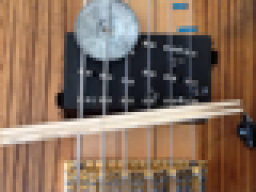
Yea totally. I don't know exact values for for winding, but I wasn't looking for an overly hot pickup. I know the bridge is overwound to have that fatness, but the neck is a bit of a mystery. The pictures show how the coils are height adjustable to balance volumes, copper shielded, and silver leads (of course). I originally wanted the coils right up next to each other, but with my tonal goals in mind, Kevin suggested some space in between. My biggest issue was keeping the aesthetics of a single pickup, and its just a but wider than a MM pickup. I think it suits it for a bass this big.

100_2999.jpg


100_2997.jpg


100_3004.jpg


IMG_3518.jpg
 
Yea totally. I don't know exact values for for winding, but I wasn't looking for an overly hot pickup. I know the bridge is overwound to have that fatness, but the neck is a bit of a mystery. The pictures show how the coils are height adjustable to balance volumes, copper shielded, and silver leads (of course). I originally wanted the coils right up next to each other, but with my tonal goals in mind, Kevin suggested some space in between. My biggest issue was keeping the aesthetics of a single pickup, and its just a but wider than a MM pickup. I think it suits it for a bass this big.

thanks. makes complete sense to me

ImageUploadedByTalkBass1413137332.240843.jpg


ImageUploadedByTalkBass1413137345.907289.jpg
 
  • Like
Reactions: Mitchthebassplayer
just a little follow up: I've been talking with Carey Nordstrand about trying a different pickup in #9, but unfortunately I can't do anything badass like these beastly pickups above cause I don't want to have to route my bass. Just for the hell of it, I decided to change the Duncan DC back to series and changed out the 250k pot to a 500k. WOW. It's almost perfect. SO much thicker and warmer, but that high end still beautifully cuts through. What's cool is that there's def a sweet spot on the tone knob, as too open and it gets clanky again, and too rolled off just causes the mids and highs to disappear from the mix. So I'm leaving it there, closing up the control cavity and that's it. Looking forward to taking it on a gig soon to test it out but I think this could be it!!
 
there's def a sweet spot on the tone knob, as too open and it gets clanky again, and too rolled off just causes the mids and highs to disappear from the mix. So I'm leaving it there, closing up the control cavity and that's it.

So you have a potentiometer just floating around inside the control cavity, not actually accessible from the front or back? Maybe squirt some Loctite around the shaft to make sure it doesn't slip from that sweet spot.
 
So you have a potentiometer just floating around inside the control cavity, not actually accessible from the front or back? Maybe squirt some Loctite around the shaft to make sure it doesn't slip from that sweet spot.

with the cover on, that pot is really held in place, as the cavity is quite small. It's a big pot too, and the solid shaft makes it really difficult to move, even when you're trying to turn it! But yeah, good idea if it does for some reason slip around....
 
  • Like
Reactions: Bob_Ross
is it me or does that bass look huge?

It is huge. 36" scale, with a large hollowed-out body. Although I've never met him from seeing him in pictures I don't believe AJ is a very tall guy to begin with compared to his peers like Jaco Pastorius, Will Lee, Stanley Clarke, or Chuck Rainey; all those guys are over 6 feet tall.
 
Agreed. When I saw him with Hirome early in the summer, it sounded... well, "Fuzzy" would be the word that comes to mind. Inarticulate is another. Sad, I've always wanted to hear him really play and all I heard out of the bass was a lot of woofing. Happily, the piano and drums were *killing* it at that show.

Sadly this was my fear and my experience of that hollowbody Contrabass. I've heard it said that Anthony had been darkening his tone for years and yeah, with passive bass and a pickup nearer to the neck than the bridge that was probably correct. I thought the hollowbody might have been a step too far in terms of losing that definition of tone.

This bass sounded a lot better to my ears:
 
  • Like
Reactions: mark beem