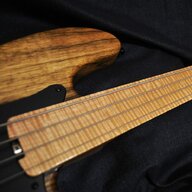
Looks like a good start Jeff. Odd how it seems to Z dive a bit at a regular spacing in some of the pics.
Do you mean the low spots at the ends of the cuts? If so that is CAM related, not CNC. Here is a pic after the rough passes:
You might guess those ends are because of some problem with the machine but they were definitely not. You can see the effect of chatter in some of the edges that are a bit wavy where they should be sharp. I am hoping the new parts will increase the rigidity enough to get rid of that entirely.
To get a small sample of the neck in CAD I just sliced off the rest of the neck with a cut so there is no change in "Z" around the ends, but it still seems like PyCAM is deciding to "rounding off" the edges. I have no idea why, but if I contour the ends I am pretty sure I could get rid of that. I actually did that on another test with a contour around the heel and it sorta worked, although the loft caused some other strangeness in the way PyCAM rendered the toolpath. Anyway, not a showstopper.
One possible improvement to the results would be to run a few finishing passes with the stepover reduced to half on the last pass.
The slop in the rails will be most prominent in the roughing passes and the finishing passes won't be pushing back so hard and allow you to get a bit tighter tolerances.
Yes, that would probably work but again, with increased spindle rigidity, I can hopefully do it in one pass.
Are you using a 1/4" ballend? A 1/2" will smooth out those cusps a lot especially if you use the same feed rate you do for a 1/4".
Yes, technically a 13/64" (5.1587 mm) actually, since those happened to be on sale. My collet is an ER11 and those only go up to 5/32 so no go on the 1/2". Still, at 80% overlap those grooves are only about 0.2 mm (0.008") deep so not much sanding there!
And yet another point, if your machine has that much slop make sure your fret slotting passes all run the same direction to try and keep the errors all pointing in the same direction and not compounding each other.
Since my frets on this one are going to be fanned that won't really be possible. Still, I don't think that will matter. At 0.6 mm (0.023") that bit will be going seriously slow -- somewhere around 40 MMPM (1.7 IPM). Again, rigidity should solve that.
It isn't obvious from most of my pics but when the bit is cutting smoothly that thing is actually surprisingly precise. Have a look at some of the surfacing experiments I ran in the bottom right corner of the block above. In areas where there was no chatter it is really tough to even detect the tool path.
These days I'm trying to get closer to finished on my projects. I've started by leaving a good deal of hand work at the end to make sure I don't go too far on the CNC but now I'd rather spend 20 more minutes on the CNC to save 1/2 an hour of sanding.
Yeah, I can always make the finishing passes even narrower (0.5 mm) and try to find a 5/32 ball end if I wanted to save even more sanding. Those changes could get the grooves down to a couple of thousandths.
Last edited: