• TalkBass has been independent since 1998. Add your voice.
    Create a free account to reply to discussions, view embedded media, and browse with fewer display ads.
    Join freeLog in
    Want zero display ads or expanded classifieds tools? Compare plans.

Any Fender Japan JV experts?

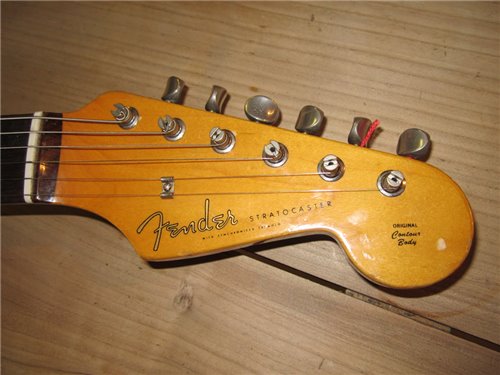
Disagree, if(!) you imply that after the JV period from 1982-1984 there were Fender Japan instruments with JV serial numbers. During the first years of production there were only JV instruments, after about two years there were no more JV instruments, only SQ instruments with SQ serial numbers. Some few instruments during the first years that were domestic only had a Fender logo (I've shown a picture of own above). Since about 1985 it gets more diversified, but no instrument to my best knowledge had a JV serial number.

This is from of the best articles on the net about the JV instruments and their history. It kind of shows that not all of these instruments had the same quality ingredients.

The Truth About... 1980s Squier Strats | Planet Botch
I said in early 80s.
 
The first Fender Japan vintage reissues had Made In Japan written in small letters on the headstock, and they had JV serial numbers on neckplates, or in the case of the OPB-54 basses, on the bridge plate. However, this changed after a few years, and some Fender Japan vintage reissues did have JV serial numbers and MADE IN JAPAN on the back of the neck near the 4 bolt plate. I have owned several, seen many more, have the old catalogs, and worked at the largest Fender dealer in this state(Utah) in the early '80's. We tried to get these guitars in our store, but the Fender reps stood firm on the policy that the JV instruments were non-export to the USA. I think the black P-Bass in this thread is a legitimate Fender Japan '62 reissue P-Bass. Of course, it's always possible someone mixed parts. Good discussion, by the way.

Some solid info - thanks!
The bass in question has a serial dating to 83, and still has the Fender logo on the neck.
To my (limited) knowledge, I thought that only early (i.e. 82) JVs had the Fender logo, and 83 and 84 had the Squier logo.
Is this incorrect?
 
Really not an expert either, but happen to be in Japan and am following the JV action on Yahoo Auction for the last few months. I am considering a bid on this one, but according to what has been said on this thread, this may also not be a true JV due to the headstock being Fender Logo, without Made in Japan written behind it, presumably that being at the back of the neck (no photo available unfortunately).

Invalid Link Removed

Now I had read somewhere that Fender JVs were for the Japanese market and I can confirm that a fair few have been sold on Yahoo Auctions for fairly high prices recently. I have hardly seen any Squier JVs, which also seems to confirm what I heard that those were mostly exported..

Here is another, Fender JV being really more common on Yahoo Auction than Squier JVs.

Invalid Link Removed
 
The first Fender Japan vintage reissues had Made In Japan written in small letters on the headstock, and they had JV serial numbers on neckplates, or in the case of the OPB-54 basses, on the bridge plate. However, this changed after a few years, and some Fender Japan vintage reissues did have JV serial numbers and MADE IN JAPAN on the back of the neck near the 4 bolt plate. I have owned several, seen many more, have the old catalogs, and worked at the largest Fender dealer in this state(Utah) in the early '80's. We tried to get these guitars in our store, but the Fender reps stood firm on the policy that the JV instruments were non-export to the USA. I think the black P-Bass in this thread is a legitimate Fender Japan '62 reissue P-Bass. Of course, it's always possible someone mixed parts. Good discussion, by the way.

Wow, superb info, thks. So does that mean that the black P is correct and genuine then...seems like it might be, anything else I need to look at.
 
The bridge saddles, tuners, and logo are correct on your P-Bass, consistent with the Fender Japan PB62-xx model, where the x was the amount of yen the instrument cost. The higher end models had cloth lead wire on the pickups(often Fender USA vintage reissue pickups) and some of the more expensive high end models had nitro cellulose lacquer finishes.
 
Would love to see some pics of heel and headstock...feel like Im getting closer to the truth with every post. Thks all.

Here are the pictures, sorry phone camera...

IMG_5164.jpg IMG_5165.jpg
 

Attachments

  • IMG_5168.jpg
    IMG_5168.jpg
    561.4 KB · Views: 356
  • IMG_2991.jpg
    IMG_2991.jpg
    1 MB · Views: 339
  • IMG_2990.jpg
    IMG_2990.jpg
    756.5 KB · Views: 357
  • IMG_2989.jpg
    IMG_2989.jpg
    783.8 KB · Views: 388
  • IMG_5167.jpg
    IMG_5167.jpg
    486.5 KB · Views: 344
  • IMG_2951.jpg
    IMG_2951.jpg
    1.1 MB · Views: 361
Here are the pictures, sorry phone camera...

View attachment 963861 View attachment 963862
This is a bit of guessing, but in a way I think this has a JV neckplate and it might have had one from the start, but at 1984 there were no more JVs, but something was going on with Fender in general:

"Fender: For Sale
Fender faced yet another crisis in 1984; CBS put Fender up for sale. Fender President William Schultz led a consortium to buy the company, but unfortunately the sale did not include the recently upgraded Fullerton plant, any of the guitar making machinery, or any of the then-current patents. This left the Fender company with no manufacturing capability in the United States. The solution was to turn to Fender Japan to build all of the company’s guitars, which would be the case for a period of some months. Fender was able start a new factory in Corona, California, about 20 miles away from Fullerton, by the end of 1985, but the vast majority of Fender guitars sold in 1985 were made in Japan."

A Brief History of Squier and the Origins of Fender MIJ

So in a way this might be not one of the domestic early JVs with a Fender decal but one of the first Made In Japan Fenders as they were massproduced since about the mid 80s. There was no US production at all, so no need to call the MIJ instruments Squier to seperate them from US production.

I like this quote:

Consequently, there were doubts back in Fullerton about the quality of the new Japanese Fenders, but those doubts were soon dispelled when the Japanese instruments arrived in California. Marketing executive Dan Smith, quoted in “The Fender Book” recalled:

“Everybody came up to inspect them and the guys almost cried, because the Japanese product was so good — it was what we had been having a hell of a time trying to do.”
 
  • Like
Reactions: xroads
Hi Dluxe,
I have a JV Jazz bass and I need to find out what make the strings are with the red cotton ends.
I love this bass and once lent it to a mate who said he did not like the strings (with the red ends) and he stuck a new set on, and now I have it back, I hate the strings !!
I am pretty sure that the res taped ends were original equipment on these basses.
My JV has the Squire name on headstock with "made in Japan" in small letters and serial no. is JV 804** on neck plate.
No other lettering on the guitar visible.
Mike.
 
Guys, hoping for some incite from those who know etc.

I've attached pics of a 1983 JV P bass. Does anyone know if this model is a Squire or is it a genuine Fender Japan model ie 'Made in Japan'. Guess my concern is the headstock decal..looks like a new one etc.

Thanks
View attachment 962580 View attachment 962581 View attachment 962582

Genuine Fender '82 JV Bass from Fujigen Factory made with all American parts and lacquered finish!
just did a gig with 1982 JV series '62 Jazz Bass Reissue and it feels and sounds as close as the real '62 vintage JB and far superior bass then American Vintage Series (which I own).
 
Great information.
I just got this bass in Japan. It has a JV Serial number, but no made in Japan anywhere. Any clues? Year? Model? The serial number indicates 1982-84.

Thanks you all.
View attachment 3121777
View attachment 3121145
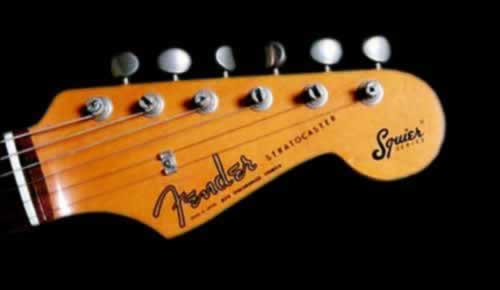
Read this entire thread. It is most likely one of the very early domestic (not for export) high quality JVs from Squier. IIRC in the neck pocket is a product number. These letters and numbers have the recommeded retail prices after the model. For example a PB57-70 means a 57 Precision copy with a recommended retail price of 70.000 Yen. The higher quality ones have retail prices and numbers like 95 oder 115. The best equiped strat for the domenstic market with a nitro finish, CTS potis and US pick-ups had the model number ST62-115. An example for a Telecaster model is TL52-95.
 
This is the cream of the crop Japanese Fender!
All the parts were sent from USA and
Built in Fujigen Plant,& It’s as good or even better than American Vintage RI!!
I played some JV series and it’s definitely better than Squire.
 
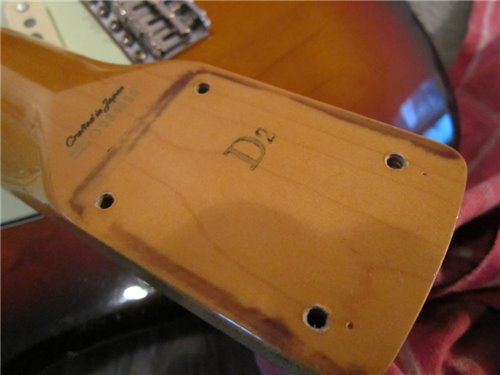
AFAIK the purely domestic ones didn't have a Squier Series stemp on the headstock. The ones with a Fender logo can be distinguished: the ones purely for the domestic market had a "d" stemp on the body underneath the neck, the ones for export had a c stemped within the neck pocket.
kopfplatte_jv_squierlogo_klein.jpg


085gitcij14.jpg


085gitcij19.jpg


Nonetheless you have one of the rare and high end ones.
 
Thanks to Jinobass1 and DirkP for your comments...
I can only say that it's light as a feather. The sound is powerful, clear, and round,
with the typical punch of the vintage US Fender basses.
Is it true that my bass is a copy of the 1962 Fender Precision Bass ?
There is no Stamp in the pocket but heel of the neck shows an engraved "E" on the flat part
that presses against the body, but I forgot to take a picture of it. Now that she’s all up I don’t
really want to undo her again... What does that "E" mean ?