
Enjoy the benefits of a premium membership!
Upgrade Account
-
TalkBass has been independent since 1998. Add your voice.
Create a free account to reply to discussions, view embedded media, and browse with fewer display ads.
Join free Log in
Want zero display ads or expanded classifieds tools? Compare plans.
You are using an out of date browser. It may not display this or other websites correctly.
You should upgrade or use an alternative browser.
You should upgrade or use an alternative browser.
Any recommendations on how to mute the b string in a 5 string bass?
- Thread starter Daniel Panus
- Start date
More options
Who Replied?

This. The only reason I would even consider going from 4 strings to 5 would be to play up higher on the neck for low notes, and the 4th fret E flat. But the tradeoffs arent worth it for me.[/QUOTE]How does that work when you are slapping the E string with your thumb? (Like 99% of funk songs rewu
Bass Wisdom.
In slap mode, I do most of my muting with the left hand. When hitting the low E (open) I'll mute the B with my left thumb hanging over top. If I'm fretting notes on the E string, then I'll fret the note usually with my index finger but extend the finger slightly to both fret on the E string and mute the B string.

note this right hand technique. called a floating thumb, 100% effective. at the time I learned this I was very depended on resting my thumb on top of the pick up, and it definitely was an annoying transition, but it also made it possible to play six string bases and never have a problem with excess string noise.

I use a thumb rest, my 4th string will resonate a little. I use a small piece of hard foam under the string at the bridge. The string has a very slight difference of sound, but almost unnoticeable.


This video was the most helpful for me when I was moving from 4 to 5 strings. It took me about a month of practice to adapt my technique as I use to rest my forearm on the bass. Not anymore.
Good Luck!
Came here to say this. You can get this technique together relatively quickly (1-2 months of consistent effort maybe?). If you want to get serious with it, Todd does Zoom lessons. He'll see you right.

As rude teen gamers like to say, "git gud." Seriously. I struggle with this too and it's just something where your technique has to get better and your playing has to be tighter.
This video was the most helpful for me when I was moving from 4 to 5 strings. It took me about a month of practice to adapt my technique as I use to rest my forearm on the bass. Not anymore.
Good Luck!
My thumb gets caught when moving between strings when using this technique, though perhaps I need to just try harder.
Floating thumb works the best for fingerstyle, but you really have to learn multiple muting techniques with both hands to still effectively mute while picking, playing octaves, slaps and pops, etc... There isn't just one muting technique that will work for everything, but floating thumb comes the closest. It takes some practice, but if you ever want to try playing a 6 string, then there's nothing new to learn.
Yeah, fret wraps and foam under the bridge work, too, but only if you want that dead string sound all the time. Fret wraps are excellent for two hand tapping and things like that, but for regular playing it's nice to have the open strings to have some sustain when you want them to.
Yeah, fret wraps and foam under the bridge work, too, but only if you want that dead string sound all the time. Fret wraps are excellent for two hand tapping and things like that, but for regular playing it's nice to have the open strings to have some sustain when you want them to.


Mine did at first as well but I was able to correct it. Keep at it and you will too.My thumb gets caught when moving between strings when using this technique, though perhaps I need to just try harder.
Good luck!
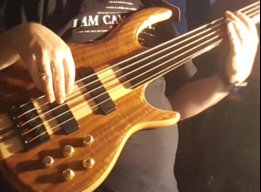
just learn to keep yoru thumb on the B string, and when you want E muted, put thumb against both B and E.
After a week or two of religious practicing slowly and doing it right, it starts to become easier. After a little longer and you don't really think about it much any more.
After a few months you'll feel as comfortable as you did on 4.
Muting only one string is the same as owning a bass with one fewer strings on it.
After a week or two of religious practicing slowly and doing it right, it starts to become easier. After a little longer and you don't really think about it much any more.
After a few months you'll feel as comfortable as you did on 4.
Muting only one string is the same as owning a bass with one fewer strings on it.
That's because you're not practicing properly. Do it slowly, correctly, over and over again. It's not always easy learning something new, but it's REALLY hard if you don't practice slowly, and do it correctly over and over. Otherwise you will never get better at it if you try it fast and make mistakes all the time, because you're just reinforcing the mistakes.My thumb gets caught when moving between strings when using this technique, though perhaps I need to just try harder.

Rest the thumb of your plucking hand on the B string. Really though, learn the floating thumb technique and you'll have a cleaner sound all the way around. As you can see, on my SR5 I had a custom thumb anchor added but I never use it now because with floating thumb it isn't needed.



Ric5
Inactive
- Jan 29, 2008
- 29,772
- 30,452
- Disclosures
- I like 5, 8, 10, and 12 string basses
I, like many bass players primarily play 5 string basses and enjoy the added range it gives. But there are times in which the added b string is not necessary and just gets in the way, having to mute it and all.
I've been trying to find ways to have the b string muted so that I don't have manually mute it when I'm only playing the top 4 strings. Here are the things I've tried so far: Simply de-tuning the b string doesn't work because it messes up the tension of the neck and creates fret buzz. I've tried using a capo to dampen the b string but it just doesn't get in the right position to do that. Of course I can just bring a second bass to gigs, but it would be much easier if I only had to bring the one.
Any Thoughts?
Thanks, Dan
I have developed a technique where my picking / plucking hand is back by the bridge a lot, and I do a lot of palm muting.

Floating thumb isn't difficult, you just have to focus on keeping your plucking hand in the position and not slip back into your muscle memory
For me it's been mental more than physical effort
sometimes I mute the B with my ring finger and pivot my wrist,but that's not optimal. Floating thumb is better
For me it's been mental more than physical effort
sometimes I mute the B with my ring finger and pivot my wrist,but that's not optimal. Floating thumb is better


I use this technique where I rest either my thumb from my plucking hand or the other finger(s) from my plucking hand on the strings.
I picked it up back in the early 00s, when I was playing a 4 string fender and would occasionally play notes on the A, D, and G strings.
About a decade later I bought a 5 string, and the technique was instantly transferable.
If you really want an upgrade to fix this issue, upgrade the stuff between the bass and the strap. It makes a bigger difference than you thinl.
I picked it up back in the early 00s, when I was playing a 4 string fender and would occasionally play notes on the A, D, and G strings.
About a decade later I bought a 5 string, and the technique was instantly transferable.
If you really want an upgrade to fix this issue, upgrade the stuff between the bass and the strap. It makes a bigger difference than you thinl.


