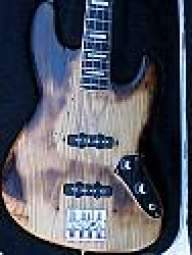
I think that what the OP wants us to find for him is a pair of standard J-Bass sized pickups with two coils placed side-by-side and not end-to-end or one atop the other that sound like big and wide MM-style humbuckers with an extended top end and none of the muddiness inherent to most side-by-side coil (PAF-like) pickup designs.
I have not seen or heard of such a pickup, and the reason might be that such a beast is either physically or electrically not feasible. Or it could be that there is no market for such a thing.
I think it is possible that OP is attempting to turn his Jazz bass into something that sounds like an Entwistle Buzzard, but without making any routing mods.
Seriously, nobody here is attacking you. We want to be friends. We want to help. It looks to me as if we either don't have an answer that meets your satisfaction, the device which you seek does not exist, or possibly both.
You got it.
I don't buy your claim that everyone here wants to be my friend though, it would be counter intuitive to my general experience with people, especially based on how they react on the internet, and it would be counter logical too based on some of the responses I got on this very thread.
Thanks for doing an attempt to make me feel welcome though

I have read the entire thread. I don't consider the Barts typical humbuckers. Rather they are an extreme example of the characteristics that humbuckers exhibit. They meet your requirement for rich and full, but in doing so have limited high frequency output.
If single coil and humbuckers exist at opposite ends of a tonal spectrum. Thick and full would be at one end of the spectrum with humbackers. Thin and bright would be at the opposite in of the spectrum with single coils. There are many possibilities between the extremes with more balanced frequency response. In the middle you might have a single coil and humbucker that sound almost exactly the same. One would be noiseless and the other would pick up hum from electromagnet emanations.
Perhaps, understanding of some electronics/physics can help you understand.
Basically as you add windings to a coil it becomes more inductive. The increased inductance emphasizes low frequency response and limits high frequency response. Inductors in series add (L1 + L2 = L total). So putting two pickup windings in series will increase their voltage output, increase lows, and limit highs. Equal inductors in parallel result in half the inductance value (L/2). When parallel inductors have disimilar values use the following formula.
View attachment 2937306
Connecting two pickup coils in parallel will reduce lows, extend highs, and reduce voltage output in comparison to the series arrangement.
There are other design factors that influence the frequency response as well.
Hope this helps.
Thanks.
I actually already knew how number of coil wraps and serial/parallel connections generally influence the tone and output of pickups.
Still appreciate you took time to explain it in details.
The Seymour Duncan Rickenbacker neck pickup seems to be strange that way though.
Even if the tone chart on the Saymour Duncan homepage for the pickup shows a pretty moderate output, it's tonal profile still seems odd, knowing that it is actually a humbucker, as it has a relatively high treble response but a fairly low response on the mids and lows:
Rickenbacker Humbucker
As I said my own experience using it as neck pickup, though not in a Rickenbacker, is that it had a very articulate and clear, yet somewhat crisp, piano like tone, even with a faint bell like character to it, if that makes sense.
But despite the tone chart displays fairly low bass and mid response I personally found that it was not exactly lacking bass, neither did it seem shrilling from a lot of high frequency content, and actually I would describe it as producing a quite balanced tone.
Well, as you can see I really loved the sound that pickup gave me, unfortunately I was stupid enough to sell the bass.
So I guess I would be going for something with approximately the same character, judging soly from the tone charts on the Seymour Duncan homepage though no P or J pickup seems to get even close, and the only pickup I found that seems to come close is a single coil P pickup, the SCPB-2:
Hot Single Coil P-Bass
But I guess that even if it does match pretty closely, there is no guarantee as a 3 band graphical representation of a tone chart kind of leaves a lot to wish for in terms of representing actual sound.
At least if I would be able to achieve what I want with the SCPB-2 it would be less of a drastic surgery installing than a lot of the other non J or P pickup options.
Edit!: Took a closer look and actually, although not exactly as close as the SCPB-2, some of the active P and J pickups come close, as well as the ANTIQUITY II P pickup:
Antiquity II P-Bass,
which is a passive pickup.
Again still hard to judge soly from the tone chart, but i guess it would be worth a shot.