Enjoy the benefits of a premium membership!
Upgrade Account
-
TalkBass has been independent since 1998. Add your voice.
Create a free account to reply to discussions, view embedded media, and browse with fewer display ads.
Join free Log in
Want zero display ads or expanded classifieds tools? Compare plans.
You are using an out of date browser. It may not display this or other websites correctly.
You should upgrade or use an alternative browser.
You should upgrade or use an alternative browser.
Anybody ever do this and if not, why not?
- Thread starter Joe Nerve
- Start date
More options
Who Replied?
Would having the MXR phase 90 on one channel throwing one speaker in and out of phase helped or hurt or ? P.S. Thanks billfitzmaurice, rpsands and, all the rest! I LOVE TALKBASS!!!Not possible.
This applet shows what happens when you have two sources, with every possible combination of distance, frequency etc.
http://www.falstad.com/wavebox/
The best result is seen when you click the 'setup' to single sources, be it point, pinhole, line or slit. You see the resulting red and green representations of the wave's positive/negative phase as uniform in the listening area. With any of the multiple source options things get all muddled up. Moving the frequency slider to the left, for lower, shows what happens to the lows when you have cabs separated. Moving it to the right, for higher frequencies, shows what happens to the mids and highs when drivers are mounted side by side in the same cab.


I would just make the comb filtering dance around instead of a stable predictable pattern like in the displays.Would having the MXR phase 90 on one channel throwing one speaker in and out of phase helped or hurt or ? P.S. Thanks billfitzmaurice, rpsands and, all the rest! I LOVE TALKBASS!!!
Randy

Why don't people do this at smaller bar gigs where they're not going through the PA?
At one time I did run this way. I was in a blues trio and the guitar player complained that he couldn't hear me. I was using a pair of my Acme B2s stacked horizontally at the time so I put one on each side of the drums. The guitar player also used two identical cabinets so we put one of his on top of each of mine. This set up sounded huge in most places we played, but not so good in a few. Eventually I tried the skinny stack of one on top of the other vertically aligned. I've never gone back to my old way and my sound is much fuller.
I say try it and see if you like the result. If you don't then go back
Paul
billfitzmaurice
Commercial User
- Sep 15, 2004
- 16,860
- 278
- 76
- Disclosures
- Owner, Bill Fitzmaurice Loudspeaker Design
No, as when doing so with horns you're extending the effective length and mouth area of the horns. There's nothing to extend with direct radiators.A question for Bill F.: If you center two direct-radiating subs (in this case, JBL PRX518S) is it beneficial to arrange them facing in toward each other, similar to the way you recommend doing it with horn-loaded subs?
Bass radiation is omni-directional, so he needs no cab near him for that. What he can't hear is your directional mids. Aim your lower cab towards him to address that issue.I've done this, but in the opposite circumstance; where bass volume on stage was so low, and the stage so wide, that the guitarist couldn't hear the bass well enough. So the loudest cab was behind me; the other cab was behind the guitarist.
Best results clustered facing a wall from about a foot away. Rules of sub placement are here, optimized for horns but sound waves function the same no matter the source.+1 I'll have to try this at our next house concert, party. We were having trouble with subs. So center or one side, yes?
http://billfitzmaurice.info/forum/viewtopic.php?f=1&t=398


I've done this, but in the opposite circumstance; where bass volume on stage was so low, and the stage so wide, that the guitarist couldn't hear the bass well enough. So the loudest cab was behind me; the other cab was behind the guitarist.
I've run a satellite bass cab in these same circumstances (wanted to keep stage volume low, and cranking my stage amp loud enough to be heard across stage by guitarist and keys was creating problems). Using a stereo power amp in this application was very useful, as it allowed for independent volumes.
Like sugar plums in our headsI would just make the comb filtering dance around instead of a stable predictable pattern like in the displays.
Randy

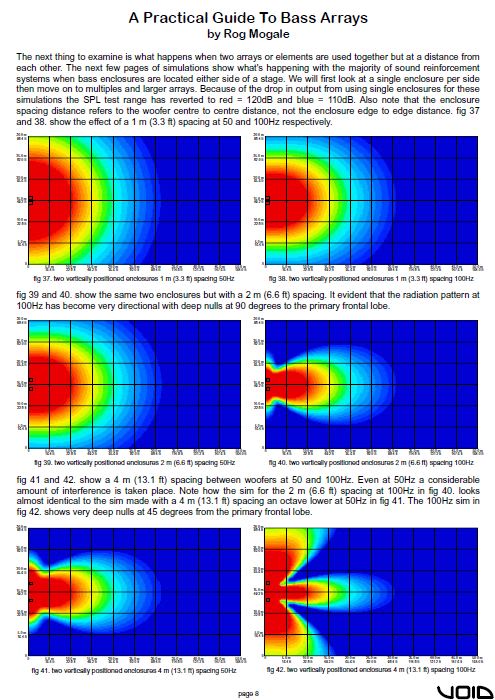
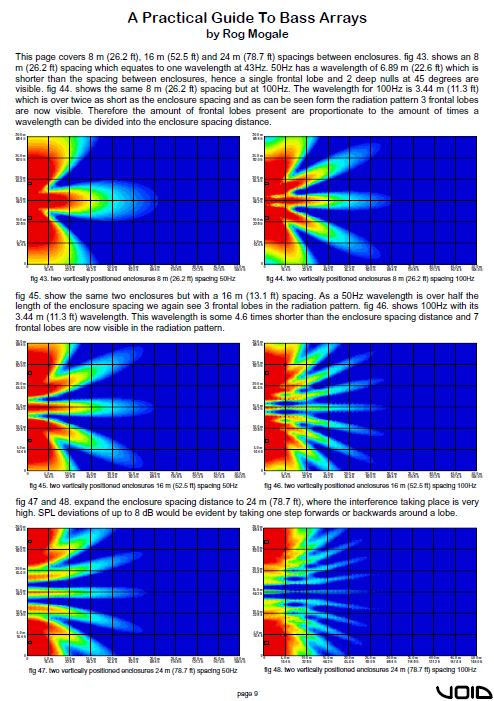
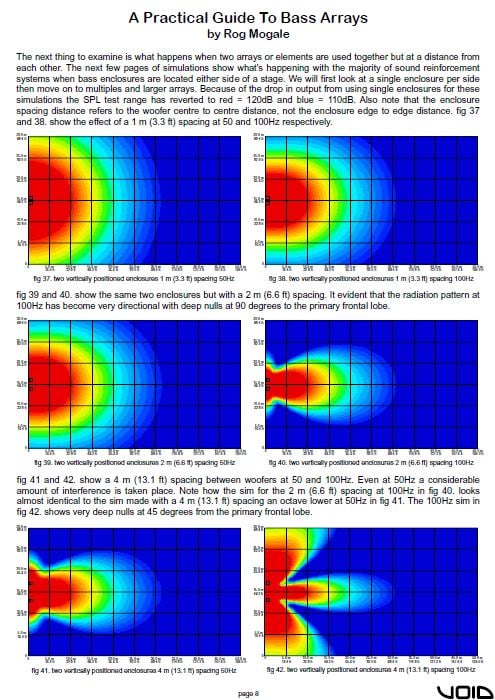
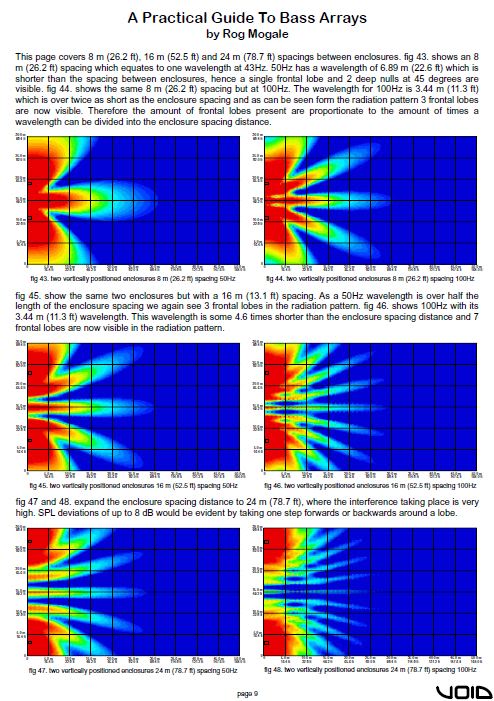
Bomb has a point. If you separate bass speakers more than a quarter wavelength (two feet or so), their sound waves interfere with each other and cause nodes of higher and lower SPL. It looks kinda like this. Note the positions of the speakers together (Fig. 38) and then, say, 26 feet apart (Fig. 44). The diagrams are for 50 hz and 100 hz.
thats pretty

listen, if they're smart, they either use only one sub, cluster the subs in one spot, or they separate them out far enough where their lowest wavelengths won't cause comb filtering. and if they're smart, they'll roll the lowest freqs off the bass in the monitors.
DING!! DING!! DING!!
We have a winner and a big +1 !!!!!

So this Link Removed is a no no?DING!! DING!! DING!!
We have a winner and a big +1 !!!!!
I've run a satellite bass cab in these same circumstances (wanted to keep stage volume low, and cranking my stage amp loud enough to be heard across stage by guitarist and keys was creating problems). Using a stereo power amp in this application was very useful, as it allowed for independent volumes.
I've spread 'em out like this too without any harmful affects but only on a big outdoor stage where I couldn't compete with the house PA if I wanted to. They were really just stage monitors. One for me and the drummer, the other for guitarist/keys. I wouldn't recommend it for anything other than that because of everything already mentioned here.

If your bandmates are standing close to your cab, they'll hear the sound of that cab, whether there is technically any cancelling going on or not. I've done it. It works great to improve small stage sound for the band on a budget.
Vertical array is well loved here on TB and for good reason, so if you have the choice I'd say try out the vertical array first, and if your bandmates can hear you, then never try splitting your cabs.
Because if you first try putting your cab on their side, they WILL hear you, and as far as some guitarists care about your sound out front: that'll do, carry on.
Vertical array is well loved here on TB and for good reason, so if you have the choice I'd say try out the vertical array first, and if your bandmates can hear you, then never try splitting your cabs.
Because if you first try putting your cab on their side, they WILL hear you, and as far as some guitarists care about your sound out front: that'll do, carry on.

- Oct 7, 2000
- 18,619
- 38,939
- Disclosures
- Endorsing artist: Musicman basses

billfitzmaurice
Commercial User
- Sep 15, 2004
- 16,860
- 278
- 76
- Disclosures
- Owner, Bill Fitzmaurice Loudspeaker Design
You may never have had any problems, but for the audience it's a different story. Arguing with physics is a losing cause, especially if one has no idea what it is that they're arguing about.I run a head and a box either side of the kit and have never had any problems.

Is it a problem to aim the upper cab this way? In some concerts where the PA is carrying only the vocals and there is a wide stage, I've aimed my bottom cab (which is a 2x12 immediately beside me on my left) toward the audience and my top cab (a 1x12) 90 degrees to the right (directly into my ears and the drummer's ears since he's on my right). We're both along the back wall of the venue. Is this OK or is it a disaster out in the audience?...Bass radiation is omni-directional, so he needs no cab near him for that. What he can't hear is your directional mids. Aim your lower cab towards him to address that issue....

yes, that is, indeed, a no no. couldn't tell who it is, but musicians are the worst for knowing audio physics.So this Link Removed is a no no?

Apart from the acoustics concerned, there's something else - i remember seeing a guitarist who already plays pretty loud walking towards my side of the stage with a second cab and he clearly intended to put it next to my rig. It infuriated me because it meant I was going to bet completely blown away with SPL and we're already playing on the loud side. I told him in no uncertain terms that if that cab came any closer to my side of the stage I'd kick the (F-bomb) thing into the crowd and encourage them to trample the (F-bomb) out of it.
Imagine your band mates would react similarly to having a bass cab over on their side of the stage.
Imagine your band mates would react similarly to having a bass cab over on their side of the stage.
Bomb has a point. If you separate bass speakers more than a quarter wavelength (two feet or so), their sound waves interfere with each other and cause nodes of higher and lower SPL. It looks kinda like this. Note the positions of the speakers together (Fig. 38) and then, say, 26 feet apart (Fig. 44). The diagrams are for 50 hz and 100 hz.
Here is the pdf link to this report.
a practical guide to bass arrays - Google Search