• TalkBass has been independent since 1998. Add your voice.
    Create a free account to reply to discussions, view embedded media, and browse with fewer display ads.
    Join freeLog in
    Want zero display ads or expanded classifieds tools? Compare plans.

Anyone have experience with Moses necks?

RyanKW

Guest
Jul 1, 2015
1,002
1,162
45
I posted a couple months ago that I'd gotten my hands, for almost nothing, on a 1984 MIJ Fender PJ. Turns out that the truss rod is locked and, even though my guy set it up well enough to make it payable, it's not ideal.

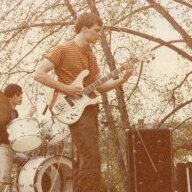
But, the sound of the thing is really good, and I want to play out with this mojo machine. I want to replace the neck. One thing I really like about it is the black headstock and dark fretboard on the legit reliced and nicotine stained white body. I'm thinking I may go even blacker, and graphite-ier. Does anyone have experience with these? Thoughts? (Bass is pictured)

Invalid Link Removed
 

Attachments

  • 20160925_094924.jpg
    20160925_094924.jpg
    1 MB · Views: 248
I think @slobake is old enough that he rubbed Moses's neck. Maybe he can help.

Just kidding. There have been quite a few basses posted with their necks around here. Someone who isn't a goofball like me will chime in shortly with help.
 
I don't have one like you linked to, but I have an early Peavey GBass that has a Moses neck. It's 1.5" at the nut and has fret spacing for a 35" scale.

It's a slim, good playing neck. It's not as immune to temperature and humidity changes as I thought it would be, but the truss rod adjusts easily and the neck responds to the adjustments well. The response to truss rod adjustment is slow, so an adjustment today that seems about right, will sometimes be too much the following day. It took me a while to figure that out so now I keep the adjustments very small and check it the next day.

One thing that is great; no dead spots. I have the curse of noticing the dead spot on every stringed instrument I play. Anything wood I've ever touched has a dead spot or two of some degree. The GBass is dead-spot free and I'm sure that's due to the graphite neck. I've read that a graphite neck will always have a resonant frequency higher than the range of a standard tuned bass, so with no neck vibrations, nothing is soaking up string vibrations.
 
  • Like
Reactions: RyanKW
I had a brief foray with a 99 American Jazz Deluxe V with a Moses neck in a store I worked at. Compared it directly to my stock 98 with the original wood neck. I really liked the Moses, it did sound a little more zippy, no dead spots and the intonation seemed more accurate. I have always kept an ear to the ground looking for a smoking deal on a Moses for my Jazz V since then.
 
I had a brief foray with a 99 American Jazz Deluxe V with a Moses neck in a store I worked at. Compared it directly to my stock 98 with the original wood neck. I really liked the Moses, it did sound a little more zippy, no dead spots and the intonation seemed more accurate. I have always kept an ear to the ground looking for a smoking deal on a Moses for my Jazz V since then.
Yeah, I think I'm going to ultimately give it a try. I can't seem to find any black wood fender style replacement necks anyway, and I've never tried graphite before. Maybe it'll become a sickness.
 
  • Like
Reactions: bigtone23
I have a Moses fretless neck installed on a G&L L2k body. It is stable, smooth, and I have dialed the action to the point of perfection (in my hands at least). I haven't touched the truss rod in 9 years of ownership.

While it is not as completely impervious to climate & transport forces as my Modulus neck, it is significantly better than all my other wooden G&L necks are. It also sounds a lot more "woody" than the Modulus does.

That being said, I am in need of a replacement neck for my ASAT bass and have considered going with a fretted Moses, but am unsure of how it will sound compared to the stock maple/rosewood. Anyone care to share what the fretted versions sound like?
 
  • Like
Reactions: RyanKW
I love my Moses Graphite Jazz necks. I have two, both fretless, one lined, one unlined, on Warmoth bodies. I'm about to order a six-string fretless neck for a custom body. Steve at Moses Graphite is pretty good about discussing options, and the necks are very customizable to your specs if you want something other than stock. The sound, feel, and sustain are amazing! Not better sounding than wood, but different and more consistent. Don't know anything about how fretted Moses necks compare to fretted wood necks though.
 
I posted a couple months ago that I'd gotten my hands, for almost nothing, on a 1984 MIJ Fender PJ. Turns out that the truss rod is locked and, even though my guy set it up well enough to make it payable, it's not ideal.

But, the sound of the thing is really good, and I want to play out with this mojo machine. I want to replace the neck. One thing I really like about it is the black headstock and dark fretboard on the legit reliced and nicotine stained white body. I'm thinking I may go even blacker, and graphite-ier. Does anyone have experience with these? Thoughts? (Bass is pictured)

Invalid Link Removed

I bought a Moses graphite j-bass neck. here's what I've learned. i was real exited about having a neck that was immune to warping due to ambient moisture in the atmosphere and couldn't wait to install it. wrong. although the headstock is drilled for machine stems, that was it. the mounting screw holes aren't there for the machine plates, they have to be drilled. the mounting screw holes at the heel aren't there. it comes with 4 threaded brass inserts and the 1/4-22 oval head Phillips screws. if you are a machinist or have a friend who is one, you can mount the neck in a vise and drill the heel holes yourself or through your friend. those brass inserts are worthless. I had to drill out a set of stainless 3/8 screws and then tap the holes to 1/4-22. they have to be precisely located. I used the backing plate as a template. you have to measure the whole heel to get these holes located in their correct place. the machine plates also have to be drilled along with the string tree. this material does not behave like wood or metal. it is extremely brittle and hard. first thing is it chips like a bb on plate glass. in fact it is almost identical to glass. when I tried to screw the string tree in the screw broke. it is still in there and I'm trying to figure out a way to remove it without doing any more damage. when I screwed the machines in a large cone shaped piece broke out of the back of the headstock which I'm trying to figure out how to repair it appears to me that all these holes will have to be drilled for threaded inserts. not sure if black magic is still being produced but it would probably work. if not I'm considering using jb weld or super glue mixed with baking powder and then painting the headstock to cover the patch. also, when they drilled the stem holes for the machines, the drills weren't all the same size or they were worn. the e-string hole is especially troublesome since the collar flange overlaps the radius that leads to the nut. this means that the collar will never sit flush to the face of the headstock. when I tried to drift the collar out, well there's another chip that needs fixing. the neck is heavy. the only good thing I can say right now is it will never warp but when it arrived, I had to tighten the truss rod up quite a bit to get the fretboard flat. conclusion; it is not worth the 400 plus dollars because of these extra procedures needed to just put it on a bass. in my opinion, buy a wood neck, paint it black and go from there, you'll save a lot of time, money and headaches.
 
I have what is said to be a Moses graphite neck in the form of a Peavey G-bass. I'm not overly impressed with it. It feels good, very narrow at the nut, but the neck relief changes on it with temp changes a little more than I expected it would. The other negative is that the neck continues to move for about 24-48 hours after a truss rod adjustment. If you tighten the truss rod until the neck relief is perfect, the strings will be laying on the frets in a day or two. If you loosen the truss rod until the neck relief is perfect, you can throw a frisbee under the strings in a day or two. I've learned to only adjust the truss rod about half of what it needs and see where the relief is the following day or two. One you get it adjusted, it plays great & has no obvious dead spots.
 
Very nice necks. I have a custom order Moses neck that I put all the bells and whistle on, even getting my initials engraved in Mother of Pearl for a very reasonable price. I loved it so much I ordered an identical guitar neck. Steve over at Moses even went the extra mile when I requested custom neck plate covers to match the neck. I have carbon fiber necks from Moses, Modulus and (fretless) Status. Honestly, I absolutely love all three. All are light, resonant and extremely bright. Unfortunately, Moses will not be making any more carbon fiber necks (AFAIK):


MOSES LLC announces our pivot to solely producing SONUSPHERE speaker
and SOUND COMPOSITES classical stringed instrument products. We have
now ceased all production of electric guitar and electric bass necks.
CURRENT CLIENTS: ‘neck’ orders that are already paid for are currently
in production, are being completed and will be shipped to you as per
agreement.

Invalid Link Removed

I found this out when I e-mailed Steve for the status of my guitar neck.
 
For potential buyers, here's my experience : I bough a P-bass neck in Paris France and bolted it on a body with a Bartolini MME (Music Man style, therefore flat top) The radius of the fret-board was so small (curved) that there was no way to set up the instrument properly and also have a good string balance (A and D to far from the P.U.). A luthier friend tried to flatten the fretboard but, since the whole thing is not solid graphite, he ended up sanding through some kind of sock around the core... Goodbye neck !
 
Since it looks like you may have difficulty getting one of these necks, perhaps you should take a second look at fixing the existing one. There are a number of techniques for getting a frozen nut off a rod, including using a tiny bit of penetrating oil. There are several hundred threads on the subject. Clean up the threads, replace the nut if it is chewed up, lightly lube things and you should be good to go. If you need more adjustment room, a couple of washers does the trick.