• TalkBass has been independent since 1998. Add your voice.
    Create a free account to reply to discussions, view embedded media, and browse with fewer display ads.
    Join freeLog in
    Want zero display ads or expanded classifieds tools? Compare plans.

Anyone moved away from bothering with a B-string?

I've played nothing but 5s my entire 15yrs of playing bass and have never owned a 4. Can't see a reason for me to ever own one that isn't purely cosmetic/GAS (it'd be cool to own an old Thunderbird or rick just for giggles....)

I use my B all the time, and its ingrained into my playing so much so that when I pick up a four, I can't even play it.

To each their own I suppose.
 
The Dingwall Combustions, and ABZs are actually too light and have bad balance. They tip over at the head/neck side. However, not while standing up. The strap knobs are placed at crucial points. I happen to be one that not favors too light basses, especially not 5 ers. Due to that necks are by default more material than any 4 (corresponding 4) but usually has a body that is designed almost the same as the 4rs. They may only have put on a wider bridge, and wider pickups, but om most bread and butter basses, it's the same body. Warwick is the most terrible ones on weight and balance.

However, I do think that a longer scale - or multiscale - are needed when going to 5 strings. As many has said already, a low F note sounds better, and are more comfy to play on the low 5 strings 6th fret than on the first fret of the e-string. On any fanned fret bass too. I would say that playing up the neck on a fanned fret 5er sounds better than on any other bass too. But that's just my I M H O personal view.

Also, most existing music - STILL - has been written and recorded with a regular 4 string (of course, standard tuning). It was first at the end of the 70's and 80's that 5ers starting to pop up. I do agree with those people having played 5ers a while but then goes back. I am not at that point yet. I think the comparison should be made with that IMPERIAL BÖSENDORFER Grand Piano, that there only exist a dozen of in the whole world. It has 3-4 extra keys at the low end, and there's only 2-3 written pieces of it in the whole world that makes use of thoes low notes/keys. Granted, you can't play those notes "anywhere else on the keyboard" as you could do on a 5 string bass. Remember though, that bass is a note range, not an instrument. Say, synths has gone that low since the start, and no one is complaining. It's so much easier there. No "flubby low b" due to that oscillators or the instrument are of poor quality. The low end on synths are only as important as the PA or keyboard amp they're put through. On bass guitars, there's other factors creeping in.

- - - -

One caveat I've heard from some 5 string players, and why they went back, but to BEAD tuning on a four string, is the difference in gauges across the 5 string that you just have to put up with. Regardless of radius of the neck, the height difference at the first few frets, as well as back at the bridge, is causing them trouble. Not me, I am just adapting to that and hone my fingers to it. I e there's a ramp up of height, from thinnes g-string to lowest B, because the top of the string are moving up. The distance to the fret must me basically the same at the first few frets, and then the neck relief kicks in gradually as you move up the neck. This may be nit picking and hairsplitting to you, but I think it's that we are discussing here anyway in the first place. Say that you're one of those bass players who plays a chord up the 5er - or 6er - neck with a BARRE finger on it, it's too hard to press the low B just down as much as the thinnest g-string. Some of the strings will not be fretted accurately enough giving it a slight buzz. Of course this is dependent on which kind of frets are or the fretboard, but normally basses, doesn't have high fat frets. Dingwalls uses thin banjo frets with low profile. Few people I know of have that kind of long index or barré finger to reach across the fretboard of a 5 or 6 string. COMPLETELY.

I do think that going back to a 4 string with altered tuning, or BEAD will relieve SOME of the 5er griefs, but I still think you need longer scale on the low B than a 34". But not on the g-string.

Don't forget that an open G-string on a bass, is the same note as the G-note on the third fret on an low E-string of any regular tuned guitar. Having all these EXTENDED RANGE basses (why should they be called basses anyway then?) with high C notes and even more up, will only give you an extended range, however, the notes fundamental and tone quality will suffer big time. You just can't have great high notes on a bass scale (say 32" or 35" scale) instrument. The notes will just turn out a percussive "thump" at a certain range. Same if you go down low too much. They just will turn out flubby. Otherwise you could just put on a super thick mega heavy gauge string on any mandolin, ukulele, and - say - regular guitar, and think that you'd get a good sounding low b.

I just think that it is all this, and much more that has already been covered in this thread, that MAY be the thing that people are SLOWLY giving up their 5 string reliance after a couple of years. Too many small things, petty things, and parameters that comes into play. Speaker and amp choices too. 4 strings seems to turn out a bit easier, and "no-nonsense" thing to them. Fair enough.

Things are slowly DAWNING on them as they go along. I agree, playing in D or Eb or C sharp is a tad "non bass" on any regular tuned 4 string. But as the great Tony Levin once said when he had a 3 string bass built for him by MM. "WHY FOUR STRINGS WHEN THREE'S ENOUGH?" As a bass player, you don't need to, or have to be the one that cover all bases (ha! pun intended) in your band. That's for the keyboard players left hand (sorry, couldn't help myself).

I still play my 5 string, and 4 string interchangeably. I have no problem to state here, if I have resorted to 4 string again. I will probably do so, or not, in a couple of years. If I go back to 4 I'd probably change tuning to BEAD, (still using fanned fret necks) or something like a drop d- tuner. Anyone has their different reasons for going back, and may very well state their opinions around here. That's what the thread was about. Not about the ones who's still playing 5ers and only plays their 5ers. The one thing to remind readers of this thread of, if

a) do you HAVE to play a 5 er? (read: does it gets you more gigs, earn more money, than with a 4?)
b) do you WANT to play a 5 er? (read: to own, just a brag trophy).
c) do you reallly NEED to play a 5 er?

All have their different reasons. I like to think that its' the c) that causes most people to revert back to just 4 strings again. When they discovered that a) and b) didn't matter anymore.
 
Last edited:
I've been playing a Peavey Dyna-Bass 4 string for 25 years. Several years ago, I purchased a Dyna-Bass 5 string and played it for a few months. I hated the sound quality of the B string. Picking up my original 4 string felt like I was coming home.

I am now in the process of having a custom bass built by a friend of mine. I seriously considered having him build a 5 string and played a friend's 5 string to get the feel of if I could manage the neck. I found I could, but when I picked my Peavey back up, it again felt like I was coming home. So the new bass guitar will be a 4 string.
 
I really need the low B. I don't necessarily use those lowest notes that much, but I play a lot of stuff in Eb at church, and I hate losing that low Eb. I do play my fours on occasion, but always wish I had one of my fives, sixes or my seven when they call out something in D or Eb. I tune my twelve DGCF, and probably should tune my fours that way too.
 
Ah yes, a nearly year and a half old 'dead horse' thread. But I don't mind beating it a little more. Some players might like that fat string up top more if they owned a bass with a tight, coherent, balanced B string. Maybe I've just been unusually fortunate, but three of my fivers have B's like that. I own an absolutely awesome 4 banger and it never leaves the house. My playing has become so intertwined with the B-G fiver that I can't imagine gigging any other way. It also makes it easier to sing lead, IMHO. Besides overall balance with the other strings, one of my tests for a B string is how coherent (for lack of a better word) it remains above the 10th fret. My Elrick, Lawrence, and Stambaugh keep it together way up the neck. My Korean made Kingston not so much. It holds together just up to the 10th/11th fret. My point is that maybe players who currently don't like the B string would feel differently if they had a bass that represented the B as it could sound. On the other hand, maybe I'm just suffering from delusion and dementia. :unsure:

M. M. :)
 
We certainly all have our own opinions.

In my case, after gigging 4's, 5's, and 6's for about the last 24 years, I find myself mostly using 4's with the HipShot for most of my cover work. So much so, I am seriously considering getting rid of all but one 6'er in the ERB part of the arsenal.

Here's why:
Contrary to some other posts, I completely find the lower register of the detuned 4 to sound much better than the same notes on any B string I have ever played. And why not? The vibrating string length is longer. That seems to me to be simple physics. Adjusting to the different fingerings is a bit of a speed bump but well worth the result.

Have to admit, I still consider the 5 as a reference bass guitar. Have not yet got my mind wrapped around the 4 + HipShot thing as standard. Yet. But, I am getting close.

IMO. YMMV.
 
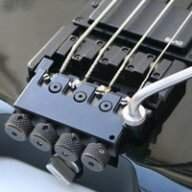
I would love to see the Steinberger TRANS TREM - usually made for headless electric guitars - resurrected and used on a regular 4 string bass. There where only about 200 of them made for headless basses but didn't work that well as intended. If you could use that whammy and lock it, and create drop tunings, by half a step, plus down to D on all strings independently, I would be all game. When doing tunes in Eb which certain guitar tunes are strung to, and big band arrangements, just a drop with the whammy and lock it would be fine. And one down too, to D tuning (for all strings). I would drop all 5ers in a go. I mean, you wouldn't use it as a whammy bar doing dive bombs, but a - sort of - reversed capo thing but without capo (!?). You just downtuned every string a half step and locked it into that. No need for hipshot drop d-tuners. It probably would turn out a bitch to set up properly without going out of tune each time. Once you've locked it, and think it's dead spot on, the string will "tune upwards" by itself in a couple of minutes, due to the strings flexibility. Just as you do when dropping tuning with the regular tuners on the head. You need to fine tune after a while anyway, they don't stay there for good. ANd if you stay in Eb for a long time, and then turn it back up to E again, within a few minutes (within a song) they will flex back to the last position with way more than a couple of cents, and you have to fine tune again. I think it's the same with hipshot drop d-tuners.

BTW Blowinblue. The last post was November 2013, before mine, so it's less than half a year since someone last posted here. Not one and a half year old. Not that severe a "necrobump".
 
I would love to see the Steinberger TRANS TREM - usually made for headless electric guitars - resurrected and used on a regular 4 string bass. There where only about 200 of them made for headless basses but didn't work that well as intended. If you could use that whammy and lock it, and create drop tunings, by half a step, plus down to D on all strings independently, I would be all game.

You mean
<------------- this, used on a regular bass with headstock, just for the transposing feature alone? Might fail for the lack of calibrated (defined) string lengths… what actual Steinberger basses suffer from as well today. Not enough trems made to justify production of said strings.
 
I have been playing 5 strings since the early 90s. I was playing in cover bands at that time that required low Eb, D, C#, C and Bs. Bass guitars had to compete with the bass synths.

I tried to the hipshot route, but it was a huge pain in the a@#! How many times did I forget to retune the string for the next song? Many.

When I finally got my first fiver, a Tobias, heaven! No more retuning! No more trying to make a .105 string play a low C.

Now I live in Nashville and have been lucky enough to tour with many great artists.

I also do a fair amount of studio work. In a Nashville session we are reading number charts and the key of the song can switch in a heartbeat....at the request of the singer.

The main artist I tour for has songs in B, Db, Ab, Db, So rather than have a Different bass for every song, I just bring my Sadowsky or Lakland 5.

Also, just because the B string is there, does not mean you have to use it all the time. In fact, there are MANY tunes where I do not touch it! There are some songs where I only play the B string on the last note, it's great for ending tunes.

JMHO!
 
BTW Blowinblue. The last post was November 2013, before mine, so it's less than half a year since someone last posted here. Not one and a half year old. Not that severe a "necrobump".

I was referring to the start date of the thread, but you are right. I stand corrected. It's just that anytime I come across an opportunity to use the phrase 'beating a dead horse' I get all excited and lose my bearings. What were we talking about? :woot:

M. M.
 
Last edited:

Latest posts