• TalkBass has been independent since 1998. Add your voice.
    Create a free account to reply to discussions, view embedded media, and browse with fewer display ads.
    Join freeLog in
    Want zero display ads or expanded classifieds tools? Compare plans.

Anyone still prefer Class A/B amps over Class D?

I should point out that the Class D heads I've worked my way through over the years include Acoustic Image (I was an early adopter back in the day), RH450, The Shuttle, STL 9.0, Promethean (which I still have for backup), and latterly a Demeter.

All sounded great, but none ever 'felt' right (to me). And with the best will in the world, no-one is going to be able to tell me I'm imagining it, no matter how much I respect them :)

(Incidentally, the GBE 750 I had back in the day was awesome)

...actually, while I say they all sounded great, that's not quite right. The RH450 was - IMO - hideous. ha ha.
 
Andy, I was simply offering my opinion in response to this post. "I'm not going to say the micros sound 'worse', but the heads I've tried certainly seem to have a common characteristic that doesn't ring my bell." When the class D amps started coming out I bought, or spent time with a number of them of them and found that to my ear, there were indeed similarities in what I was hearing from the IcePowered units. In my experience every one of these amps sounded dramatically better by running the preamp out into my Stewart World 2.1, Ashdown ABM500, or Aguilar DB750. We were also working on a IcePowered class D at the time and abandoned that path because we all felt our objectives could not be met with the technology at that time. Our engineering team was fully up to the task and knows how to set up listening test. Believe it or not, there are other very talented people out there.

What I was trying to point out was the fact that many players made up their minds about class D based on the performance of the first wave of class D amps to hit the market and that the newest generation of class D amps have come a long way. And while I have great respect for your talents, you do tend to adopt an attitude that any opinion that conflicts with your own is simply not valid. The point of these forums is for people to be able to read different points of view and I think the community as a whole benefits when people are able to express themselves without someone else trying to diminish their position. And while it's great to say that your opinions aren't based on marketing, people should also consider that commercial users can hardly be expected to provide totally unbiased opinions that don't paint their company's products, or the technologies that they use in anything other than the very best light.
Roger, I have been through enough double-blind tests to know without any doubt that many opinions "stated as fact" quickly disappear when the ONLY selection criteria is performance. Enough of the so called "class D is not as good" folks have selected the class D choice when they didn't know which source was which, that the prejudice becomes clearly in the mind and not in reality.

Sure there are other talented people out there, I've worked with some and additionally, I have often praised other products that I think made good achievements with the class D platform (most recently Pat Quilter Bobby Baldwin and Jim Bergentino). The attitude I have adopted comes from the double blind tests where these very people who categorically stated that class D could never be as good as (pick solid state class AB or even tubes) who then chose the class D amp in the test. Of course, the excuses start to fly it wasn't a "fair" test, the wind was blowing the wrong way, the sky was too cloudy, etc ;).

I often present different points of view for the very reason of the community, but this is done (and I do try hard) in a more factually oriented way including how the different approaches work, the pros and cons of them, and why one might be selected over another. You seem to forget that I designed a whole lot of class AB linear amps, including some pretty large high performance ones, so I have been in all categories of the market... including big tube power amps. In fact the company I work for now is probably one of the few companies that offers all 3 topologies in their product line: TUBE(Prodegy-Strategy), solid state linear (Carbines and Walkabout)and class D Subway) in their current product line, so I wouldn't say that we are a class D only philosophy, in fact we about as far from painting a single technology in the best light as you can get. There are some cool things that can be done with each technology, but to say that one is "better" than another without clearly qualifying the how and why (backing up with data) is not presenting the information in an unbiased fashion (and I have also mentioned that there are biases present which is WHY double-blind testing is so important... especially for a designer)

Class D is not as mature as other amplifier types, it is complicated, has its own unique quirks, and requires a lot of engineering expertise to get the most out of the platform. Unfortunately, there were (and still are) a lot of false starts and poor examples of this technology and its applications on the market, both performance as well as reliability and it's IMO unfair to judge all class D products based on those that may not have been the best implementation, or even the best voicing choice for the player. I hope that the market continues to mature, and that more good examples of class D get introduced, which will help folks recognize the potential of this technology.

That doesn't mean that I wouldn't be interested in designing another big linear solid state power amp (might have on sitting on my bench actually) but the question is if there is sufficient market for a big, heavy, expensive bass amp like this. Sadly (I mean this) my gut says no.

[edit for improved accuracy]
 
Last edited:
In fact the company I work for now is probably the only company that offers all 3 topologies in their product line: TUBE(Prodegy-Strategy), solid state linear (Carbines and Walkabout)and class D Subway) in their current product line
Weeeeeell, I can think of one other...

:D

Respect to Mesa, though. The guitarists in my two bands (as well as the drummer in one) use their stuff and love it.
 
Weeeeeell, I can think of one other...

:D

Respect to Mesa, though. The guitarists in my two bands (as well as the drummer in one) use their stuff and love it.
Yeah, true that. Good point, maybe 2 others...
 
Last edited:
My first real amp was a GK MB800. It was fantastic, punchy, clean, handled effects pretty well. My next was a Meatsmoke Pre into a Crown XLS Class D Power Amp. It wasn't....bad...but one day I tried it out running into an RB800 and I was just chuffed to bits at how good it sounded. I picked up a GK RB700II for $270 and haven't looked back. It sounds miles better to me than running into the Class D. It's hard for me to quantify, I *Know* Class D can sound great, but there's just something about the impurities added in that just make it seem so much more...real.

I'd have no real problem using a Class D again. I've had my eyes on a GK Fusion as a backup but it's hard to justify since my old Crown XLS is still staring at me from the rack across the room, waiting for the day the RB700 fails me and I need a power amp in a pinch :p
 
  • Like
Reactions: R Baer
Roger, I have been through enough double-blind tests to know without any doubt that many opinions "stated as fact" quickly disappear when the ONLY selection criteria is the performance. Enough of the so called "class D is not as good" have selected the class D choice when they didn't know which source was which, that the prejudice becomes clearly in the mind and nit in reality.

Sure there are other talented people out there, I've worked with some and additionally, I have often praised other products that I think made good achievements with the class D platform (most recently Pat Quilter Bobby Baldwin and Jim Bergentino). The attitude I have adopted comes from the double blind tests where these very people who categorically stated that class D could never be as good as (pick solid state class AB or even tubes) who then chose the class D amp in the test. Of course, the excuses start to fly it wasn't a "fair" test, the wind was blowing the wrong way, the sky was too cloudy, etc ;).

I often present different points of view for the very reason of the community, but this is done (and I do try hard) in a more factually oriented way including how the different approaches work, the pros and cons of them, and why one might be selected over another. You seem to forget that I designed a whole lot of class AB linear amps, including some pretty large high performance ones, so I have been in all categories of the market... including big tube power amps. In fact the company I work for now is probably one of the gew companies that offers all 3 topologies in their product line: TUBE(Prodegy-Strategy), solid state linear (Carbines and Walkabout)and class D Subway) in their current product line, so I wouldn't say that we are a class D only philosophy, in fact we about as far from paining a single technology in the best light as you can get. There are some cool things that can be done with each technology, but to say that one is "better" than another without clearly qualifying the how and why (backing up with data) is not presenting the information in an unbiased fashion (and I have also mentioned that there are biases present which is WHY double-blind testing is so important... especially for a designer)

Class D is not as mature as other amplifier types, it is complicated, has its own unique quirks, and requires a lot of engineering expertise to get the most out of the platform. Unfortunately, there were (and still are) a lot of false starts and poor examples of this technology and its applications on the market, both performance as well as reliability and it's IMO unfair to judge all class D products based on those that may not have been the best implementation, or even the best voicing choice for the player. I hope that the market continues to mature, and that more good examples of class D get introduced, which will help folks recognize the potential of this technology.

That doesn't mean that I wouldn't be interested in designing another big linear solid state power amp (might have on sitting on my bench actually) but the question is if there is sufficient market for a big, heavy, expensive bass amp like this. Sadly (I mean this) my gut says no.

[edit for improved accuracy]

All very good points. People tend to get the impression that I'm against class D, which isn't true. I certainly wasn't impressed with the early stuff, but I did understand that many players liked what they were hearing and there's no denying the benefits when it comes to size and weight. The early stuff, in my opinion lacked a certain heft to the body of the note and I certainly wasn't the only one saying this. My take was that the SMPS on the modules didn't have the ability to sustain a note in the same way the large capacitors and a 15lb. transformer of a conventional power supply can. The class D's had lots of initial burst power, but then a much quicker dying off of the note, which to many of us was quite noticeable. I heard time and time again from players at NAMM that they felt the class D amps just seemed to be missing something on the low end and I agreed. Much in the same way that players felt something was lacking from the early neo speaker cabs. But that was years ago and today's class D amps (and neo cabs) are very good.

At some point, I never think of one tone as "better" than another. Much like you can't say that rosewood sounds better than maple, nickel sounds better than stainless, or that tubes sound better than solid state (although those are certainly my preferences). Once the performance of the class D modules improved, it just became another option for designers to use. I agree that the days of the lead sled, for as much as I love them is drawing to an end. Not that players won't still love and use them, but I doubt that the sales numbers are going to be high enough to cover the R&D cost, especially small guys like myself. We are working with class D now because that's what our clients want, but my heart will always be in the big stuff. Much like the way we drive a VW GTI now, but I still really, really miss my 1970 Camaro SS. The GTI is actually just as fast and handles worlds better, but there's still nothing quite like the feeling on stomping on the pedal of a really well built 350.

Oh, and I don't forget that you designed class A/B amps. I had the chance to play the GBE750 and had a NeoPak for a while. Both of which I greatly preferred to the Shuttle amps. The NeoPak was a very impressive little amp and was my favorite of the GB stuff. As for the Mesa stuff, I had a Big Block 750 and loved it, so that should tell you where my taste lie.
 
Last edited:
It's also important to recognize that tastes have changed as well, along with many of the music styles that simply didn't exist 25 years ago. With new music styles come new tastes, new wants, new needs and most importantly new expectations. Our job as a designer is to figure out what amp platforms and approaches fit these groupings of players the best and how to make the most players the most satisfied. No one amp can possibly do it all, it's just impossible... without going down the DSP route WITH a vast amount of investment in modeling the various amp (and speaker) combinations. While this may be better accepted in the future, I suspect that this will be a MUCH harder sell than class D and SMPS ever was. It's starting to catch on at the very top of the e. guitar world, but there's not a lot of market penetration (yet).

IMO, I think Jim Bergentino's B/AMP is a great first step. IME, it's a tremendous undertaking, not just in technology, but also in educating and supporting such a concept in a relatively conservative marketplace.
 
I dunno man, this Subway seems waaaaay heavier than the ToneHammer I had (sarcasm). I've had most amps, just sold a CL. The D's work fine. You guys must have some ungodly senses of hearing. And the weight thing? I still lug around a 610. And before that, at least a 410...lotta time the 810E. I've had a bunch of D's. Earliest was Portaflex's and a couple 7's. they all had the dreaded cutout issues...that scared me off D's. Then I got a TH500, and now this Mesa. Game over. The only way this Subway 800 could be any better is if they put a tuner out on it. Yeah I know, get the +...but that thing got a lotta knobs.
 
  • Like
Reactions: bucephylus
It's also important to recognize that tastes have changed as well, along with many of the music styles that simply didn't exist 25 years ago
That's a very good point. Should manufacturers ignore the quest for full spectrum their customers desire and seek to make new amps sound like the old? Then the fight would be, so class D sounds the same, why should I replace my a/b?
 
That's a very good point. Should manufacturers ignore the quest for full spectrum their customers desire and seek to make new amps sound like the old? Then the fight would be, so class D sounds the same, why should I replace my a/b?
Huh? I know you have a point in there, but danged if I can find it :D What does the topology of the amp have to do with that? Seems to me that it's less about creating new sounds as it is about creating amps with more wattage and less weight. Full spectrum is much more a function of the cabs IMHO, and manufacturers have been addressing that for a couple decades now.
 
I was pretty happy with my last class D amp (Shuttle 6.0) but was curious to try a Mesa Walkabout. Then I decided to go old school with a Reeves Custom 225. I have an advantage in that I don't have to move my gear around anymore, so weight is not an issue. The desire to have a backup/home amp led me to invest in one of Kevin Shaw's B-15's on steroids (B-150). These are probably the last two amps I will buy. I don't see myself playing out of the church sanctuary any more (if I do, I'll use the Shaw), so the class D amp will continue to evolve without me just fine. :cool:
 
  • Like
Reactions: R Baer
Huh? I know you have a point in there, but danged if I can find it :D What does the topology of the amp have to do with that? Seems to me that it's less about creating new sounds as it is about creating amps with more wattage and less weight. Full spectrum is much more a function of the cabs IMHO, and manufacturers have been addressing that for a couple decades now.
The easiest point to locate as I ramble is the one atop me old skull, mate.

I'm saying that new SS amps are designed to please the new sound. They shouldn't sound the same as the oldies. Things have changed. Technological and application.

OT but one of the fun things about engineering is predicting the future. Im good at that in network design. I keep getting told we will never... I ignore, then we always do :D
 
Nothing wrong with a loving, gentle, big heavy dog if you can manage him. Made to bark out those low notes.

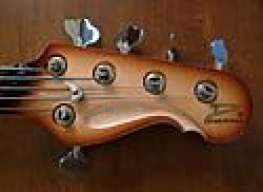
Image.jpg
 
The easiest point to locate as I ramble is the one atop me old skull, mate.

I'm saying that new SS amps are designed to please the new sound. They shouldn't sound the same as the oldies. Things have changed. Technological and application.

OT but one of the fun things about engineering is predicting the future. Im good at that in network design. I keep getting told we will never... I ignore, then we always do :D
Network design is a rapidly changing marketplace where technological advances are still happening and the best is yet to come. Electric bass design is a marketplace where the most recent truly innovative innovations happened a couple decades ago, most way farther back than that, and everything else since then has been incremental changes to the same old thing. Sure, micros and neo speakers are innovative, but they haven't fundamentally changed the art of making music on electric bass or redefined the role of the bassist. And even they have been around for a good while now.
 

Latest posts