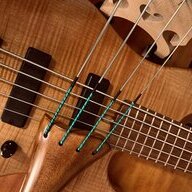
Still using Pure Blues. I'm experimenting with a super light set up, so I'm mixing up gauges.
My favorite stock set is the VW .040. But I'm going lighter, or drastically down tuning, depending on your view.
On a four string, standard tuning, E-G, I'll probably end up running .080-.030. I'm shifting the stings so the .080 A string is now my E, and so on. So the VW set is a little light and the stock .040 set works better. This also depends on the scale length. On a Dingwall Super P (34"-32" fanned fret) I can use stock Boomers .030. But the Pure Blues work better.
On the longer scale basses, a 35" Cirrus, or the long scale Dingwalls (36.25"-34" fanned fret) I need something a little heavier, like a .085-.032. Otherwise, I end up too far on the light side and its difficult to mute without touching frets and creating overtones. Just not quite enough tension. It's a really fine line.
I'm a couple hundred bucks into this exploration since I just ordered quite a few sets and singles to try with fresh sets.
It was cheap enough to get started as I had plenty of used sets on hand and only needed a few single C strings to try my idea. I'm about six months into exploring the super light side and I really like where its going.
The D'Addario .035 super lights and the GHS Boomer .030 are inexpensive sets to try out the light side right out of the pack. Or you could tune your E-G down to B-D for a quick peek at how this feels. (there's a little more set up work than that involved, but you'll get the idea)
This experiment has used DR Hellborgs and nickel Lowriders as well as Dingwall and Payson strings for the longer fanned frets. I keep coming back to the Pure Blues because I like the feel, both the outer wrap and response. I'll be setting up the Super P with TI flats once my single .030 arrives. I can't wait to see if that works for me.
TLDR: Still Pure Blues and TI flats for me.