

Enjoy the benefits of a premium membership!
Upgrade Account
-
TalkBass has been independent since 1998. Add your voice.
Create a free account to reply to discussions, view embedded media, and browse with fewer display ads.
Join free Log in
Want zero display ads or expanded classifieds tools? Compare plans.
You are using an out of date browser. It may not display this or other websites correctly.
You should upgrade or use an alternative browser.
You should upgrade or use an alternative browser.
Double Bass Anyone using Harp tailpiece?
- Thread starter Barcza
- Start date
More options
Who Replied?

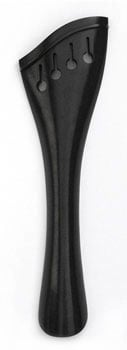
I just installed one today, ebony version though (about 210 grams). It replaces a hardwood tailpiece on an old czech flatback bass which was lighter, not by much though. This new tailpiece isn't exactly huge or particularly heavy. It's the "Harp" Tailpiece from this retailer:
Invalid Link Removed
The first impression is positive yet I would not want to make any detailed statement until the bass and the strings have settled in a bit. I will post more later.
Invalid Link Removed
The first impression is positive yet I would not want to make any detailed statement until the bass and the strings have settled in a bit. I will post more later.

Jake deVilliers
Commercial User
- May 24, 2006
- 6,349
- 607
- Disclosures
- Owner of The Bass Spa, String Repairman at Long & McQuade Vancouver
I interested, that's really improve the sound or the feel or something?
The angled string holes make it easier to get all the differently gauged after-lengths in tune. Otherwise, you can usually only get two in tune; two are still causing phase cancellations.
Alright, played a gig with the modded bass yesterday night, 2.5 hrs of trio (drums, bass, tenor sax), no amps:
I gotta say that my expectations were rather low since I couldn't really find too much consensus on the influence of the tailpiece across this board or among luthiers, BUT in my personal case I find it to make a pretty significant difference. Ok, I was hoping to get this exact effect, so I might be biased, but I am also usually not into fooling myself, so I claim to be speaking the truth (or at least some decent portion of it!):
Again, setup change: pretty long and wide yet light hardwood tailpiece replaced by this ebony "harp" tailpiece, which is a little heavier, sounds way more dense knocking on it and has the obvious curve. I cannot rule out effects of the overall reset of the instrument naturally, taking all the strings off and on again etc., but I taped (!) the soundpost to it's current position while working on it, so I am fairly positive that it hasn't moved. Also had a bunch of heavy books on the top to provide a little bit of extra pressure.
I didn't approach setting the new after-lengths too scientifically, the G string basically now is what it was before, and thus the lower strings now have an extended after-length. The strings are Velvet Garbo.
Compared to before I feel a very noticeable difference on the E and A string, the open A still pops out a bit yet with a more solid feel, not as barky anymore. The E String most definitely speaks and rings more easily now. Generally speaking I feel like the voice of the instrument has changed slightly, kind of like a slightly lower formant sounding a bit more mature to me. Everything just feels a tad more solid and "deep". Also arco as well as pizz I sense a tad less wolfiness than before which is good.
Another thing I got to mention: I cannot sense any loss in overall volume, but then again the tailpiece isn't so much heavier than the other one, no idea what a 400g chunk would do respectively. That being said, although the concept might be similar, this tailpiece is smaller, slimmer and lighter than the Pecanic tailpieces I've seen. Again, it's 210g according to the retailer, not very heavy for an ebony tailpiece. It's also not exactly huge, but I shall find my measuring tape and post some numbers...
For now I have to say that I am very pleased with this change, will post more if my initial perception changes at any point.
I gotta say that my expectations were rather low since I couldn't really find too much consensus on the influence of the tailpiece across this board or among luthiers, BUT in my personal case I find it to make a pretty significant difference. Ok, I was hoping to get this exact effect, so I might be biased, but I am also usually not into fooling myself, so I claim to be speaking the truth (or at least some decent portion of it!):
Again, setup change: pretty long and wide yet light hardwood tailpiece replaced by this ebony "harp" tailpiece, which is a little heavier, sounds way more dense knocking on it and has the obvious curve. I cannot rule out effects of the overall reset of the instrument naturally, taking all the strings off and on again etc., but I taped (!) the soundpost to it's current position while working on it, so I am fairly positive that it hasn't moved. Also had a bunch of heavy books on the top to provide a little bit of extra pressure.
I didn't approach setting the new after-lengths too scientifically, the G string basically now is what it was before, and thus the lower strings now have an extended after-length. The strings are Velvet Garbo.
Compared to before I feel a very noticeable difference on the E and A string, the open A still pops out a bit yet with a more solid feel, not as barky anymore. The E String most definitely speaks and rings more easily now. Generally speaking I feel like the voice of the instrument has changed slightly, kind of like a slightly lower formant sounding a bit more mature to me. Everything just feels a tad more solid and "deep". Also arco as well as pizz I sense a tad less wolfiness than before which is good.
Another thing I got to mention: I cannot sense any loss in overall volume, but then again the tailpiece isn't so much heavier than the other one, no idea what a 400g chunk would do respectively. That being said, although the concept might be similar, this tailpiece is smaller, slimmer and lighter than the Pecanic tailpieces I've seen. Again, it's 210g according to the retailer, not very heavy for an ebony tailpiece. It's also not exactly huge, but I shall find my measuring tape and post some numbers...
For now I have to say that I am very pleased with this change, will post more if my initial perception changes at any point.
The angled string holes make it easier to get all the differently gauged after-lengths in tune. Otherwise, you can usually only get two in tune; two are still causing phase cancellations.
Does the slight increase in lengths in the lower, particularly the E, strings mean that their harmonics are no longer located directly across from each other, but are now curved towards the bridge? But, for a better overall sound, I guess one can get used to it as when tuning in the 3rd position

The harmonics don't change (they might at best by a fraction of a millimeter).
The string is fixed between nut and bridge.
There is some vibrational energy transfer from the string to the afterlength because of
a) the bridge moving itself and
b) the stiffness of the string
(if the string north of the bridge goes up, it goes down south of the bridge
due to stiffness)
The string is fixed between nut and bridge.
There is some vibrational energy transfer from the string to the afterlength because of
a) the bridge moving itself and
b) the stiffness of the string
(if the string north of the bridge goes up, it goes down south of the bridge
due to stiffness)
The harmonics don't change (they might at best by a fraction of a millimeter).
The string is fixed between nut and bridge.
How silly of me! Of course they stay the same. I was imagining the entire string length and forgetting about the fixed playing length. Thanks for the clarification.
Jake deVilliers
Commercial User
- May 24, 2006
- 6,349
- 607
- Disclosures
- Owner of The Bass Spa, String Repairman at Long & McQuade Vancouver
Does the slight increase in lengths in the lower, particularly the E, strings mean that their harmonics are no longer located directly across from each other, but are now curved towards the bridge? But, for a better overall sound, I guess one can get used to it as when tuning in the 3rd position
No Gerry, your string length doesn't change, just the relative notes of the after-lengths.

Yes. I realize that now, after a gentle prodding by DoubleMidi.
That curved tailpiece makes a lot of sense. When I recently installed the new tail piece cord you sent me, I tried to tune the after-lengths. But, as you mentioned in an above post, I could get only the D and G realatively "in tune." I gave up on the A and E. I even considered removing the end-wrappings from them to make them more "tunable," but I wisely gave up on that brain fart
That curved tailpiece makes a lot of sense. When I recently installed the new tail piece cord you sent me, I tried to tune the after-lengths. But, as you mentioned in an above post, I could get only the D and G realatively "in tune." I gave up on the A and E. I even considered removing the end-wrappings from them to make them more "tunable," but I wisely gave up on that brain fart
Jake deVilliers
Commercial User
- May 24, 2006
- 6,349
- 607
- Disclosures
- Owner of The Bass Spa, String Repairman at Long & McQuade Vancouver
Yes. I realize that now, after a gentle prodding by DoubleMidi.
That curved tailpiece makes a lot of sense. When I recently installed the new tail piece cord you sent me, I tried to tune the after-lengths. But, as you mentioned in an above post, I could get only the D and G realatively "in tune." I gave up on the A and E. I even considered removing the end-wrappings from them to make them more "tunable," but I wisely gave up on that brain fart
Peeling the silks helps but I usually just make little wooden string perches and put them under the strings where they need them ie further back. Or you can whittle little wedges out of softwood.

If you are going to get a tapered tailpiece, you should order one from Mike Pecanic in California. He will custom make one for your bass, out of an amazing assortment of woods, and it's very affordable. I've got two from him, and they really do make a difference


