You are right that Fender cab wasn't the best for bass and Hartke had better cab design in combo. On the other hand that Hartke had way more control over the tone being more versatile.This predates the silver faced amps by a few years, but not too much different. The 50W was adequate for some low key jobs, but a properly tuned efficient speaker box goes a long way to making the most out of those 50 watts.

Enjoy the benefits of a premium membership!
Upgrade Account
-
TalkBass has been independent since 1998. Add your voice.
Create a free account to reply to discussions, view embedded media, and browse with fewer display ads.
Join free Log in
Want zero display ads or expanded classifieds tools? Compare plans.
You are using an out of date browser. It may not display this or other websites correctly.
You should upgrade or use an alternative browser.
You should upgrade or use an alternative browser.
Are Class D amps really 5 times less powerful than A/B?
- Thread starter mbell75
- Start date
- Status
- Not open for further replies.
More options
Who Replied?
They all use transistors as output devices. A transistor is not a digital device.
A logic gate is made of transistors.
All Apple is Fruit. Not all Fruit is Apple.
Logic gates existed long before digital audio signals. A transistor does not change something to a digital signal.
I was responding to the assertion that a transistor is not a digital device; in certain uses it can be and therefore the blanket statement is incorrect.
Whether or not a class-D amplifier is a digital device or not is an interesting question and I can't say that it isn't.
Whilst computers with clocked signals operating at a certain frequency to synchronise the switching and propagation of logic is indeed a digital system, it does not mean that (with reference to the apple/fruit analogy) all digital systems must operate in that way.
In other words, Digital does not mean an encoding of 0 & 1 state as a 0/5V signal clocked at 1 GHz (or whatever); that is simply a common implementation.
Digital per-se refers to a component which represents data by switching between an on/1 state and an off/0 state and does not define the time processing.
By way of examples: a common light switch is a digital device which is operated at semi-random times, when you count to 10 on your fingers (your digits) the time between incrementing is not precise, a traffic policeman holding up a hand to say stop or waving to go is a digital system.
Back to the amplifier; a class-D amplifier encodes the signal as varying duration on/off pulses (ie. pulse-width modulation in the 0 or 1 state); these are then fed through a low-pass filter to remove the frequencies above the audio range and thus produce an audio output signal, as shown in this diagram from wikipedia (Class-D amplifier - Wikipedia) shows the process.
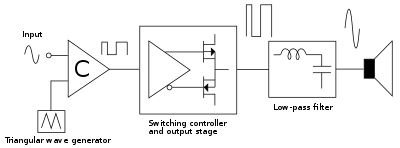
In the diagram the middle bit is definitely made up of digital signal levels varying between the 0 and 1 states; however there is no set clock-rate controlling propagation of the signal and thus the time-series is analogue.
The above link then suggests that the output not being clocked "non-quantised time" means that it is not a digital device.
But the digitised encoding of the signal also means that the system is not entirely analogue either.
Based on the above, I would say that a class-D is a hybrid of analogue & digital, but neither one nor the other.

All of them so I am not going to waste my time naming them.Ok, that might be true but can you name any Class D bass amps with analog power sections? I can't think of a single one. Most every Class D is digital.
See above.Ok. Again, every class D combo bass amp Im aware of has a digital power section. Give me some examples of class D combo bass amps with analog power sections. Thanks


Possibly.I'm wondering if it's speaker breakup that they find so wonderful, rather than amplifier distortion. A good amp should have relatively low distortion throughout it's dynamic range, until the onset of clipping.
My experience with some ss heads is is clipping em ain't particularly nice, where others that've been designed to obviously , sound great.
One being my TH500 Aggy. oh and the DB750. Tube front in that tho.

By way of examples: a common light switch is a digital device which is operated at semi-random times, when you count to 10 on your fingers (your digits) the time between incrementing is not precise, a traffic policeman holding up a hand to say stop or waving to go is a digital system.
Probably best not to confuse integrated digital systems with discrete binary or simple logic devices.
4 different design philosophies, none of which are better or worse, and none of those examples are categorical of the amp's class, but more of the power supply and intent or byproduct.
Correct me if I'm wrong, but isn't the power supply integral to each of the amplifier types as a whole? And isn't the availability of burst power integral to the 'feel' of an amplifier?
edit - Don't get me wrong, I'm not going back to a led sled. The size, weight and performance of the new lightweight amplifiers makes that illogical.

Nope, nothing that exotic. D was the next letter in line after A, AB, B, and C.
. . . . and don't forget, AD, BC and CCDEEF?
The OP took this tire fire to another thread. 20 pages, didn't make a dent.
This. Not only that but remember that unlike most combo amps that are Class D, the Katana amps have an A/B power section. So while 60 watts may not sound like a lot, it's about 300 watt equivalence to a Class D bass amp. It should be plenty to gig at a church or small clubs.
Please don't share this information here, as it is not true. There is another topic where statements like this are proven to be wrong by many people who know their stuff. Class A/B does not make things magically more powerful than class D.
We are talking about the Boss Katana bass amp here. Im going by what the President of Boss says in this interview below. I think he knows more about his amps than you do, thanks

Here's an article on burst power. Draw your own conclusions.
Measuring Burst Power | Bass Gear Magazine
Tidbits from the article in italics:
Class-D #1
740 watts; 1% THD+N filtered 20Hz-20kHz; 680 mVrms 1kHz sin Input Continuous
930 watts; 1% THD+N filtered 20Hz-20kHz; 770 mVrms 1kHz sin Input Burst
Power Difference = 190W930 watts; 1% THD+N filtered 20Hz-20kHz; 770 mVrms 1kHz sin Input Burst
Decibel Difference = 0.99dB
Tube
275 watts; 2.5% THD+N filtered 20Hz-20kHz; 120 mVrms 1kHz sin Input Continuous
370 watts; 2.5% THD+N filtered 20Hz-20kHz; 135 mVrms 1kHz sin Input Burst
Power Difference = 95W370 watts; 2.5% THD+N filtered 20Hz-20kHz; 135 mVrms 1kHz sin Input Burst
Decibel Difference = 1.29dB
Solid State
400 watts; 1.6% THD+N filtered 20Hz-20kHz; 120 mVrms 1kHz sin Input Continuous
620 watts; 1.6% THD+N filtered 20Hz-20kHz; 150 mVrms 1kHz sin Input Burst
Power Difference = 220W620 watts; 1.6% THD+N filtered 20Hz-20kHz; 150 mVrms 1kHz sin Input Burst
Decibel Difference = 1.9dB
Class-D #2
306 watts; 6.6% THD+N filtered 20Hz-20kHz; 240 mVrms 1kHz sin Input Continuous
398 watts; 6.6% THD+N filtered 20Hz-20kHz; 247 mVrms 1kHz sin Input Burst
Power Difference = 92W398 watts; 6.6% THD+N filtered 20Hz-20kHz; 247 mVrms 1kHz sin Input Burst
Decibel Difference = 1.13dB
Class D #1 makes 740W continuous. Let's compare this to the burst power of the other amps.
Tube Burst = 370W (3.01dB below 740W)
Solid State Burst = 620W (0.77dB below 740W)
Class D #2 Burst = 398W (2.69dB below 740W)
Solid State Burst = 620W (0.77dB below 740W)
Class D #2 Burst = 398W (2.69dB below 740W)
Class D#1 makes 930W of burst power. Let's compare this to the burst power of the other amps.
Tube Burst = 370W (4dB below 930W)
Solid State Burst = 620W (1.76dB below 930W)
Class D #2 Burst = 398W (3.68dB below 930W)
Solid State Burst = 620W (1.76dB below 930W)
Class D #2 Burst = 398W (3.68dB below 930W)
IMHO, You can't really draw any conclusions based on such a small sample of amps. However in practical terms, when you have a more powerful amp, the dynamic headroom is likely to be less of a factor. Based on the numbers, with all other things equal class D #1 will be the loudest amp even though it has the least amount of dynamic headroom. However, the voicing can have a significant impact on perceived volume, and it's unlikely these amps will all have the same voicing. So class D #1 may not be perceived as the loudest, regardless of what the numbers say.
My feeling is it doesn't really matter as long as you like the way the amp sounds and it gets loud enough for your needs. So if class D #2 meets your needs, then Bob's your uncle.
I'm always amazed at how many amps some of you guys have gone through. I've had five in 40 years. The only tube amp I had was a Musicman HD 130. . . .
I had an HD130 and HD150. I liked those amps but they were replaced by a solid state Dynacord combo which just sounded 100% better.

Alli know is I've gotten rid of a Fender Rumble amp and just recently, an Ampeg RB amp. They are pretty sterile, boring and sound nothing like their tube big brothers IMO. Meanwhile, I've just recently tried a Boss Katana 210 and an Orange Crush 100. Both sounded significantly better than the Fender and Ampeg IMO. I know the Boss is A/B and I'm pretty sure the Orange is too but not sure, and both use analog everything from what I've read. So I guess I'm just not a Class D guy…
which Rumble and RB amps did you try?
They make some small combos with small cabinets and those just never have the 'oomph' we like from bigger amps. Some are nicer than others but in general I find most lack a lot, largely due to the speaker cabinet.
The clearest example I've experienced was actually a very silly situation. Many years ago my band was asked to play at a local small festival in the woods just out of town. All equipment provided, just bring your bass, type of deal. Great! Right?
I arrive and I'm directed to a small black box... a 30W tiny practice combo amp (brand 'Gorilla' in case any of you knows those amps, they used to be quite common here as a very budget-friendly practice amp). I laughed and cried at the same time

Now, that combo had a pretty disappointing sound: not much depth, very middy... and once the band starts it was useless as a monitor even (I ended up putting it on a table and aimed at my head, and it was barely audible). However, the sound out front was pretty decent (taking a line-out from the amp, to desk). The amp is only part of the equation.
The clearest example I've experienced was actually a very silly situation. Many years ago my band was asked to play at a local small festival in the woods just out of town. All equipment provided, just bring your bass, type of deal. Great! Right?
I arrive and I'm directed to a small black box... a 30W tiny practice combo amp (brand 'Gorilla' in case any of you knows those amps, they used to be quite common here as a very budget-friendly practice amp). I laughed and cried at the same time
I bet that was a class-AB amp.

But that's not what most people of are thinking of when they use the term digital.I was responding to the assertion that a transistor is not a digital device; in certain uses it can be and therefore the blanket statement is incorrect.
Whether or not a class-D amplifier is a digital device or not is an interesting question and I can't say that it isn't.
Whilst computers with clocked signals operating at a certain frequency to synchronise the switching and propagation of logic is indeed a digital system, it does not mean that (with reference to the apple/fruit analogy) all digital systems must operate in that way.
In other words, Digital does not mean an encoding of 0 & 1 state as a 0/5V signal clocked at 1 GHz (or whatever); that is simply a common implementation.
Digital per-se refers to a component which represents data by switching between an on/1 state and an off/0 state and does not define the time processing.
By way of examples: a common light switch is a digital device which is operated at semi-random times, when you count to 10 on your fingers (your digits) the time between incrementing is not precise, a traffic policeman holding up a hand to say stop or waving to go is a digital system.
Back to the amplifier; a class-D amplifier encodes the signal as varying duration on/off pulses (ie. pulse-width modulation in the 0 or 1 state); these are then fed through a low-pass filter to remove the frequencies above the audio range and thus produce an audio output signal, as shown in this diagram from wikipedia (Class-D amplifier - Wikipedia) shows the process.
In the diagram the middle bit is definitely made up of digital signal levels varying between the 0 and 1 states; however there is no set clock-rate controlling propagation of the signal and thus the time-series is analogue.
The above link then suggests that the output not being clocked "non-quantised time" means that it is not a digital device.
But the digitised encoding of the signal also means that the system is not entirely analogue either.
Based on the above, I would say that a class-D is a hybrid of analogue & digital, but neither one nor the other.
If back in the 20's or 30's, or whenever the class designations for amplifier topology was developed and the letter available for this type was F, there is no way people would be calling these new Class F amps digital.
Last edited:
I bet that was a class-AB amp.
Yeah, I bet that made all the difference

And therefore, using the data kindly supplied by the boss at Boss, that amp was the equivalent of a 1500-watt Class D.I bet that was a class-AB amp.
An excerpt from the OP's post in a new thread:
Inconceivable!So you are saying a well respected company like BOSS is knowingly misleading customers?

Well, I guess there's correct and common perception.But that's not what most people of are thinking of when they use the term digital.
If back in the 20's or 30's, or whenever the class designations for amplifier topology was developed and the letter available for this type was F, there is no way people would be calling these new Class F amps digital.
Incidentally, on the Watts thing; an approximate rule is 10x Watts = 2x loudness, ie. a 1000 Watt amp is twice as loud as a 100W one (like-for-like across all other components).
(Of course, yer Watts may be RMS, peak, at a particular frequency, or other variations.)
(Of course, yer Watts may be RMS, peak, at a particular frequency, or other variations.)
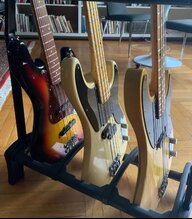
SVT's and B-15's to my ears sound very different from one another.
Two classic Ampeg sounds that defined decades of music in several genres, including Motown and arena rock.

My (hopefully) last comments:
First, devices functioning in the digital domain typically (as in 99.9%) of the time have a thing called a D/A (digital to analog) converter before the digital information can be projected in the analog domain. Class D power sections do NOT have a DAC in them. So, they are NOT digital devices. Digital devices can not project analog signals (at least useful ones). They would sound like what you hear when you call into a FAX machine by mistake. So, NOT digital.
Second, the VAST majority of large venue amplified musical performances are now driven by Class D power amplifiers. No amount of dramatic debate by a bunch of bass players is going to affect that in the least. So, if you get an opportunity to perform on a big stage, your sound going out to your audience is courtesy of Class D technology. All of us debating the merits / demerits of tonal aspects is very much the fleas arguing about which one owns the dog. It is absurd.
Third, I just don't understand the comments that "the SVT or B15 are awesome; but, I played a Fender Rumble, and it wasn't even close. Therefore Class D sucks." Seriously? I don't really care what any other bass player plays. We all have different prefs. I adore the SVT FWIW. But, coming to the conclusion that all Class D amps suck based on a comparison of a budget Class D GC "rig" vs a $2k tube rig is just…."rigged"? OK, if a player puts some gig time in on a Mesa / Genzler / Demeter / Bergantino properly designed Class D amplifier; and then decides they want to drag the tubes around with them, then ok. Personal prefs. Comparing an SVT to a Fender Rumble as evidence of amplifier class is either ignorance or troll bait.
Back to my Demeter / Mesa rigs. I'm out. Enjoy!
First, devices functioning in the digital domain typically (as in 99.9%) of the time have a thing called a D/A (digital to analog) converter before the digital information can be projected in the analog domain. Class D power sections do NOT have a DAC in them. So, they are NOT digital devices. Digital devices can not project analog signals (at least useful ones). They would sound like what you hear when you call into a FAX machine by mistake. So, NOT digital.
Second, the VAST majority of large venue amplified musical performances are now driven by Class D power amplifiers. No amount of dramatic debate by a bunch of bass players is going to affect that in the least. So, if you get an opportunity to perform on a big stage, your sound going out to your audience is courtesy of Class D technology. All of us debating the merits / demerits of tonal aspects is very much the fleas arguing about which one owns the dog. It is absurd.
Third, I just don't understand the comments that "the SVT or B15 are awesome; but, I played a Fender Rumble, and it wasn't even close. Therefore Class D sucks." Seriously? I don't really care what any other bass player plays. We all have different prefs. I adore the SVT FWIW. But, coming to the conclusion that all Class D amps suck based on a comparison of a budget Class D GC "rig" vs a $2k tube rig is just…."rigged"? OK, if a player puts some gig time in on a Mesa / Genzler / Demeter / Bergantino properly designed Class D amplifier; and then decides they want to drag the tubes around with them, then ok. Personal prefs. Comparing an SVT to a Fender Rumble as evidence of amplifier class is either ignorance or troll bait.
Back to my Demeter / Mesa rigs. I'm out. Enjoy!
Oh boy. Found this in the Wikipedia entry for Power Amplifier Classes, and I'm confused:
No citation provided, of course.Another advantage of the class-D amplifier is that it can operate from a digital signal source without requiring a digital-to-analog converter (DAC) to convert the signal to analog form first. If the signal source is in digital form, such as in a digital media player or computer sound card, the digital circuitry can convert the binary digital signal directly to a pulse-width modulation signal that is applied to the amplifier, simplifying the circuitry considerably.
- Status
- Not open for further replies.
Latest posts
-

-
 New guitar design, with interesting adjustment/assembly features…
- Latest: IanStephenson
-

-
-
