• TalkBass has been independent since 1998. Add your voice.
    Create a free account to reply to discussions, view embedded media, and browse with fewer display ads.
    Join freeLog in
    Want zero display ads or expanded classifieds tools? Compare plans.

Are Class D amps really 5 times less powerful than A/B?

Status
Not open for further replies.
In the year 2022 ( does this post support that fact? ) IMHO gigging dudes whom want a light, reliable, amp probably select class D, and they are probably carrying 1 or 2 light-weight neo cabs, and are doing the rest with IEM's and FOH. And the audience thinks they rock. And a lot of guys that play nice venues probably skip the amp and cabs.

IF I was still gigging, at a large event, I would probably drag out my Mesa 8:88 and some very large cabs.
With roadies doing all the heavy lifting. Even when I dial it "down" to 200W, the 8:88 it is very, very "loud". But the cabs have a LOT to do with that.

A 100W D class amp with a not-so-"loud" ( probably combo ) cab? Probably not so "loud".

And loud is over-rated these days. I would wait for applause, but I would not be able to hear it. See above.

I miss the old days...
I run into this everytime I switch to my in house speaker, an Aguilar GS 112 with my WD 800, watts that is, (Swimmin pools, movie stars :))

I run it @ 2 ohms producing 300 watts. After a while I forget that it's a 800 watts let alone 300 watts, until I hook it up to a bigger cabinet. Like a 4x10 or an 8x10. That 1x12 thing is deceiving.

:)
 
Why is a 100 watt, tube A/B Fender Bassman a totally giggable monster of a bass amp and the 100 watt Class D Fender Rumble little more than a bedroom practice amp? Because one is a Bassman and one is a Rumble? Come on. Stop drinking the marketing kool-aid. There is a massive difference between a 100 watt A/B amp being driven by 6L6s and the other with a Class D power section.
You need to understand how power ratings are derived including, among other things, the THD factor. This has been written about extensively on this site and others. Do some research and you'll answer your own question.
I enjoy quoting myself :smug:
 
Why is a 100 watt, tube A/B Fender Bassman a totally giggable monster of a bass amp and the 100 watt Class D Fender Rumble little more than a bedroom practice amp? Because one is a Bassman and one is a Rumble? Come on. Stop drinking the marketing kool-aid. There is a massive difference between a 100 watt A/B amp being driven by 6L6s and the other with a Class D power section.


Again it depends on designer intent. I have not played any 100W class D amp, but I have gigged an 85W blackface Fender and I did not consider it enough.

I did one gig where I rigged up an 80W HiFi amp to push a second cab with the Fender on top. The HiFi amp was louder than the Fender.

The reason class-D amps are so powerful is because it can be done in a small package for relatively low cost. I own tube amps rated for over 400W, class-D amps rated for 2,500W, and class G/H amps that can be bridged to 4,000W. (If you don't know, class G/H is generally considered an advanced for of AB). The 400W tube amp is extremely heavy and was also extremely expensive. But guess what, if you can tolerate the cost and weight, you can make more powerful tube amps. I have worked on 3kW tube RF amps. There is/was a variant of that amp rated for 10kW. The one I worked on was bigger than most people's refrigerator.


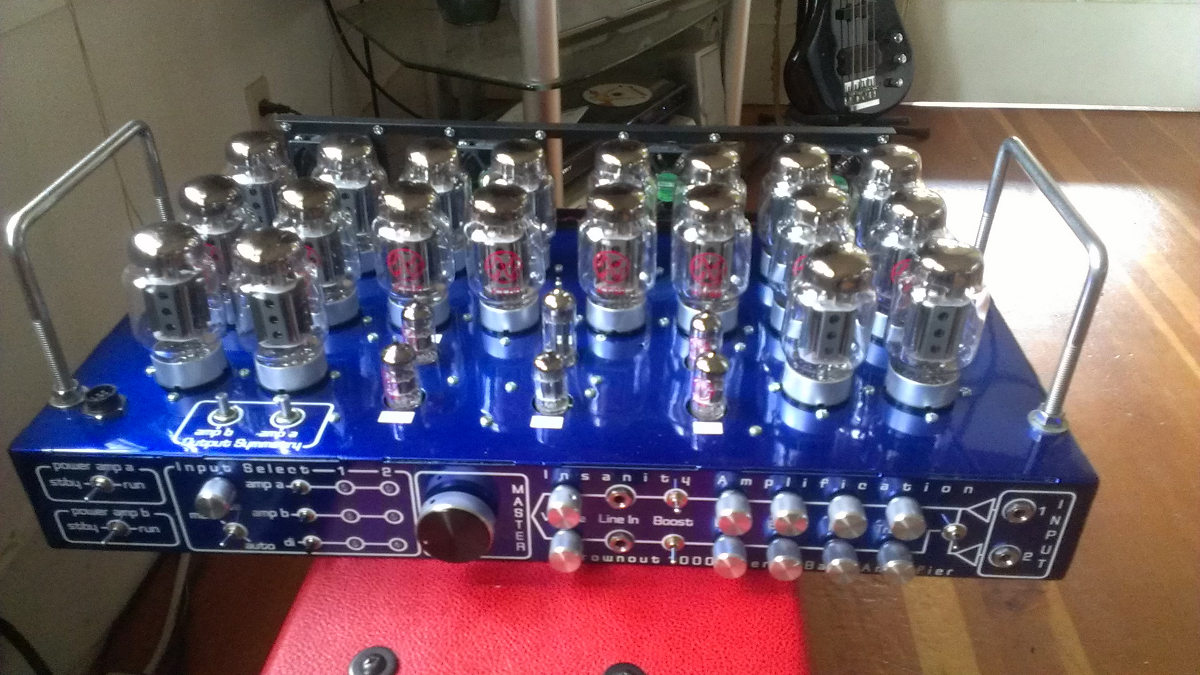
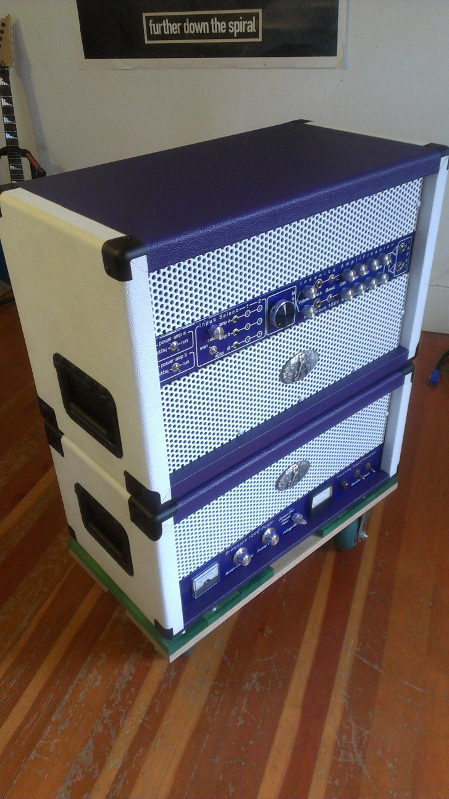
I believe this is 2x500W (@Passinwind provided these images on another webite) Maybe he can point you to a good thread on it.


InsanityAmp1.jpg


There are two more sections.
InsanityAmp3.jpg
 
I want an honest answer. If a watt is a watt and a Class D power section is no different from a tube, A/B power section, why do the Class D Bassman amps have 5 times the watts? Why not 100 and 300 just like the tube amps? Also, maybe @agedhorse can answer this one. Why are the Mesa tube, A/B amps only 250 watts while their Class D are 800 wats? Hmmm, thats about 5 times more watts on the Mesa Class D amps as well. Im sensing a trend here....

Frankly, I think it's time this story comes to a close. My sense is that you already have your answer, so why belabor the point out until infinity. I can play outdoors very comfortably with my Grace Designs Preamp, powered through a Jule Monigue M700 using any one of
a dozen different cabinets. No problem. I can also do that with a Walter Woods Electroacoustic Ultra High Power that puts out 800 watts RMS into a 8 ohm load. Easy peasy. Simply put it's much easier and more cost effective to build an amplifier for bass around Ice, Hypex, and Pascal
power amps than it is to build a V4B or especially a SVT. that used massive lead sleds and a large compliment of glass tubes which use toxic elements in their construction. With the current state of tubes being in high demand, until things are sorted out in the Soviet union I woundn't
recommend that anyone get a tube based amplifier until things settle down and that may be quite some time.
 
I see we have resorted to childish insults when one can't answer a simple question. You clearly believe there is no difference between a 100 watt A/B Bassman and a 100 watt Class D Rumble. Ok

You seem to be obsessed with how much you dislike the Fender Rumble 100. Cool. I'm with you there. Have you ever actually HEARD or played through any class D Aguilar, Bergantino, GK, Mesa, Quilter, Demeter, other higher end class D offerings? Sometimes you just get what you pay for, and class A/B vs. class D is maybe, just maybe - sort of irrelevant? Well - I gave it a shot anyway.:)
 
So its just purely coincidental that just about every Class D bass amp has 5 times the watts of its tube counterpart, and has nothing to do with the fact that it takes 5 times the watts to equal the same power of a tube, A/B amp? Ok...
A few pages back you had gotten kinda amenable after people explained how this works and why, but now you're back to grinding away on your initial weird assumptions.

Have to confess that now that the thread's been running an average of roughly 10 posts an hour for 50 hours straight I'm mostly here to see how long you can keep goading people to run in circles. But I suspect the mods are going to start minding at some point.
 
You seem to be obsessed with how much you dislike the Fender Rumble 100. Cool. I'm with you there. Have you ever actually HEARD or played through any class D Aguilar, Bergantino, GK, Mesa, Quilter, Demeter, other higher end class D offerings? Sometimes you just get what you pay for, and class A/B vs. class D is maybe, just maybe - sort of irrelevant? Well - I gave it a shot anyway.:)

Sure, I have played thru several of those Class D amps. My point was not that they dont sound good, my point was in regards to the power and why every Class D amp is roughly 5 times the power of their tube. A/B counterparts. Fender Bassman, Mesa amps etc..If there is no difference between an A/B or a Class D power section, why does every Class D amp have 5 times as many watts as its A/B counterpart?
 
Sure, I have played thru several of those Class D amps. My point was not that they dont sound good, my point was in regards to the power and why every Class D amp is roughly 5 times the power of their tube. A/B counterparts. Fender Bassman, Mesa amps etc..If there is no difference between an A/B or a Class D power section, why does every Class D amp have 5 times as many watts as its A/B counterpart?
But it's not a counterpart, each amp you mentioned is not a replacement amp or counterpart as you called them.

They are different amps all filled a need at different power points that's all. And class D offers more power, less weight and less cost then a tube amp.

So people can afford a higher watt amp now and don'r have to use 100 watt tube amps exclusively, especially if a tube sound is not their huckleberry.

Most people use tube amps because of the tone, not because they are louder then XYZ class amps.

I don't understand your point.

Go on and use your V4-B in good health but please stop fussin' with folks.

:)
 
Last edited:
But it's not a counterpart, each amp you mentioned is not a replacement amp or counterpart as you called them.

The Fender Bassman amps are literally called the same thing, they are exactly counterparts. The tube Bassmans are 100 and 300 watts. The Class D Bassmans are 500 and 800 watts. Exactly 5 times more watts in the Class D. Why?
 

Attachments

  • image.png
    image.png
    161 bytes · Views: 25
The Fender Bassman amps are literally called the same thing, they are exactly counterparts. The tube Bassmans are 100 and 300 watts. The Class D Bassmans are 500 and 800 watts. Exactly 5 times more watts in the Class D. Why?
Check your math. Even that is wrong. Since when is 800 five times as much as 300?
 
The Fender Bassman amps are literally called the same thing, they are exactly counterparts. The tube Bassmans are 100 and 300 watts. The Class D Bassmans are 500 and 800 watts. Exactly 5 times more watts in the Class D. Why?
So they are all called Bassman, which doesn't mean they are the same amp. Rumble for instances has more than that one 100 watt amp you keep referring to. They make a 40, 100, 500, and an 800 watt amp. Why? Because everybodies needs are not the same.

So, some people like more power, some people like less, some like tubes, some people like solid state, some like a mix of both.

It's not about just what one persons needs are.

Oh, and BTW, it's obvious you didn't read all of my reply. Because I answered this question you are asking in that very post, as to why.

:)
 
Last edited:
  • Like
Reactions: Texican
Status
Not open for further replies.