Now I see. Thanks guys. I’ll swap the saddles.Look at the placement of the adjustment screw and spring on each from your bass and compare them to the photo posted by @DanDBassist. The E and G on yours appear to have swapped places.

TalkBass has been independent since 1998. Add your voice.
Create a free account to reply to discussions, view embedded media, and browse with fewer display ads.
Join free Log in
Want zero display ads or expanded classifieds tools? Compare plans.
Now I see. Thanks guys. I’ll swap the saddles.Look at the placement of the adjustment screw and spring on each from your bass and compare them to the photo posted by @DanDBassist. The E and G on yours appear to have swapped places.



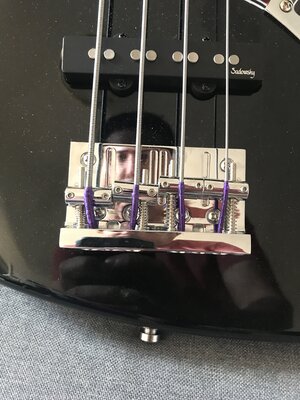
I don’t think I understand. I can’t get the saddles to sit horizontally. That’s the issue at hand. I tried loosening the strings a ton and manually moving the saddles but I couldn’t level all of them—couldn’t move the A string saddle at all—and now all four string ends are at an angle from the end of the bridge to the saddles. See pic.The 2 little screws that adjust the saddle height are a little 'funky'.
Look at the A string saddle: one side is is much higher than the other, in the opposite orientation that I would expect. So is teh E string, but a bit less.
OP: what happens if you level each saddle? (not with each other, simply having each saddle more horizontal like)
If they were to be swapped the grooves would be off the edge of the bridge plate. The photo I showed was of a completely different company and was only to show how the saddles should be in alignment with the string hole in the back of the bridge and not be pulling the strings to one or the other side.Look at the placement of the adjustment screw and spring on each from your bass and compare them to the photo posted by @DanDBassist. The E and G on yours appear to have swapped places.

Yep, you're right. The other Sadowsky photos seem to confirm that this is simply how Roger implemented the bridge saddles on these bass designs.If they were to be swapped the grooves would be off the edge of the bridge plate. The photo I showed was of a completely different company and was only to show how the saddles should be in alignment with the string hole in the back of the bridge and not be pulling the strings to one or the other side.
The saddles seem to be correct but I think the string holes are in the wrong place.I feel that the saddles are not correct for the bridge. Don't know exactly why they are on there, but they don't line up somehow. The strings shouldn't have that much lateral distance to be "in the groove".
I don’t think I understand. I can’t get the saddles to sit horizontally. That’s the issue at hand. I tried loosening the strings a ton and manually moving the saddles but I couldn’t level all of them—couldn’t move the A string saddle at all—and now all four string ends are at an angle from the end of the bridge to the saddles. See pic.
Your Sadowsky has the E and G saddles like mine, with the screws on the outside of each saddle. Yet your saddles are horizontal. I think you’re right, that swapping those two saddles might not solve the problem.
I sent an email to Warwick to see what they think. They handle all Sadowsky Metroexpress support tickets.


Do you mean one saddle screw is higher than the other both for the E and A? If the screws are set to the same height, the saddles won’t be level vertically.I meant parallel to the bass body surface. Each saddle has one big screw to move if forwards and backwards, and two little ones to adjust the height. On your E and A saddles, it looks like one side is much higher than the other.
That’s probably the root of the issue. Good catch. EDIT: I think the pic you posted is of a Metroline. Mine is a Metroexpress. Pics of these show a shorter gap between the bridge pickup and the bridge, like mine.Another thing to look at on fretless for lower action is the nut. I file my slots in the nut to a hair above the fretboard. This also gives a bit of mwaa to the open strings. If you shim the neck, it should be to tilt it back. That way you can raise the bridge back up and have full string height adjustment. As stated above, the neck should have little to no relief. It looks like part of the problem is that the bridge was installed too close to the pickup. That would explain why the saddles are pushed so far to the rear. Here is a picture of another Sadowsky with the saddles sitting much better and the bridge farther from the pickup.
Originally I used a business card. If I go thicker, I won’t be able to raise the action enough before some of the saddle screws become loose.I might suggest this: Use a thicker shim, narrow, placed just at the neck heel, a bit shorter than the width of the neck pocket, maybe 1/2" wide. This will tilt the neck back and consequently lower the action to a point where the bridge saddles will have to be raised so the strings don't lay on the fingerboard. In addition, it will make the distance from bridge to nut slightly longer so the saddles will need to be extended to properly intonate (insofar as that's doable on a fretless) and the saddles won't be so jammed up against the bridge backplate. Finally, that break angle provided by the shim will make 1st position playing a bit easier as well. I've done a lot of these. Works well for me. YMMV.
BBB
I have, on occasion, ordered longer screws (all sorts of lengths and sizes, metric and English, are available on eBay and Amazon) if the shim tilts back that far. I personally have not had issues with the saddles needing to be parallel to the body, and in fact usually angle the saddles to mimic the fingerboard radius. Bet of luck! Keep me posted!Originally I used a business card. If I go thicker, I won’t be able to raise the action enough before some of the saddle screws become loose.
The only way I could fix that problem is if I lowered those screws and raised the others, per saddle. But then the saddles will be crooked vertically.
What do you recommend?
I’ll try a thicker shim tomorrow and will level the screws first, to generate more headroom for raising the action. I’ll probably just use the same business card as before and the copy paper that’s in the neck pocket currently.I have, on occasion, ordered longer screws (all sorts of lengths and sizes, metric and English, are available on eBay and Amazon) if the shim tilts back that far. I personally have not had issues with the saddles needing to be parallel to the body, and in fact usually angle the saddles to mimic the fingerboard radius. Bet of luck! Keep me posted!
BBB
I'd be interested to know your results.I’ll try a thicker shim tomorrow and will level the screws first, to generate more headroom for raising the action. I’ll probably just use the same business card as before and the copy paper that’s in the neck pocket currently.
"I usually string my basses with 4/64” on the G, D and A and 5/64” on the E, all measured at the highest frets."I just got a fretless and after setting the neck relief to about 0.012 and adjust the string height, the action is still a bit high for my taste. I usually string my basses with 4/64” on the G, D and A and 5/64” on the E, all measured at the highest frets. So I put a business card shim in the neck pocket and am able to set the action lower but to get the action to my liking—and not too low—I had to lower the saddle screws about as much as they can go down. As a result, some of the saddles are a little lopsided now and I think there’s more pressure on the bridge. Pic attached. Is this an issue? If so I could try a shim made of a piece or two of copy paper instead of a business card.