Tried active on an American Fender P deluxe and my current Warwick Corvette $$ didnt like either. I much prefer the passive tone.

Enjoy the benefits of a premium membership!
Upgrade Account
-
TalkBass has been independent since 1998. Add your voice.
Create a free account to reply to discussions, view embedded media, and browse with fewer display ads.
Join free Log in
Want zero display ads or expanded classifieds tools? Compare plans.
You are using an out of date browser. It may not display this or other websites correctly.
You should upgrade or use an alternative browser.
You should upgrade or use an alternative browser.
Are on board active preamps really necessary ?
- Thread starter BassikBrad
- Start date
More options
Who Replied?

The closest choice in the poll - for me - is "No, it is more convenient" so I voted that way. My answer does not mean I think that it's always more convenient for every player every playing situation.
One reason is that I like being able to set my basic tone at my amp and then leave it there. Then I can use my bass to make any tweaks I need to on the few songs that need them. I mostly stick with a basic tone and only when a specific song needs a specific tone do I make an adjustment, such as getting a raspy, bright, or cutting tone or a deep full tone that you feel as much as hear. With active controls on my bass I can make those kinds of adjustments quickly and easily.
Another reason addresses why it's more convenient for me. I also do vocals so I'm in front of keyboards in two bands and in front of a guitar player who doesn't sing in another. In all three bands, there's also a drummer behind me. There's rarely, if ever, enough room for me to thread my way through a non-existent path between all that gear without knocking any of it over or damaging my bass just to get back to my amp. With my active basses, I can stay where I am and make necessary adjustments. Going back to the amp all the time might work for some, but it simply does not for me.
Not to get on my soapbox, but .... I'll step briefly on my soapbox anyway. I see a lot of posts here on TB from players proudly proclaiming that they use ONLY passive basses and making negative comments about active basses, alleging that everyone who plays them spends more time twiddling all those knobs than playing actual notes and that their tone always s*cks. Well, I don't spend all my time fiddling with knobs and I've never seen anyone else do that. However, even if that was true in some cases, so what? If a player is getting a tone that works well and is keeping a good groove going, then why should you care how often or how infrequently they touch a knob? And if a player isn't getting a good tone or keeping a good groove going, I'd bet it's far more often a function of the player than it is the bass. But, if you are one of those people who are bothered by the existence and use of more than a volume and tone knob, then might I suggest simply closing your eyes and just listening?
  OK, I'll step down now.
TL;DR - An active bass is just a tool, just like a passive bass is just a tool. Use what works best for you in your situation and anyone who looks down on you for your choice of tool, well, that person is also just a tool.
EDIT: In case the camps on either extreme make any assumptions, my five basses are actually split 50-50. My Stingray and a FrankenJazz are active-only and my Precision and Ibanez AGB-205 are passive-only. My L-2500 is active-passive. I like and use all of them.
One reason is that I like being able to set my basic tone at my amp and then leave it there. Then I can use my bass to make any tweaks I need to on the few songs that need them. I mostly stick with a basic tone and only when a specific song needs a specific tone do I make an adjustment, such as getting a raspy, bright, or cutting tone or a deep full tone that you feel as much as hear. With active controls on my bass I can make those kinds of adjustments quickly and easily.
Another reason addresses why it's more convenient for me. I also do vocals so I'm in front of keyboards in two bands and in front of a guitar player who doesn't sing in another. In all three bands, there's also a drummer behind me. There's rarely, if ever, enough room for me to thread my way through a non-existent path between all that gear without knocking any of it over or damaging my bass just to get back to my amp. With my active basses, I can stay where I am and make necessary adjustments. Going back to the amp all the time might work for some, but it simply does not for me.
Not to get on my soapbox, but .... I'll step briefly on my soapbox anyway.
I see a lot of posts here on TB from players proudly proclaiming that they use ONLY passive basses and making negative comments about active basses, alleging that everyone who plays them spends more time twiddling all those knobs than playing actual notes and that their tone always s*cks. Well, I don't spend all my time fiddling with knobs and I've never seen anyone else do that. However, even if that was true in some cases, so what? If a player is getting a tone that works well and is keeping a good groove going, then why should you care how often or how infrequently they touch a knob? And if a player isn't getting a good tone or keeping a good groove going, I'd bet it's far more often a function of the player than it is the bass. But, if you are one of those people who are bothered by the existence and use of more than a volume and tone knob, then might I suggest simply closing your eyes and just listening? OK, I'll step down now. TL;DR - An active bass is just a tool, just like a passive bass is just a tool. Use what works best for you in your situation and anyone who looks down on you for your choice of tool, well, that person is also just a tool.
EDIT: In case the camps on either extreme make any assumptions, my five basses are actually split 50-50. My Stingray and a FrankenJazz are active-only and my Precision and Ibanez AGB-205 are passive-only. My L-2500 is active-passive. I like and use all of them.
Last edited:

Other have said this as well, but I'll add my $0.02. I have EMG X active pickups in the basses I play most often. I love the range of active tone adjustment I can make with those, in the middle of a tune, without much effort. I could get by without that, but I like having it. Especially in the few tunes where I am using effects pedals, or where (even more rarely) I'll play a solo.
On the other hand, having an onboard preamp always adds the tiniest bit of worry for me at gigs about the battery, or leaving the bass plugged in overnight (or longer) after practice.
On the other hand, having an onboard preamp always adds the tiniest bit of worry for me at gigs about the battery, or leaving the bass plugged in overnight (or longer) after practice.



Yes, always.
You might want to talk to Mr. Wishnevski about that. Say what you want about the construction of his basses, most of them sound pretty awesome, including the piezo only basses with NO battery.
I stand corrected, then.
I'm sure Mr. Wishnevski has better things to do than talk to a non-customer about his "battery less" piezo system.
I'm sure Mr. Wishnevski has better things to do than talk to a non-customer about his "battery less" piezo system.
I like active pre-amps on the bass. My first electric bass in 1987, I put Bartolinis and Bill recommended a pre-amp. When I added a passive mode it sounded too quite. I do like passive basses specially if you use an all tube amp. I cannot imagine a MusicMan/Ernie Ball with passive pickups
As someone else said, the manufacturers make basses to sound a certain way, I either like it or I don't and it has absolutely nothing to do with being passive or active. If Musicman basses were made passive, I doubt that they would even still be being made.
I don't understand topics like this at all, go ahead have an opinion...sometimes you just need to keep it to yourself though, unless you are a troll. And the poll, absolutely ridiculous!

My pre-amp is on the pedal board:
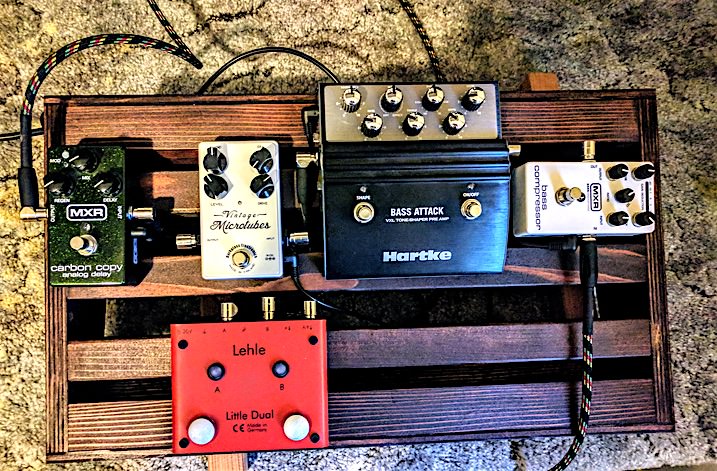
No batteries to mess with (runs off Strymon power supply) and plenty of knobs to tweak stuff.
No batteries to mess with (runs off Strymon power supply) and plenty of knobs to tweak stuff.

My Dingwall has dissimilar pickups with different output levels - so I run them through an adjustable-gain buffer (Bartolini AGDB) to balance the output.
The rest of the bass' electronics is passive (cut only) - pan, pickup selector, master volume, and tone knob
The rest of the bass' electronics is passive (cut only) - pan, pickup selector, master volume, and tone knob
It depends on the preamp. A lot of early active preamps were pretty junky, especially if you weren't looking at high end stuff, though a few mid range companies (MusicMan, G&L come to mind) did them right. Even now, there are quite a few varieties of preamps out there. My Main J bass has an audere in it, and, when set flat, it sounds like a passive J. I like it because I can tweak tone on the fly, and because I like blend controls instead of individual volumes, and that doesn't work well passively. I'm also playing my stingray a lot lately. Complete 180. A lot of the stingray sound seems to come from the pre amp, and it's a glorious sound. On the other hand, I play a couple passive P types, and they sound good too.

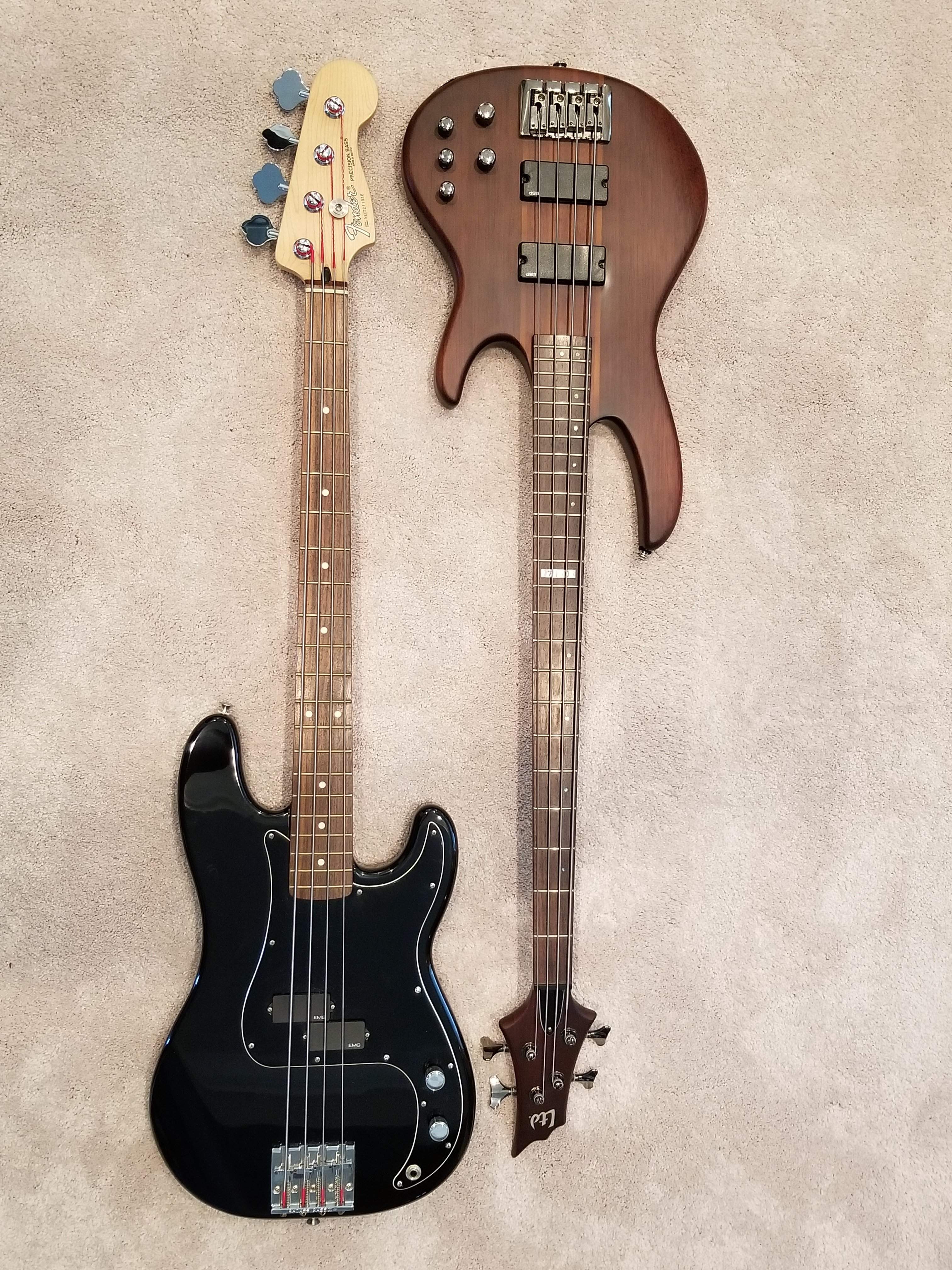
I swing both ways, I love my passive Fender P. Its my main player. But p basses are generally not clean without a pedal or the amp set way off center. I can play my LTD D4 and the amp controls are generally centered. It has a nice big bass sound with a little snap on top. If i need a little different tone, its a just a quick change on the guitar. My p has emg's, good strings.

Never tried the Sadowsky nor do I have experience with a lot of bass specific EQ and pre-amp pedals , but the ones I tried, to me they all sounded noisier than battery driven builtin pre-amps. Also if you are have a home DAW or home project studio and when I mean home, a regular home, not a mansion size estate, a builtin preamp really helps when tracking the bass direct specially if you have hobby grade interface. With passive bass, you need to mess around with an external preamp or some EQ in the DAW and when that track is used by a real studio many times it is not useable. YMMV but IME, I lost time and ideas doing that.
Before the modern age, I only used Bartolini preamps and they have served me well. The Pope pre-amp on the Tune bass I have is really good with a very wide range, maybe too wide that it is hard to make small increments sometimes. I love Bartolinis to this day, however dated they may be. I also like the East drop in for the J-Bass but may still go back to Bart's. Never tried Aguilar, Audere or Delanos. I like what Carvin did with the J5. In passive mode one of the tone controls is also a passive tone control. Anybody else does this?
Before the modern age, I only used Bartolini preamps and they have served me well. The Pope pre-amp on the Tune bass I have is really good with a very wide range, maybe too wide that it is hard to make small increments sometimes. I love Bartolinis to this day, however dated they may be. I also like the East drop in for the J-Bass but may still go back to Bart's. Never tried Aguilar, Audere or Delanos. I like what Carvin did with the J5. In passive mode one of the tone controls is also a passive tone control. Anybody else does this?

Piezo equipped basses usually have a preamp or at minimum a buffer. It is not essential, however. Dave Wendler (electrocoustic) makes fantastic sounding basses that contain a piezo and magnetic pickup and are completely passive and have output levels similar to any regular passive bass.
It's not the level, it's the impedance matching. In fact, many piezos have more output than magnetic pickups. Most people never think about their amp's input impedance because usually the only way you can change it is by switching between active and passive input jacks on amps that have them, but that also affects the signal level. Piezos like to see very high impedance loads, usually 1Mohm or more and some players will tell you that they can hear the tonal difference between 1, 5 and 10Mohms on amps that do have switchable impedance. A lot of bass and guitar amps have input impedances well below 1Mohm.
Anything you put between the instrument and the amp can also affect the impedance load on the pickups, pedal users hear this all the time even if they don't understand why the tone changes when they have a pedal connected but bypassed. Go to the pedal forum to read all about "true bypass", active buffers on pedal inputs and tone suck from using pedals with neither.
The typical effect on a piezo of mismatched impedance is a "scratchy" or "nasal" sound, with a resonant peak somewhere in the midrange, often accompanied by a loss of low end. The primary purpose of the preamp is to provide the proper impedance loading for the pickup to obtain a flatter frequency response. Any EQ circuitry added is just a convenience.
I can’t handle active. I fiddle with the controls endlessly.
My BC Rich Eagle had a zillion controls but only two that were due to the active circuit: an on/off switch and a gain control. I once calculated that without touching a knob there were well over 100 possible combinations of the switches. This pic is of a Rich guitar but the basses had the same controls...and this one doesn't even have the preamp (one more knob, one more switch).
Last edited:

wmhill
Inactive
- Aug 20, 2012
- 4,054
- 17,209
- Disclosures
- MTD basses endorsed artist Bartolini pickups emerging artist TECAMP bass players gear endorsed

Passinwind
I know nothing.
- Dec 3, 2003
- 23,065
- 45,983
- Disclosures
- Designer/Toaster Tech @ Passinwind Electronics
I like what Carvin did with the J5. In passive mode one of the tone controls is also a passive tone control. Anybody else does this?
Yep, Noll and I think several others do that these days. Personally, I kind of like having a passive tone control in play even in active mode. IIRC the Sadowsky VTC works like that, for one.
My worthless opinion is that preamps were designed with old school amps that didn't have much to offer. Volume, Tone and maybe a Mid. Fine. But you also had the early preamp problems too, like what knob does what. hiss. dead battery(S) at the most in opportune time, a visit from "Mr. Scratchy-pots"
My MM Saber has an LED light that tells you your preamp is hot when it's plugged in,, and reminds you to unplug it so the preamp isnt sucking needlesssly on the battery while Im on break. That's cool!
I've found out though with modern rigs, you have so much more control over the tonal settings than ever before. My now antiquated SWR 400 has lots of slides to adjust to what you want. Far superior than to my old Kustom 150.
Take my active Ibanez. When I play through my digital Ashdown head, theres something squirrely with the tone that I don't have with my non active basses. Havent figured that out....yet
See, I told you my opinion was worthless. LOL!
Ill shut up for now and go back to reading bad builder threads...
My MM Saber has an LED light that tells you your preamp is hot when it's plugged in,, and reminds you to unplug it so the preamp isnt sucking needlesssly on the battery while Im on break. That's cool!
I've found out though with modern rigs, you have so much more control over the tonal settings than ever before. My now antiquated SWR 400 has lots of slides to adjust to what you want. Far superior than to my old Kustom 150.
Take my active Ibanez. When I play through my digital Ashdown head, theres something squirrely with the tone that I don't have with my non active basses. Havent figured that out....yet
See, I told you my opinion was worthless. LOL!
Ill shut up for now and go back to reading bad builder threads...


