• TalkBass has been independent since 1998. Add your voice.
    Create a free account to reply to discussions, view embedded media, and browse with fewer display ads.
    Join freeLog in
    Want zero display ads or expanded classifieds tools? Compare plans.

Are Signature Basses Special?

Special, both, player, roasted carrots?

  • The original bass was special!

    Votes: 17 8.1%
  • It was the player, and therefore all hype.

    Votes: 81 38.6%
  • It was both!

    Votes: 60 28.6%
  • Roasted carrots.

    Votes: 52 24.8%

  • Total voters
    210
I'm still wondering why there seems to be so many on TB who are so rigidly averse to the whole "signature model" gestalt, that they feel the need to repeatedly express it in public. Are they being triggered by the very idea of having "someone else's" name on an instrument, as if that automatically creates an affront to them? Is it an ego thing? Or a lack of self esteem? There must be something at work there. Seems psychologically unhealthy.

"Calling Doctor Freud....calling Doctor Sigmund Freud."
 
I have a Victor Bailey signature 4 string Jazz Bass. It’s beautifully constructed with a mahogany/rosewood/Koa body and a rosewood fingerboard. Nicely voiced pre amp.
Fender did an amazing job on this bass.
The Pino Palladio bass is legendary here on Talkbass..
I think it’s overpriced but that’s just me.
The signature models are definitely with a look though.
 
Like all series produced basses the signature basses are developed by the house luthiers whether or not in consultation with the sig-artist of the production company.
Does this make the product more special because a stamp has been imprinted by a well-known name, or because it is produced in a lower edition?

IMHO... a special instrument can come out of it, but not a unique one.
 
  • Like
Reactions: Doctor Intrepid
I have a USA Geddy and I didn’t buy it because it was a signature bass (although I am a Geddy fan). I wanted a ‘70s Jazz bass and my research drew me to the conclusion that the USA Geddy was the best option out there for the money. I am not disappointed, the tone, the build quality and the model-specific neck are outstanding.
If I was in the market for a passive ‘60s Jazz, I’d more than likely end up with an Adam Clayton signature. Not because of the the name on the headstock (the whole signature thing actually turns me off, TBH) but because I love a Sherwood Green bass, especially with a matching headstock, a blocked and bound rosewood board, and if the build quality is anything like my Geddy, I again feel that it would be great value for the money.
In all honesty, I have no idea what makes this bass an Adam Clayton Signature bass other than the color. But it looks like a really well put together ‘60s Jazz Bass.
So do I think there are special features on signature basses that make them desirable? Yes. Is it the signature on the headstock? In my case, no.
 
Last edited:
Not to me. If it's a bass that I was in love with I would buy it as long as the fake autograph logo wasn't too obvious. Some of the Fenders, for example, come with 1st day upgrades so there's a value proposition to the buyer. Example, if you buy a Clayton you don't have to order a replacement bridge because it comes with one. But the Pino? Come at me if you want. But paying $3,500 extra for a set of TI strings? C'mon. Pino is cool but that's a lot of surcharge to be a fanboy.
 
A follow up to my question last week.

Every signature bass started as a off the rack bass. Some standard bass that a no one bought and played the crap out of. So was it the bass or the player? What makes the bass special?
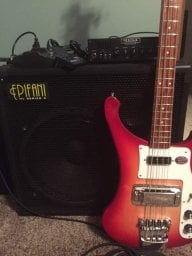
I know the signature Geddy is popular, as is some others. Are they special basses found by the right person or is it nostalgia or some type of hype?

Let me know!
Your premise is flawed.
^
^
^

Definitely.
Not EVERY signature bass started off the rack.
Jeff Berlin and Brian Bromberg signature models come to mind.
 
I used to be one of those anti signature model people that many in the community would eyeroll at. Nowadays, if a bass has features I'd be into and isn't an overpriced rebadge of something else, I don't care who's name is on it.

The Carvin SB5000 (Sekou Bunch sig model) is one of the more lauded instruments on TalkBass. I know next to nothing about Sekou's body of work, but I know that bass is lovely to play and is probably one of the best 5-strings I've handled.

People also really like the Carvin Bunny Brunel basses. I know nothing of Bunny's body of work, but I'd try one of his sig basses simply to see how its design with the super long upper horn would balance on me standing.

I've seen many in the TalkBass community laud the Yamaha Attitude bass, which is the Billy Sheehan sig. I am familiar with Billy Sheehan's body of work, but I wouldn't play an Attitude bass because they only have 21 frets (I like 24 fret basses) and are reputed to have chunky necks and I like thin, fast necks on my basses because I have smaller hands.

My main axe is a heavily modded sig model; specifically an LTD HTB-600 Children of Bodom bass. I bought it preowned for a rock bottom price. I wasn't interested in it because it was a sig model. I bought it because I needed a backup for my then-main, this bass was the equivalent of a Fender at a Squier price (way under my budget), and I had enough left over to have a luthier give it a sick paintjob and mod the electronics to my taste.
 
A follow up to my question last week.

Every signature bass started as a off the rack bass. Some standard bass that a no one bought and played the crap out of. So was it the bass or the player? What makes the bass special?

I know the signature Geddy is popular, as is some others. Are they special basses found by the right person or is it nostalgia or some type of hype?

Let me know!

Signature basses are marketing. Thats it.
 
  • Like
Reactions: Doctor Intrepid
The only signature bass I bought because of the artist endorsement was a Lakland Skyline Duck Dunn, but I also loved the looks, tone and playability. I ended up gigging it exclusively for 10 years and took a USA Precision Bass as a backup.
I also have owned MIJ Sting and Geddy basses but didn't get them for the artist and didn't end up bonding with either one.
 
Just like with instruments in general, there are no rules that say “signature instruments must....”

Some are the same as anything else on the shelf with a different color and/or pickguard. Some have a completely unique controls setup or different wood selections. Some are a unique combination of readily available options and can be further customized (my Alembic Mark King) and some are configurations that only exist for the signature model and come as is, no modifications or options available (Music Man Joe Dart) View attachment 3998410
That knob
 
A lot of pros mod their gear to some extent. Some don't. A signature bass is either a copy of what they did to their instrument, or it's a copy of what the artist requested from a custom shop. Most of the time, as they're making a bunch of them (it may not be thousands but it's more than 1), they'll be made on a production line of some sort. So, they're not truly being made just like the original, but they may be just as good - that all depends on the particulars of things.

They cost more because....they think you'll pay it. Just like a custom shop instrument, it isn't necessarily better than the normal thing that they make lots of, it's just....different, and given the lower numbers (1 if it's truly custom), they have some additional expenses that they incur compared to the stuff that they make hundreds or thousands of. They decide to do the project based on the belief (internally) that there are enough folks out there that will want one that they can make a profit off the project - just like any other model.

Then there are my basses. I make my own (they are all 1 of a kind), and I sign the headstock with my initials. By definition,...they're all signature basses.
 
  • Like
Reactions: Doctor Intrepid
A follow up to my question last week.

Every signature bass started as a off the rack bass. Some standard bass that a no one bought and played the crap out of. So was it the bass or the player? What makes the bass special?

I know the signature Geddy is popular, as is some others. Are they special basses found by the right person or is it nostalgia or some type of hype?

Let me know!
Lot of the time people just buy signatures because they come with a unique feature. For example I own a Dingwall NG2 Nolly Getgood signature. I am a fan of his work but I am a very different style player. I mainly play with fingers, he mainly plays with a pick. Really wasn’t about him. I’ve had a bunch of basses over the years and I tend to gravitate towards basses that don’t have neck pickups that get in my way. Musicman single H sting rays, Warwick thumbs. For me it was really more about the pickup configuration and the finish options. I even changed the factory pickgaurd on mine to be more my style.

here’s the before and after
13EF71BA-8158-4455-A48A-74B4B97F5CC1.jpeg
7172B005-9CA6-4C46-A1FF-3CC45A4F7469.jpeg
58D6AF3A-DFDA-47E5-B937-6A94396A2EE1.jpeg
 
Last edited:
Signature bass..... A bass either designed by or recreation of a bass that a famous person considered perfect...... for them.
Would I consider it " perfect"?.....maybe, maybe not.
My " forever" bass began life as a stock Precision bass. And I loved it from day one. But over time I made modifications to it. Sonic changes(pickups) playability changes( neck and fret work, removing ashtrays and thumb rest)
Aesthetic changes ( pick guard swap). All things that eventually made it perfect for me.
Would it be perfect for you?...maybe, maybe not...probably not.
But what if I was famous.?.
From a playability angle, I honestly don't lust after most of the signature models . But from a collectabilty angle...
I'd love to have a Dennis Dunnaway or Gary Thaine signature bass.
Why?.. Cause I admire those players so much. I might find out I don't even like what they like. But if I had stupid money ( I don't) and they existed( they don't)
I'd buy em....
 
Last edited:
Every signature bass started as a off the rack bass.
Nice rack. Yeah... As some astute respondents here already pointed out, so-called signature instrument models are always just marketing ploys. Slap some new paint and different pickups on a stock instrument and hey, presto! it's a signature.


[Invalid or Expired Link Removed]

"The Anthony Jackson Presentation Contrabass Guitar is the result of Anthony’s original 1987 idea for a new instrument tailored precisely to his needs. Anthony decided to discard any and all features for a pure playing experience which included, among other things, passive electronics, a single pickup voiced by ear alone, and ergonomics suited to Anthony’s playing style and needs. The extended single cutaway was Vinny’s solution to Anthony’s request for additional neck stiffness without the incorporation of graphite or other stiffening materials that might compromise tone."

IMG-0295-Edit-Edit-59398fc60dc5a-1125x1500.jpg

IMG-0359-Edit-Edit-59398febd0b3b-1125x1500.jpg


[Invalid or Expired Link Removed]

"The Anthony Jackson Presentation II is our first complete, all-encompassing re-working of the original Presentation since its inception (as Number 7) in 1987-88. In our ongoing work with Anthony, Number 7 followed Numbers 5 and 6 (“Anthony Jackson Contrabass”, 1984-1987). The Presentation II encompasses the many changes made based on Anthony’s 17-year life with Number 10 (1996), including modifications to virtually every aspect of the instrument. This includes changes to the pickups, bridge, nut, wiring, frets, tuning machines, spacing and set-up, as well as the adoption of the “Hybrid” design."

IMG-3536-2-Edit-5942f0023e1dd-1125x1500.jpg

IMG-3593-2-Edit-5942f0156b0b2-1125x1500.jpg
 
710016A1-A682-498D-BC8D-3F3E3234A71A.jpeg
I have a Shecter JD Deservio signature.

Being I’m friends with John, we had a discussion about his bass.

He took a standard body, standard neck and tweaked them.

He told me he went through a bunch of neck designs before settling on the one he chose for his model.

Electronics are tweaked to his specifications.

Then he painted it to reflect his band, no fret markers and his initials at the 12th fret.

Inside joke on the truss rod cover.

It does sound and play amazing.

When he plays out in BLS, he plays just stock production instruments; no fancy custom shop models.

The fit and finish is really top notch for an overseas instrument.

All in all a great bass.