there is no "right or wrong" when it comes to electric bass technique. however i cant imagine a competent player who's not comftorble using the pinky on the fretting hand all the time.

TalkBass has been independent since 1998. Add your voice.
Create a free account to reply to discussions, view embedded media, and browse with fewer display ads.
Join free Log in
Want zero display ads or expanded classifieds tools? Compare plans.
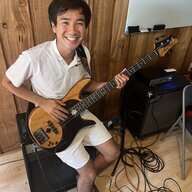
This is the waymy pinky is my strongest finger, keep workin' it.


To use your pinky (fretting hand) efficiently, it helps a lot to use other fingers to support it in pressing down the string when you fret with the pinky.




The pinky and the index finger are actually the most important fingers for the left hand. A lot of traditional bass patterns, like the ones containing octaves and fifths for example, rely on index/pinky fingerings. It also puts less tension on your hand than 1-3, especially down low. So I would suggest using your pinky right from the start.
Can you elaborate on that?
Are you talking about major chords where you use your middle finger for the root and play fifth and octave with the pinky or are you doing that with your index finger fretting the root, too?
Why are octaves 1-4? Are they not supposed to be 1-3?
That's how you see guitarists play octaves but in my experience, with the greater distances between frets, bass players mostly use 1 and 4.
1 and 4 lets you cover the distance without stretching.
In the low part of the fingerboard, many players do not use 1-2-3-4 fingerings, but the Simandl fingering borrowed from double bass, in which the hand remains relaxed, spanning 2 half steps, played with 1-2-4 (finger 3 supports the pinky). This obviously implies more frequent shifting, but shifting is not something a string player should be afraid of... When you use 1-2-4 technique, you use the pinky all the time.Why are octaves 1-4? Are they not supposed to be 1-3?
Why are octaves 1-4? Are they not supposed to be 1-3?