
Enjoy the benefits of a premium membership!
Upgrade Account
-
TalkBass has been independent since 1998. Add your voice.
Create a free account to reply to discussions, view embedded media, and browse with fewer display ads.
Join free Log in
Want zero display ads or expanded classifieds tools? Compare plans.
You are using an out of date browser. It may not display this or other websites correctly.
You should upgrade or use an alternative browser.
You should upgrade or use an alternative browser.
Aria Cliff Burton reissue
- Thread starter Michedelic
- Start date
More options
Who Replied?

It’s an Aria reissue but the picture is Cliff with an Alembic. Strange choice picture.
Was his Aria an SB1000?
My understanding is that he received an SB-1000, gigged a little with it and didn't like it. Unfortunately he was video'ed and photographed playing it so it became attached as lore. The truth as I understand it is that he preferred the passive SB Black n' Gold I/IIs, which were cosmetically and functionally identical to the Aria Pro II SB-R60/80 and Elite I/IIs. He also recorded with the BnGs and the Alembic, so the SB-1000 never made it to tape beyond video.
The SB-1000 is very different in that the pickup is a big hot ceramic MB-1E humbucker whereas the BnG/Elite/R models were MB-II pickups, which were a P-bass sensing pattern of steel poles with AlNiCo magnets. The SB-1000 is an active balanced 18v circuit with a passive backup mode and narrow spacing with a brass bridge and nut. The others were all passive with zinc bridges and plastic nuts, although the BnGs might have been brass.
The Black and Gold models changed throughout production also. Initially they were all Maple/Walnut 5-piece laminate through-necks with body stringers under the solid paint. I believe this changed to simpler 3-piece Maple laminates later.
It's not a very good signature model in either the model choice or the price. Realistically, a Black n' Gold I would be a true signature model, but the price should be more around the €1500, perhaps €2000 if MIJ without corners being cut.
Aria Pro II is now legacy IP rather than being anything near what it was in the Matsumoku era. The electronics are piss poor, made down to a price and not up to a spec as one might hope.
Last edited:



One minor correction, afaik all SB models had a brass nut, but at least my 83 Elite I, 86 Elite II, and 80 SB900 all did. My 84 RSB was plastic though.My understanding is that he received an SB-1000, gigged a little with it and didn't like it. Unfortunately he was video'ed and photographed playing it so it became attached as lore. The truth as I understand it is that he preferred the passive SB Black n' Gold I/IIs, which were cosmetically and functionally identical to the Aria Pro II SB-R60/80 and Elite I/IIs. He also recorded with the BnGs and the Alembic, so the SB-1000 never made it to tape beyond video.
The SB-1000 is very different in that the pickup is a big hot ceramic MB-1E humbucker whereas the BnG/Elite/R models were MB-II pickups, which were a P-bass sensing pattern of steel poles with AlNiCo magnets. The SB-1000 is an active balanced 18v circuit with a passive backup mode and narrow spacing with a brass bridge and nut. The others were all passive with zinc bridges and plastic nuts, although the BnGs might have been brass.
The Black and Gold models changed throughout production also. Initially they were all Maple/Walnut 5-piece laminate through-necks with body stringers under the solid paint. I believe this changed to simpler 3-piece Maple laminates later.
It's not a very good signature model in either the model choice or the price. Realistically, a Black n' Gold I would be a true signature model, but the price should be more around the €1500, perhaps €2000 if MIJ without corners being cut.
Aria Pro II is now legacy IP rather than being anything near what it was in the Matsumoku era. The electronics are piss poor, made down to a price and not up to a spec as one might hope.
The signature model they made back in 2013 looked to be pretty spot on to a BnG I, but was very limited and crazy expensive!
One minor correction, afaik all SB models had a brass nut, but at least my 83 Elite I, 86 Elite II, and 80 SB900 all did. My 84 RSB was plastic though.
The signature model they made back in 2013 looked to be pretty spot on to a BnG I, but was very limited and crazy expensive!
Appreciated. I deal almost exclusively with the SB-1000 electronics and restorations, so the details of some of the passive models can be a little less known to me in that regard. I think that if they absolutely HAD to put out a Cliff Burton tribute model rather than "signature", then an SB-1000 with an MB-II pickup and wide string spacing would be an acceptable compromise. Absolutely the BnG I was too expensive, but if the quality of workmanship and materials was there then perhaps yes at €2000 for a faithful no-holds-barred sig.
I saw someone commented on the brass nut. The only other thing is that, according to the Aria bass blog, there's a photo of Cliff in the studio, also seen on same blog, holding the SB-1000. It's very hard to see if it has the BB Circuit, but it had the same bridge and dot inlays like his SB-1000. So, going by that, he actually did use it on the Master of Puppets album.My understanding is that he received an SB-1000, gigged a little with it and didn't like it. Unfortunately he was video'ed and photographed playing it so it became attached as lore. The truth as I understand it is that he preferred the passive SB Black n' Gold I/IIs, which were cosmetically and functionally identical to the Aria Pro II SB-R60/80 and Elite I/IIs. He also recorded with the BnGs and the Alembic, so the SB-1000 never made it to tape beyond video.
The SB-1000 is very different in that the pickup is a big hot ceramic MB-1E humbucker whereas the BnG/Elite/R models were MB-II pickups, which were a P-bass sensing pattern of steel poles with AlNiCo magnets. The SB-1000 is an active balanced 18v circuit with a passive backup mode and narrow spacing with a brass bridge and nut. The others were all passive with zinc bridges and plastic nuts, although the BnGs might have been brass.
The Black and Gold models changed throughout production also. Initially they were all Maple/Walnut 5-piece laminate through-necks with body stringers under the solid paint. I believe this changed to simpler 3-piece Maple laminates later.
It's not a very good signature model in either the model choice or the price. Realistically, a Black n' Gold I would be a true signature model, but the price should be more around the €1500, perhaps €2000 if MIJ without corners being cut.
Aria Pro II is now legacy IP rather than being anything near what it was in the Matsumoku era. The electronics are piss poor, made down to a price and not up to a spec as one might hope.
Other than that, you were absolutely spot on!
I have to tell you, I love reading your comments. You really know your Aria basses! I appreciate you for sharing your knowledge on these amazing basses.
Actually, I've been wanting to DM you and tell you how I just got the deal of a lifetime on a 1981 Aria Pro II SB-R60. I had found out after I bought my SB-R60 that it's the same bass as my hero Cliff's favorite BnG I model, just a different color. It's a beautifully aged oak finish. But, I was thinking about refinishing it eventually (when I start my courses on bass/guitar building) and getting the gold tuners and getting a black Aria bridge (if I can even find one) and adding gold saddles.
Aside from the half-dead MB-II pickup which works perfectly in series mode, it is absolutely amazing. Right up there with my 1990 Rickenbacker 4003 as my 2 favorite basses I own. Never thought I'd own a bass that compares with my Rick. I do love my Fender Artist Series Jaco bass, but no other bass competes with these 2. I also purchased the SB-CLB and I'm waiting on that to arrive. I'm sure I will love it regardless of it not being as good as the original SB-1000 MiJ model, but that's okay. I missed out on the 2013 Cliff tribute (signature?) bass, so I wasn't going to miss out this time. But, I do agree with everything you said about how they should make a proper tribute to Cliff. I thought the same thing.
I'll post some pics of my SB-R60 in the Aria club very soon for all the other Aria lovers to see. Right now I'm just waiting on the PJ Marx humbucker I found (the only reasonably-priced one!) and, like Cliff had done to his Aria, I'm going to install it in my R60. Hopefully it sounds great, or at least good enough, because I'm jamming with my drummer friend in 2 weeks! Lol
I do want you and everyone to see the weird chrome jack-plate (or whatever you call it) that my bass came with. I never saw it on any other Aria bass.
Pickup-wise, I guess my only other choice, especially nowadays, is to get a Kent Armstrong replacement pickup. From what I've read, especially from your post, the KA model that I would go with in order to match the MB-II is the model that says "P-style" (or something to that effect - I can't remember the part number).
BTW, I wish there was a list of the differences between the MB pickups. I still don't understand what the difference is between an MB-I and MB-II as far as sound, output/ohms, tone, etc. Or any MB pickups for that matter.
Anyway, I just wanted to comment/reply to you and thank you. Your posts really helped me out.

Cheers!
O.
I saw someone commented on the brass nut. The only other thing is that, according to the Aria bass blog, there's a photo of Cliff in the studio, also seen on same blog, holding the SB-1000. It's very hard to see if it has the BB Circuit, but it had the same bridge and dot inlays like his SB-1000. So, going by that, he actually did use it on the Master of Puppets album.
Other than that, you were absolutely spot on!
I have to tell you, I love reading your comments. You really know your Aria basses! I appreciate you for sharing your knowledge on these amazing basses.
Actually, I've been wanting to DM you and tell you how I just got the deal of a lifetime on a 1981 Aria Pro II SB-R60. I had found out after I bought my SB-R60 that it's the same bass as my hero Cliff's favorite BnG I model, just a different color. It's a beautifully aged oak finish. But, I was thinking about refinishing it eventually (when I start my courses on bass/guitar building) and getting the gold tuners and getting a black Aria bridge (if I can even find one) and adding gold saddles.
Aside from the half-dead MB-II pickup which works perfectly in series mode, it is absolutely amazing. Right up there with my 1990 Rickenbacker 4003 as my 2 favorite basses I own. Never thought I'd own a bass that compares with my Rick. I do love my Fender Artist Series Jaco bass, but no other bass competes with these 2. I also purchased the SB-CLB and I'm waiting on that to arrive. I'm sure I will love it regardless of it not being as good as the original SB-1000 MiJ model, but that's okay. I missed out on the 2013 Cliff tribute (signature?) bass, so I wasn't going to miss out this time. But, I do agree with everything you said about how they should make a proper tribute to Cliff. I thought the same thing.
I'll post some pics of my SB-R60 in the Aria club very soon for all the other Aria lovers to see. Right now I'm just waiting on the PJ Marx humbucker I found (the only reasonably-priced one!) and, like Cliff had done to his Aria, I'm going to install it in my R60. Hopefully it sounds great, or at least good enough, because I'm jamming with my drummer friend in 2 weeks! Lol
I do want you and everyone to see the weird chrome jack-plate (or whatever you call it) that my bass came with. I never saw it on any other Aria bass.
Pickup-wise, I guess my only other choice, especially nowadays, is to get a Kent Armstrong replacement pickup. From what I've read, especially from your post, the KA model that I would go with in order to match the MB-II is the model that says "P-style" (or something to that effect - I can't remember the part number).
BTW, I wish there was a list of the differences between the MB pickups. I still don't understand what the difference is between an MB-I and MB-II as far as sound, output/ohms, tone, etc. Or any MB pickups for that matter.
Anyway, I just wanted to comment/reply to you and thank you. Your posts really helped me out.
Cheers!
O.
Thanks, that's incredibly gratifying to hear. I appreciate it.
I will say however, that there are better historians than myself on both Aria Pro II and Cliff's basses. I was previously unaware of the black SB-1000 being photographed in the studio, however I'm fairly certain that this simply fed into interpretative lore rather than improved facts around it. The SB-1000's specs differs from Cliff's other basses in a number of ways, any of which might contribute to why he didn't like it, or at least favoured the Black n' Golds.
The pickup type is one, as even in passive mode the ceramic humbucker is very different in tone and somewhat more compressed to that which Cliff seems to favour. Another is the output impedance of the SB-1000 and how that might have interacted with his Morley wah. I'm no expert on those either, beyond knowing it was an older optical "curtain" style of Morley. A lot of these old school pedals were sensitive to the instruments that fed them, and some basses didn't jive as well as others. This is purely a personal theory, and all we are ever going to have is speculation. Cliff simply never explicitly told us beyond what he chose to play. This is always going to be fan lore after a point, and therefore faulty and relying on assumptions. The SB-1000 can be pushed into a passive backup mode if the batteries fail, and if Cliff preferred the way the bass in passive mode interacted with his rig, the active aspect is redundant. Going for a simpler and more maintainable passive bass is makes better road sense. When an SB-1000 goes wrong....it really goes wrong.
It could be that the SB-1000 contributed to the recordings of MOP, however I would still say that as a "signature instrument" it is not representative of Cliff as much as the Black n' Golds were. Cliff never realised a true signature instrument in his lifetime, only those on agreement with the Burton family after his passing. I would say that these were purely interpretive as a signature. Even then, the modern "signature" basses differ from the original Matsumoku basses Cliff played, but this is always going to be academic since no true "signature spec" can be locked down beyond what Cliff seemed to elect to play on the MOP touring.
I honestly think that the "signature" bass thing is overrated and overconstrued. It would be more appropriate and maybe accurate to have released it as a "Cliff Burton Day On The Green" bass alongside the Black n' Gold I/II as a touring bass. That meets the fan expectation and aligns with reality - as much as we can divine that - a lot better.
The PJ Marx pickup is something I have discussed previously. I don't know if it was a conscious decision for the purposes of tonal option or improvement. I suspect that it was a road repair done using what was available at the time and where they were. A failed pickup effectively nails a bass unless a replacement part can be sourced, so needing something that night or that week makes for improvisation. That's my working theory, and it might be as good as we ever get.
edit: @ me in when you post in the APII club with the SB-R60! Congrats on the acquisitions!
Last edited:
Thanks, that's incredibly gratifying to hear. I appreciate it.
I will say however, that there are better historians than myself on both Aria Pro II and Cliff's basses. I was previously unaware of the black SB-1000 being photographed in the studio, however I'm fairly certain that this simply fed into interpretative lore rather than improved facts around it. The SB-1000's specs differs from Cliff's other basses in a number of ways, any of which might contribute to why he didn't like it, or at least favoured the Black n' Golds.
The pickup type is one, as even in passive mode the ceramic humbucker is very different in tone and somewhat more compressed to that which Cliff seems to favour. Another is the output impedance of the SB-1000 and how that might have interacted with his Morley wah. I'm no expert on those either, beyond knowing it was an older optical "curtain" style of Morley. A lot of these old school pedals were sensitive to the instruments that fed them, and some basses didn't jive as well as others. This is purely a personal theory, and all we are ever going to have is speculation. Cliff simply never explicitly told us beyond what he chose to play. This is always going to be fan lore after a point, and therefore faulty and relying on assumptions. The SB-1000 can be pushed into a passive backup mode if the batteries fail, and if Cliff preferred the way the bass in passive mode interacted with his rig, the active aspect is redundant. Going for a simpler and more maintainable passive bass is makes better road sense. When an SB-1000 goes wrong....it really goes wrong.
It could be that the SB-1000 contributed to the recordings of MOP, however I would still say that as a "signature instrument" it is not representative of Cliff as much as the Black n' Golds were. Cliff never realised a true signature instrument in his lifetime, only those on agreement with the Burton family after his passing. I would say that these were purely interpretive as a signature. Even then, the modern "signature" basses differ from the original Matsumoku basses Cliff played, but this is always going to be academic since no true "signature spec" can be locked down beyond what Cliff seemed to elect to play on the MOP touring.
I honestly think that the "signature" bass thing is overrated and overconstrued. It would be more appropriate and maybe accurate to have released it as a "Cliff Burton Day On The Green" bass alongside the Black n' Gold I/II as a touring bass. That meets the fan expectation and aligns with reality - as much as we can divine that - a lot better.
The PJ Marx pickup is something I have discussed previously. I don't know if it was a conscious decision for the purposes of tonal option or improvement. I suspect that it was a road repair done using what was available at the time and where they were. A failed pickup effectively nails a bass unless a replacement part can be sourced, so needing something that night or that week makes for improvisation. That's my working theory, and it might be as good as we ever get.
edit: @ me in when you post in the APII club with the SB-R60! Congrats on the acquisitions!
You're welcome, my friend! Of course! You're one of the 3 people who have been helping me out big time!
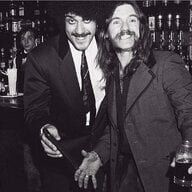
I'll find that photo of Lars and Cliff (with what is, according to Jason from the Aria Bass blog) his SB-1000. I will admit, the one thing that threw me was that it looked to have more block and cat eye inlays instead of dots. But, it could be that because it's such a tiny photo it's very hard to tell. However, the bridge is all gold just like his SB-1000. The BB Circuit is near impossible to see. Of, course, that would seal the deal and make it unquestionably the SB-1000, so that's why it still leaves a slight question mark for me.
I completely agree about the whole "Signature" bass. I even made a joke about it to my fiancée telling her, "They modeled the signature/tribute bass after the bass Cliff sent back to Aria's CEO." Lmao
Really, it makes absolutely no sense to sell a signature/tribute bass modeled on anything but the bass he specifically settled on, the Black 'n Gold I/Elite I (or getting more technical, the SB-R60 as it was originally known as).
Another little known fact I came across, again on the Aria blog, Cliff also had an Aria Pro II Integra bass that he gave to Faith No More's Bill Gould. So, he wasn't a fan of that model either. Bill Gould played that bass for years. I'm wondering if he still has it? I imagine he would never get rid of that thing.
Correct me if I'm wrong, but isn't the Black 'n Gold II the version with 2 pickups? I never saw a photo of Cliff playing an Aria with more than 1 pickup. I'm just wondering. Maybe you have? That would be really cool info to know!
I had my thoughts on Cliff's PJ Marx mod: He was always experimenting with guitar pickups in his basses. His Rickenbacker was modded with a Duncan Strat pickup in the actual bridge(!) His guitar tech buddy from SF, who he stayed loyal to even after he started seeing success with Metallica (that's just the way Cliff was; a damn good, loyal guy) explained that mod to Cliff biographer Joel McIver. It's very interesting. Cliff came up with the idea and his tech made it happen. The tech, whose name I forget at the moment, added a push/pull pot which would engage the Strat pickup during Cliff's solos.
But, you could very well be correct and needed whatever pickup was available. He had his other 3 (at least) Black 'n Gold basses, but I have seen pics of him playing that specific bass the most out of all of them on the MoP tour, especially in the last couple of months before his tragic passing.
There are little ways to tell them apart. For example, one of them looked to have chrome tuners on the E and D and gold tuners on the A and G.
Plus, although they all had the cat eye inlays, some of them had different shaped inlays on the other frets. It's really interesting.
NOTE: My profile pic shows my Rickenbacker with a DiMarzio humbucker in the bridge position. However, I have since replaced it with a high-gain Joe Bartin (sp?) Rickenbacker replacement pickup.
Back in the 90s, my original bridge pickup died on me so my local guitar tech/music shop owner replaced it with the DiMarzio. So I didn't do it to intentionally to copy Cliff. Just an odd coincidence.
Speaking of pickups, my SB-R60 is having some pickup problems and I don't remember if I mentioned it or not - I'm too wiped out this weekend from work to even look back at my post. Lol
Plus, I got a PJ Marx humbucker of my own that I'm trying to wire up. Problem is, I can't find a proper PJ Marx wiring diagram OR a diagram for my SB-R60. I found someone on here who has an '82 SB-R60, but he has a 3-way switch. Mine has the typical 2-way Aria switch.
I'll DM you and explain the problem. I don't want to fill up this topic on the Cliff bass with posts about my pickup problems.
But, I'm just wondering if my MB-II pickup was wired in wrong.
Talk more in a bit and thank you as always!
That history is more or less discussed and are all knowns, so you can probably confirm it as valid on that basis. The BnG II is two pickups, yes. I am fairly certain Cliff had one, but that's just going off the top of my head. I am probably wrong.
I believe that bass actually made its way into the hands of @Alembic83 and might actually be back with Billy. Those basses are another "very-Aria Pro II" design, not entirely dissimilar in principle to way that a couple of other guitars' electronics - like the RS Esrpit and RS-850 - were designed as a combo of Lo-Z pickups and active electronics.
I believe that bass actually made its way into the hands of @Alembic83 and might actually be back with Billy. Those basses are another "very-Aria Pro II" design, not entirely dissimilar in principle to way that a couple of other guitars' electronics - like the RS Esrpit and RS-850 - were designed as a combo of Lo-Z pickups and active electronics.


