• TalkBass has been independent since 1998. Add your voice.
    Create a free account to reply to discussions, view embedded media, and browse with fewer display ads.
    Join freeLog in
    Want zero display ads or expanded classifieds tools? Compare plans.

As a complete beginner, I need lots of help regarding everything help

I just learning bass and by just started I mean like a week ago. I don't understand practically everything. I've been watching and reading lots of things to try to understand but people keep talking in terms that I don't know. So here are some big questions I have.

1. HEADPHONES - these are important to me bc I mostly have time to practice at night. For headphones, I know I can plug it into an amp, but is there a way to have the music from my computer play while I'm playing the bass? I want to play along to the music but if my headphones are on then I can't hear it.

My suggestion would be to plug in your bass in the amp and have headphones so you can practice at night, and have headphones in the music device (computer, ipod, etc.) that way you can have one of each in your ears and you can play along without disturbing anyone.

2. What is a DI box and why do I need it? Or do I? I don't really understand

You'll need a d.i. box if you want to ease the process of recording, or even live playing in a band. It's easier to set up and EQ and less complicated than setting up an amp (well at least for the soundman.) But in anycase, i don't think you'll need one now, give yourself some time to practice and better yourself at mastering techniques and playing skills.

3. How would you record? I'm the type of person who likes to go back on what I did and fix it so I would like to record my bass audio. Would I just stick a mic in front of my amp? What program should I use?

Two ways to record: Plug through an amp and send that to the recording device using mics, or plug your bass directly to the recording device. If you're with an amp, place the mic strategically so you can have the best tone all around. meaning that the low ends and high ends have an equal amount of wiggle room in the mix. There are tons of videos on youtube that can be usefull in the event you want to record somewhat professionaly all by DIY.

4. I'm getting tons of fret buzz. I know it has something to do with the action but can someone explain in greater detail what I should do...

You should see if the neck is straight or bowed. again there are videos on youtube explaining how to set up basses. But action isn't all in the neck. A badly setup bridge can be cause to string buzz too. The frets are only a foctor if the manufacturer didn't properly set it up in the first place.

5. Ways to produce a clearer sound please. When I switch from frets, the noises of me going up and down the strings are really loud. Also, when I press down the clicky noise is really noticeable. I know I need to practice but are there any ways to make a clearer sound?

With what you said...Practice. That's all you need really. Theres no other way to get a clearer sound than practicing your attack on the strings (fretting hand and plucking hand)

6. What kind of equipment does a bass player usually have? I'm not saying I'm going to buy these anytime soon, but it would nice to know what a standard bass player has.

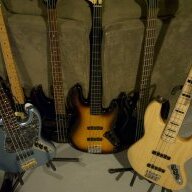
Bass: choice is over the top, but you want something that feels good in your fretting hand and while playing sitting down or standing up. Never mind your playing level, if you choose a bass that is comfortable all around for you to enjoy playing it, it'll be easier to develop and learn to play bass. Start with precision and jazz bases (fender, squier, or imitations) then move up from there. You can also go epiphone.

Amp: since you're just starting out, i'd suggest not going with a huge giging rig. Get yourself a decent sized combo amp. It's better for home use, and you can even record as well with it in the event of. I'd say something between 15-75 watts. Don't worry, there are lots of amp manufactureres that have combos, so research, and don't forget, choose the one that gives out your specific tone liking. You can go based on bands you like, and ask for advice.

Then the basic accessories such as a good 15 ft long input cable, a strap to play standing up, variety of pics (if you play with a pick, choose different gauges: .96-1.14, it can determine which you feel more comfortable playing with. You can even try using .80 (guitar picks) if ever you don't like .96 and above. A gig bag to carry your bass around safely with all the equipement listed above.

7. Slap bass is so cool. How.

Please explain everything, including terms that you're using bc I am a noob and I don't understand quite a lot. If you could help shed some light I would be so grateful! Thanks!

Slap is cool, but you should definately start with just finger plaing or playing with a plectrum (pick). Afterwards you can do slap. How to slap: use the side of your thumb and slap the bass accordingly to make it "melodic". Slap poping is when you slap and pop the note and it's octave on another string. Usually a higher pitched octave. Example Open E string with 2nd fret of the D string (E higher octave).

EDIT

Wow ! You guys are all so helpful, a bit background into why I haven't gotten a teacher and why I'm hesitant as to setting up the bass. 1) I need to save up money for multiple reasons. 2) I'm more in the experimental stage, my uncle is a music teacher and therefore I borrowed his bass to try it out. I always thought bass players were really cool so I wanted to try it out and so far its really fun (with the simple things my uncle has taught me).

Since the bass isnt mine, I would rather not mess with it too much. Even though my uncle is a music teacher, he's more piano kind of person and his bass is just part of his multitudes of instruments that he owns. I don't think he knows how to play that much other than simple things.

Ive looked up things multiple times before I wrote this thread BC i couldnt find clear answers on them. Usually the answers I get are filled with words I don't understand or long videos. I made this thread bc I needed a concise answer!

And thank you so much! You guys are helping so much, I know I'm a newbie. As for the slap bass, yeah, I know I know I'm going to need to practice. Anyways, if anyone else has stuff to add go ahead.
But wow seriously so helpful thanks you guys even gave me links

Also now I'm curious as to what "bad habits" I should avoid. Thoughts?[/QUOTE]
 
Check the sticky posts always at the top of the Technique and General Instruction forums... tons of amazing info. Spend a few days reading it all, even if you're having trouble understanding it at first. Get a teacher, a metronome, and a small practice amp; and practice practice practice. Play everything slowly at first, making sure to fret cleanly and BE IN TIME. You'll be rocking solo in less than a month, ready to jam with friends on easier stuff within 2 months, and pretty good within 6.
 
  • Like
Reactions: hookgrip
Don't be wowed by the allure of the flashy decadent slappers! You don't need to slap like a seizure patient to be a good bass player and if you overdo it, slapping is obnoxious and awful.

I would learn simple finger style or pick playing first. Finger will give you he most control over your sound, pick will give you an aggressive attack and great tone but it can be challenging to grasp (literally) for a new player.

Finger strength will improve only with practice, but that's the answer to all styles of playing, and paramount to those who want to slap their bass and have it sound halfway decent. You don't have to do repetitive techniques or endless scales to get your fingers in order, as long as you are playing the bass you will get better. Don't burn yourself out with boring theory, play what you want to play, play music you like.
 
  • Like
Reactions: ptleftybass
Welcome to the forum. When I practice in my room, I run an RCA jack from my iMac computer to my Fender Rumble v15 practice amp. I then plug my guitar and headphones into the amp. This way I can play along with any iTunes play list. As for fret buzz, most of it will disappear in time with practice. Right now, your fingering is sloppy and you are not hitting the frets properly. You need to have your bass guitar set up by an experienced luthier as this will help with fret buzz as well. Guitar Center, Sam Ash or a local guitar store can do that for a nominal fee. A good set of medium gauge strings like the Roto Sound round wound "Swing Bass" strings would be a good start. Next, go to an instructor, especially if you want to play funk and slap. Be patient, it takes a while to get your fingers to stretch and to build up callouses. Take your time and learn the instrument properly and you will enjoy it very much. Good luck and let us know how you make out.:):cool::bassist:
 
  • Like
Reactions: hookgrip
Tori-

When I started out, a couple TBers suggested that I get the Hal Leonard Bass Method books by Ed Friedland. I will pass that suggestion on to you, especially if you can't afford a bass instructor yet.

The book walks you through all the basics, step by step, and the exercises are fun rock/blues/funky songs that you can play along with on a provided CD. (I loaded them into my iPod and play off of that.) It even has a section on slapping and popping, since you're interested in that. But that comes much later in the book, after your hands are confident on the fingerboard and you're keeping good rhythm.

My daily practice schedule as an absolute noob was 1 or 2 exercises from the book (~15 min of focused practice), followed by 15+ min of working on a song I wanted to learn, like Under Pressure.

2 months later I am halfway through the Bass Method book, and can play through Feel Good Inc, Smoke in the Water, I Wish, Under Pressure, and am working on the Sesame Street Counting song (don't laugh- it's more challenging than you think). I'm also talking to friends about setting up a recurring monthly jam session.

So, yeah, in 2 months you can be jamming. You just have to PRACTICE.

Good luck!

Ps- I hesitate to mention this because I haven't actually used it myself, but another recording option might be to get the Apogee Jam which lets you plug your bass into an iPad or iPod and record yourself that way.
 
  • Like
Reactions: vishalicious
1) You can use an asio device like a zoom r16 to play your bass through your PC, and in turn play music through the same set of headphones. Another alternative is just about any mixer, and you can even try loop pedals, like the BOSS-RC3 has an alternate input, for hooking up an android phone, iphone, ipad, cd player, or PC to be sent through your signal chain.

2) DI Boxes basically eliminate the need for an amp.. or can be used as an effects pedal for your amp. Great for in house recording, or even for gigs that have a decent FoH system.

3) I personally use a zoom r16.. for $400 there really aren't many things with the amount of functionality that this has. But you can get away with just running a line out into your pc's line in/microphone jack. Just be careful, you pump too much through it you could blow your sound card. A DI box into a mixer is a great way to record.

4) Action is a usual culprit, but so are your fingers. Make sure you're fretting in the correct spot between frets, and not pressing to lightly or too hard. Take your bass to someone who can set it up..they'll charge you but your bass will sound and play awesome. I personally play with my action set to the lowest height possible without my strings touching my frets.

5) Again, ensure you have your action set to the way you like.. and just keep practicing..most guitars/bass guitars these days come with jumbo frets and take very little muscle power to get a clean note out of them. You also don't need a super heavy attack with your plucking hand. A light touch imo is the way to go, UNLESS YOU WANT those nasty noises in your sound.. which is another story and totally viable.

6) You want at the very least, a bass, a guitar chord, and a small practice amp. If you want to join a band you will want some real power. If the drummer plays with soft dynamics you can probably get away with 250-300w, but, I will say drummers like to bang loudly... so I recommend at least 500w. At any point in time you can choose to run effects... but personally I recommend working out your technique with a clean tone first.

7) Again it's about light touch and practice.

Your best bet is to go take weekly lessons. Sure..it costs money.. but.. having an instructor can get you miles ahead of trying to learn on your own. They can tell you what your problem areas are and give you techniques to correct them. Just make sure you choose a bass instructor
 
You do not want to be working on slap at this time.
You need to get lots of stuff under your belt before it makes sense to start studying how to slap.

Get the Bass for Dummies book. Don't be insulted by the title. The whole Dummies series is very good, and the most recent version of the Bass for Dummies book is excellent. It also takes you through many of the questions you are asking.

http://www.amazon.com/Guitar-Dummies-Online-Instruction-Hobbies/dp/1118748808/ref=dp_ob_image_bk
 
As an Amazon Associate, TalkBass may receive commissions from qualifying purchases made via links on this site.
  • Like
Reactions: hookgrip
Many posts and only one mention of a metronome. :rollno:

Get a metronome. Practice with a metronome. All the time.

I think it's a bad habit, including myself, not playing with a metronome. But i could never get used to doing it like that. I've learnt everything by ear, but i can still keep the groove in tempo and i do somewhat practice like that too. I just choose songs and slow them down and learn to play note for note all while keeping in time. Then i speed it up and go even beyond the original tempo to see where my breaking point of keeping up will be.
 
I have been playing 20+ years and still do not know how to slap well (don't really get much opportunity since I play in a church band)....would love to but not useful for my application.....learn to play what you need to to play the type of music you want to/need to play...slapping IS cool.....but few know how to do it well... (IMHO)

you have come to the right place to learn....and get ideas.....cruise the thread and investigate....

Sorry for the hijack, but try my redeemer lives {boom bing ba da da da boom ping}and the contemporary altered version of be thou my vision (you are my vision){boom boom ping, boom boom ping to a 12312312}
 
1) If your amp has two inputs, plug your computer into the second one. Most amps have two inputs, one low and one high impedance. Putting something in both usually makes them both function as "low."

2) No, you don't need one. When you finally do, you'll know it.

3) That, or an output from the amp into the computer, or direct from your bass into a computer. You can accomplish that with a simple 1/4" to 1/8" cord or jack from Radio Shack. $7. You can also buy fancy interface/external sound card boxes. There's lots of options. Program depends on how you do it. If you own a Mac, it comes with GarageBand. It'll do what you need it to do.

4) Pay for a setup, or try to do it yourself. Search the site, hell, isn't there a whole setup forum?

5) Pay for a setup, or try to do it yourself.

6) A bass, an amp, and a cord. Picks optional. Tuner suggested. Everthing else is optional.

7) Practice.
 
I'm more in the experimental stage, my uncle is a music teacher and therefore I borrowed his bass to try it out. I always thought bass players were really cool so I wanted to try it out and so far its really fun (with the simple things my uncle has taught me).
With absolutely no knowledge of the bass you are experimenting? It's much more productive to experiment from knowledge than ignorance.

When you are serious, start taking lessons. Until then I don't think it matters what you do, just go on YouTube and find videos that you think are interesting.
 
Many posts and only one mention of a metronome. :rollno:

Get a metronome. Practice with a metronome. All the time.
+1 to this ^^^^ Timing Timing Timing. Don't think it uncool to tap your foot to keep time, and sing the notes you play to yourself, you'll see most monster bassists doing this, after a while you do it without thinking. Also learn jazz standards, might not seem cool but I thank my bass teacher every day for making me play jazz way back 30 years ago when my 12 year old self only want to play popular music.
 
For #4, take the bass to a shop and have a tech go over it, and put new strings on it. If the tech has time, ask if you can watch the setup procedure. I was lucky enough to have a tech explain the whole setup procedure to me, and let me watch what he was doing. Once you get a basic knowledge of how all the adjustments interact with each other, you'll probably feel better attempting them yourself. The difference between a properly set up bass and a poorly set up one can be huge, and it's as important as lessons when you're first starting out. Congrats on jumping into the bass fold!

I didn't read every post, so if someone already suggested this, my bad!
 
As for #1. I'd keep it simple and use the Vox Amplug. I use it with my phone. Plugs right into your bass and any halfway decent headphones will do.

I agree with the "headphone amp" suggestion and have another alternative recommendation…a Pocket Rockit S1b. It's a little chunkier than a Vox, but it's got excellent sound reproduction, is simple to use and can line-in sound from either an mp3 player or any computer with a headphone jack. All you need is a 1/8"-to-1/8", male-to-male stereo plug, which is painfully easy to get.

This puppy has kept me alive and well and not bloodily murdered for the past three years…something to do with living with a girlfriend who works from home, is very A.D.D. and prone to migraines. :whistle:
 
Don't slap, play.

Get rid of the strings that are currently on your bass. They are usually garbage. Half-wounds or flatwounds will be easier on your fingers, and at the same time will toughen them up to learn how to apply the proper amount of finger pressure when you fret.

Everyone else mentioned getting a teacher or checking out youtube channels. It is flabbergasting how much knowledge there is that's free and easily re-windable, etc. Until you can get someone to teach you face to face, it is a very good subsititute. Almost all the well-known channels have beginner stuff.

Also, aside from getting these kinds of tutorials, once you can get your bass set up (there are some videos that can show you how to do the more basic stuff that can vastly improve its playability, like truss rod adjustments, intonation, radius checking -- all stuff that can affect that buzzing you're getting.)

If you have any knowledge about music (as in 12-note scales), one very quick tip is the box method. Google it. It's one of the first building blocks on how to learn your fretboard (like, where all the notes are, and it will help you figure out at the very least some basic bass lines)

Listen to lots of music. Even stuff you normally wouldn't. Listen to a lot of old stuff, from even obscure bands or artists. Listen to all of the instruments, not just the bass -- get inspired.

Good luck. Then you can slap later on if you want to. Everyone, look at your hands...
 
Since everyone seems to be chipping in well, I'll just add a couple of things that haven't been mentioned a lot yet,

1. Get a metronome
2. To learn to slap, get Tony Oppenheim's 'Slap It!', and practice it with your metronome. Guaranteed slap chops.

EDIT: Here are some things that, when I look back on, I wish I had done:

1. Spend more money on lessons than gear. Like, a LOT more. Any bass sounds good when you are a killer player.

2. Practice EVERYTHING with a metronome. Even just noodling about.

3. Learn lots of styles. Don't listen to anyone tell you slap isn't cool. Learning slap made me a way groovier fingerstyle player.