• TalkBass has been independent since 1998. Add your voice.
    Create a free account to reply to discussions, view embedded media, and browse with fewer display ads.
    Join freeLog in
    Want zero display ads or expanded classifieds tools? Compare plans.

Ash issues

buldog5151bass

Kibble, milkbones, and P Basses. And redheads.
Oct 22, 2003
26,734
70,249
Connecticut
bulldogbatsonline.com
As someone who makes custom baseball bats, I hear a lot about the Ash Borer, and some people feel that in a decade or so, ash may disappear as a commonly used wood. While I think some people are looking up at the sky falling, I know of some growers who are starting to bring their trees to mills as soon as possible, earlier than they used to, afraid they may get infected.

What's the word from here?
 
Well, this is news from about.....10 years ago. It was around 2008 that the ash boring beetles devastated the supply of ash in the US. I personally had all of my ash supply infected and two completed bass bodies destroyed by them. Cost me a lot of money and grief. That's when I stopped using ash, and switched to poplar. I haven't used ash since in my basses, although I like its characteristics. Too much risk. But I have been using some ash in the last few years in bodies for other Luthier clients. Their risk.

I haven't paid close attention, but I thought they had battled back against the borers reasonably successfully, and that clean ash was becoming available again. For a couple of years, ash was almost unavailable here in California.
 
  • Like
Reactions: saabfender
I'm hearing it from both sides. There is an effective treatment available, but you have to treat every tree every year. I am still using primarily ash (western New York mill), and prices and supply have remained fairly consistent, but I've seen the lavae on some trees here in Connecticut.
 
Yes, I've read that they have a pretty good protective treatment, to prevent the borers from getting into a live tree. The problem now is with stockpiled boards. If one infected board is put in a room with other clean boards, within a few months, they will get into all the other boards too.

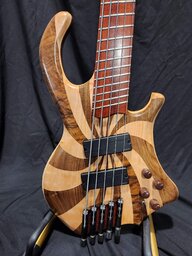
In my own shop, I had boards that were more than 10 feet apart, where the borers apparently sniffed them out and walked over to the other boards. In 2008-2009, I had to get rid of every single piece of ash in my shop. Even some small pieces of ash that I used for fixtures and templates got infested. It was terrible. Fortunately, they never got into my collection of finished Scroll Basses that I built with ash bodies. It appears that if the ash is sealed up with a good finish, they aren't interested.

They only get into ash. I had ash boards in the middle of a stack of boards of poplar, maple, mahogany, etc. They found and infested the ash boards, but didn't touch the others. And once they are into a board, you cannot get them out of it. Chemical, heat treatment, IR treatment, sealing it in vacuum, none of that works. The eggs are in there and they will survive almost anything. Next spring, a fresh squadron of borers are munching away. You have to burn the board or send it to the landfill.

I still have the two Scroll Bass bodies that got infested, wrapped in plastic and sealed in a box. I haven't looked at them in a few years, but for at least 6 years the borers still kept hatching every spring. Those two bodies look like cheese, hundreds of holes. Natural chambering.
 
Around the days of the ash nightmare, I did some experimenting with birch. We built about 6 guitar necks from birch, thinking it might be a lighter weight alternative to maple. It didn't work. The birch was way too unstable. If I remember correctly 5 of the 6 necks ended up getting returned because they were warped or twisted. And we thought the board was thoroughly dried out. Since that ugly experience, I haven't had much enthusiasm for birch.
 
  • Like
Reactions: bass nitro
Here is a good, if lenghty, discussion of EAB by an academic expert. It's a huge problem here in the midwest. I have 10 ashes on my property including two big specimen trees in my front yard. I have been treating with one of the more promising insecticides for several years, but there's maybe a 50% chance it will work in the long run.

 
Yowza! I had no idea they would go after dry wood. I don't use Ash for instruments but have some around for other projects. As far as availability goes I picked some up about two years ago and it was still fairly cheap, easy to find and good quality.