• TalkBass has been independent since 1998. Add your voice.
    Create a free account to reply to discussions, view embedded media, and browse with fewer display ads.
    Join freeLog in
    Want zero display ads or expanded classifieds tools? Compare plans.

ash vs mahogany

LOL

I wasn't referring to you. You actually tried out some basses. Now send in your samples and get back to us when the labs come in. Fingers crossed.
:meh:

j/k. This stuff gets deep. All in good fun.
;)[/QUOTE
Such a negative way to go through life. You won't believe something is possible until someone else proves it to you.

I took the opposite approach. I played a buttload of basses. Way more fun IMO. Informative too.
:D
Very true, it is fun to play lots of basses & see what sounds good & what doesn't... Anyhow, in these days of post-modernist ways of thinking & "no absolutes"... We can all be right lol. The old "your truth is your truth" & "my truth is my truth" can apply :)
 
  • Like
Reactions: Brad Johnson
I believe what is supported by evidence and disbelieve what isn't. I don't think it's sad at all really. Different strokes.

I'm cool with however you want to look at this. If I were to look at it the same way, I would find it sad, in the face of some basic facts. That, along with the rest of this is my opinion.
Negatives don't need to be proven. Only positive claims. You don't understand the nature of evidence or the burden of proof.

*insert snarky emotion here*

Love the snark :D. It ties in nicely with what you claim I don't understand about the burden of proof. You think it's always about proving a negative. Which means it's never about proving a positive. That's the standard web logic.

It's also a copout. I'm asking you about your claim. You can take the copout that it's not the OP's original claim if you'd like (apparently you would). Turnaround's post explaining the different components of what makes up an electric bass clearly laid out the position. Your counter is no proof even though proof was offered.

So please, tell me how this is supposed to work? That the person claiming impossibility can ignore the proof and not support their point.

I'll just use a big old grin :D
 
I'm cool with however you want to look at this. If I were to look at it the same way, I would find it sad, in the face of some basic facts. That, along with the rest of this is my opinion.


Love the snark :D. It ties in nicely with what you claim I don't understand about the burden of proof. You think it's always about proving a negative. Which means it's never about proving a positive. That's the standard web logic.

It's also a copout. I'm asking you about your claim. You can take the copout that it's not the OP's original claim if you'd like (apparently you would). Turnaround's post explaining the different components of what makes up an electric bass clearly laid out the position. Your counter is no proof even though proof was offered.

So please, tell me how this is supposed to work? That the person claiming impossibility can ignore the proof and not support their point.

I'll just use a big old grin :D
I clarified, a few times, that it's not impossible. I don't believe that tonewood can make a difference. I don't believe you or anyone else can discern the difference. I make no claims.

Emoticon.
 
I want double blind trials with sample sizes of at least dozens. More would be better. A sizable control group is also required. Anything less is anecdotal. Ash vs mahogany. Rosewood vs maple. I withhold belief in any difference without scientific evidence. I am an a-tonewoodist.
Wood makes all the difference for acoustic instruments. I don't think it makes any difference for solid body electric instruments.
 
Wood makes all the difference for acoustic instruments. I don't think it makes any difference for solid body electric instruments.

Well, I own a bunch of acoustic guitars and a couple of hollow body basses of a couple woods and types. I don't think there is anyone here that is true-believer religious enough to claim that those woods make no difference whatever. (Remember these are ELECTRIC instruments with pickups and things) The various resonances of hollow body instruments (just thump on the body for crying out loud) are so so obvious and pronounced and show up so strongly in the final sound that to argue you can build a violin out of silly putty and it will sound just like a Strad is as silly as it sounds.

So now who is going to argue against Turnaround and say that when you have a SOLID piece of wood that somehow physics no longer applies. And all the resonances and couplings that give character and tone to a hollow acoustic instrument are somehow no longer there as if it had suddenly become a saxophone or something? Obviously THAT is nonsense too and same physics still applies. It still has strings, and frets and nut and bridge and wood still has resonances. In other words it the SAME just different in matter of DEGREE.

So now we get to the crux. And that is in a solid body instrument does wood "make no difference"? Well now we've gone from physics (are there resonances that color sound...Answer yes there are) to the totally subjective: Do those wood colorations make ANY difference to ME? Now there is no one answer. The answer depends on which person is playing the instrument! Notice too that not making any difference, is not quite the same thing as "I can't hear/feel any difference". You may feel the difference but don't care. Another person may feel/hear a difference and VALUE that difference. Then like Brad Johnson wood DOES make a difference TO YOU.

This argument over tonewood is NOT unique to bass and guitar forums. I recall HUGE discussions in Drum forums over whether wood matters. If you're interested, where that discussion evolved (devolved?) to was discussions of building a concrete drumset for a final determination if tonewood matters. And interestingly enough there is an urban legend floating around that Leo once build a STONE guitar body to try to answer the question if tonewood matters! Unfortunately if the question was answered, it seems Leo took the answer with him when he left! :) As I recall a long time ago I think I remember a thread of someone who built a concrete bass...

And hey! Someone was listening! Check this out: DW Concrete Snare Drum
 
Bassbenji, great points... I will agree with you, some people obviously can't hear any difference in wood types. And some folks definitely don't care what their bass is made of. Other people, myself included, are very detail oriented & pay extremely close attention to the finer details of our instruments & do care about what types of wood are involved. We care because we distinctly hear the differences. Those are major factors for me, when purchasing a bass. (Along w pickups & preamp types of course), scale length, etc. Tonewoods matter :)
 
  • Like
Reactions: Rev. Cornelius
Well, I own a bunch of acoustic guitars and a couple of hollow body basses of a couple woods and types. I don't think there is anyone here that is true-believer religious enough to claim that those woods make no difference whatever. (Remember these are ELECTRIC instruments with pickups and things) The various resonances of hollow body instruments (just thump on the body for crying out loud) are so so obvious and pronounced and show up so strongly in the final sound that to argue you can build a violin out of silly putty and it will sound just like a Strad is as silly as it sounds.

So now who is going to argue against Turnaround and say that when you have a SOLID piece of wood that somehow physics no longer applies. And all the resonances and couplings that give character and tone to a hollow acoustic instrument are somehow no longer there as if it had suddenly become a saxophone or something? Obviously THAT is nonsense too and same physics still applies. It still has strings, and frets and nut and bridge and wood still has resonances. In other words it the SAME just different in matter of DEGREE.

So now we get to the crux. And that is in a solid body instrument does wood "make no difference"? Well now we've gone from physics (are there resonances that color sound...Answer yes there are) to the totally subjective: Do those wood colorations make ANY difference to ME? Now there is no one answer. The answer depends on which person is playing the instrument! Notice too that not making any difference, is not quite the same thing as "I can't hear/feel any difference". You may feel the difference but don't care. Another person may feel/hear a difference and VALUE that difference. Then like Brad Johnson wood DOES make a difference TO YOU.

This argument over tonewood is NOT unique to bass and guitar forums. I recall HUGE discussions in Drum forums over whether wood matters. If you're interested, where that discussion evolved (devolved?) to was discussions of building a concrete drumset for a final determination if tonewood matters. And interestingly enough there is an urban legend floating around that Leo once build a STONE guitar body to try to answer the question if tonewood matters! Unfortunately if the question was answered, it seems Leo took the answer with him when he left! :) As I recall a long time ago I think I remember a thread of someone who built a concrete bass...

And hey! Someone was listening! Check this out: DW Concrete Snare Drum
The major difference here is that violins, acoustic guitars, and drums are acoustic instruments that get their sound from the vibration of the wood. A solid body elect guitar is a magnetic pickup that gets the sound from a metal string vibrating that causes an electric current. I fail to see how the wood of the instrument has any effect. I might think that with an acoustic electric instrument, it may play some part, but not a solid body.
The difference to me is like flying through the air as opposed to being thrown through the air.
 
The major difference here is that violins, acoustic guitars, and drums are acoustic instruments that get their sound from the vibration of the wood. A solid body elect guitar is a magnetic pickup that gets the sound from a metal string vibrating that causes an electric current. I fail to see how the wood of the instrument has any effect. I might think that with an acoustic electric instrument, it may play some part, but not a solid body.
The difference to me is like flying through the air as opposed to being thrown through the air.

Does the construction of an acoustic bass have an effect on how the string vibrates?

Does the construction of an acoustic bass guitar have an effect on how the string vibrates?

Does the construction of an electric bass guitar have an effect on how the string vibrates?
 
The major difference here is that violins, acoustic guitars, and drums are acoustic instruments that get their sound from the vibration of the wood. A solid body elect guitar is a magnetic pickup that gets the sound from a metal string vibrating that causes an electric current. I fail to see how the wood of the instrument has any effect. I might think that with an acoustic electric instrument, it may play some part, but not a solid body.
The difference to me is like flying through the air as opposed to being thrown through the air.

Strung acoustic instruments really make a poor analogue of what goes on with electric ones. All acoustic instruments depend upon a resonator, a cavity. The size of the cavity determines what the frequency tuning will be of the finished instrument. For example, in the case of classical guitars, the luthier is usually seeking a body tuning somewhere centering on G. Some makers will tune as low as E and others as high as A. In any case, they will seek to tune the body somewhere either side of a note to help avoid wolf tones which will, in practice, be unavoidable, as every guitar I've ever handled and there have been many over a span 50 years, has had a wolf. Some however are better than others. What the instrument is made of has absolutely no bearing on wolf notes. That said, the string once excited sets the bridge in motion which transfers a vibration to the soundboard with which it is in some manner coupled to. In the case of violins, celli, guitars etc. the torque of the string upon a bridge depends upon the height of the string and hence the height of the bridge on the body.
Soundboards are far more important than body wood or material as demonstrated by the 19th century luthier, Antonio de Torres, who in trying to prove that body wood mattered less than the physics involved with acoustic instruments constructed a guitar with back and sides out of papier mache, essentially, cardboard. The original is in a museum, here is a Youtube video of a copy, , which though it IS a recording, still sounds pretty good to my ear.
You see pretty much the same sort of debates go on with acoustic players. In the case of classical guitars, there are players who swear that Brazilian rosewood is superior to and easily identifiable over any other rosewood or alternative body wood. One thing is certain, it is more expensive but not necessarily for the reasons players may think. So far no one in a blind test has ever been able to determine with absolute accuracy what the back and sides are made of by listening any more than they've been able to determine what the soundboards ( the other great debate amongst classical guitarists) ( usually spruce vs. cedar) are made of. There are, to the chagrin of "golden ears", luthiers who can make a cedar guitar sound "sprucey" and vice versa. And there are luthiers like the great Torres was, who can make cardboard sound like wood.
If I had to make string instruments analogous to something else it would probably be, ironically, the loudspeaker.
 
Last edited:
You're playing with a lot of dirt in your tone so it probably makes no difference. You want an amp that sounds glorious when cranked up.

So what if the wood makes your mids less present (or whatever). Turn the mids back up in the amp. Use brighter strings. There's loads of other easily altered factors to your tone than the wood of the bass.

A bass you feel comfortable holding for a couple hours a day and with a neck that lets you play the runs you need to will sound better than whatever minute differences body wood can make. If only because you can play it better.
 
  • Like
Reactions: Bob_Ross
Since this has devolved into yet another endless tonewood debate, I'll throw my piddling unscientific experience into the ring for general condemnation, if you've read my little Tonewood diatribe before, please ignore:

I have a 1986 Steinberger XP-2, CF neck, epoxy painted rock maple "flying vee" shaped body, looks just like this one:
xp2-main_zpsidhbhzsf.jpg

Nothing wrong with it, a superb sounding and functioning bass in every respect, I just got tired of the dated 80's look, and very trebly sound, wanted to "warm up" the tone, maybe get a little more bass fundamental out of it if possible.

I transferred EVERYTHING, neck, electronics, bridge, neck bolts, and even strings (they were new, and in a very light guage that's hard to find) from the original body to this ho-made mahogany body. Not a masterpiece by any means, but it's more comfortable for seated play, and gives me a place to rest my forearm, and it was a fun first body build. The only parts not relocated were the pickguard, misc. screws, and the flip-out knee rest. The only change therefore, was the body wood, from rock maple to one-piece mahogany. The maple body has some kind of bulletproof, thick finish on it, the mahogany was finished in Watco Danish Oil. The weight feels roughly the same, though I haven't weighed it, but that should be irrelevant if the wood has no impact on tone. I accept that a change in MASS might have some effect, maybe on sustain, which does seem slightly less with the new body. I spent a great deal of time getting a finger-tight neck pocket that bevels inward along it's vertical and lengthwise dimensions to match the original neck pocket. The beveled neck cross section allowed Steinberger necks to be cleanly popped out of the mold, a HUGE PITA to re-create in a wood body, let me tell you, so I'm pretty confident the neck pocket was nearly identical to the original.
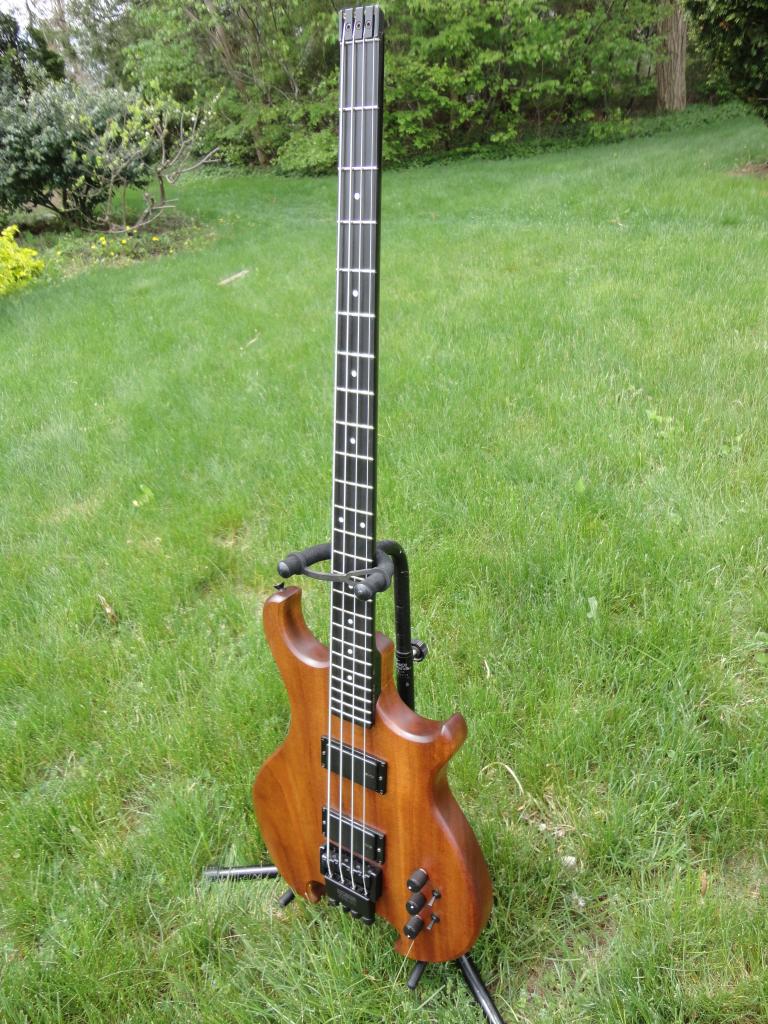
DSC00859_zps675068d6.jpg


I had hoped to get a warmer tone out of it, and it's definitely more resonant unamplified, but it's also warmer and bassier plugged in. This having been my goal, one could say I'm just a victim of wish fulfillment, but a couple other bass players, who knew what the Steinberger sounded like, also remarked on the change in tone, so I think there is something there. I have no before and after soundclips to offer as proof, so I don't expect anyone to believe me, or share my conclusions, but it HAS convinced ME that the wood has some effect. This is only interesting in that I inadvertently created as close to an isolation of body wood as a tone generator as I've seen on TB. If somebody has a convincing explanation for why changing the body wood has changed the tone, I'd be genuinely interested to hear it, I still have an open mind on this subject.
 
Last edited:
I think mahogany has a more focused sound

This has been stated here more than once, and not about maple or basswood... Must be something different about the sound from mahogany basses (generally), (and I agree) in many player's experience. This opinion despite coming from different players, regarding different basses, with differing hardware. What a co-incidence!
Similar type observances regarding ash or maple basses. What a co-incidence!
Haven't heard of any similarities between 'sandwich' basses, tho.
What gives?