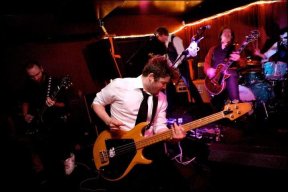
In case you don't know me I'm a noob bassist who comes from a drumming background... If there is anything you wanted to ask a drummer but didn't, here's your chance.
Hit me!
Hit me!

TalkBass has been independent since 1998. Add your voice.
Create a free account to reply to discussions, view embedded media, and browse with fewer display ads.
Join free Log in
Want zero display ads or expanded classifieds tools? Compare plans.
Woah slugger! I'm a bassist too. A new bassist but a bassist none the less.


OK, brother. In that case: Do you think that drummers generally hear music in a different way than musicians who play more tonal instruments? For example, are they generally more likely to perceive and respond to such relatively non-tonal elements as changes in dynamics or changes in tempo, than they would to things like key changes or changing chord progressions?
And do they really howl at the full moon?
MM
OK, brother. In that case: Do you think that drummers generally hear music in a different way than musicians who play more tonal instruments? For example, are they generally more likely to perceive and respond to such relatively non-tonal elements as changes in dynamics or changes in tempo, than they would to things like key changes or changing chord progressions?
And do they really howl at the full moon?
MM
I've got a question. I played one gig on drums (don't ask, long story) and really struggled with the tonality of the other instruments. Why? Because you're sitting behind all the speaker cabs. Did that trouble you? Would it trouble you now that you've had a chance to stand in front of the speaker cabs and can hear them the way they were intended?
I'm also a drummer. Played drums professionally for the 1st 20 years of my musical career before moving to bass and keyboards. As a drummer I approached music in almost a mathematical way rather then a melodic way. (I was big into odd time signatures and ploy-rhythms ... Think Bill Bruford) Many of the BEST bass players started out as drummers. (For example Mark King started out as a drummer) When a bass player has drums in their background it's easier to understand where the drummer you work with is coming from and it's easier to find the pocket they like to play in. Some drummers like to play in front of the beat, some right on and some behind ... it really helps to be able to hear and understand their approach so you can lock in with them. I think you can tell a bass player who started as a drummer because their approach is more rhythmic. They can lay into a simple pattern and make it swing and move rather then just play the notes. I'd suggest ALL bass players study drums or at least really listen to them, understand the way your favorite drummers think, understand the way the drummer you gig with thinks. Definitely a marriage! A good drummer and bass player combo will make any band cook even if the other musicians are lack luster.
I don't mean to steal this thread, but as someone in the same position as the threatstarter, I can answer as well:
Yes, I do believe that drummers respond more to changes in tempo and dynamics moreso than changes in chord progessions.
I know that when I am listening to a song for the drum parts, in addition to hearing what the drums are doing, I'm listening to those things more than what the guitar is playing, whereas if I am listening to the song for the bass or guitar parts, the dynamics and tempo are somewhat secondary to the chord progessions.
Dynamics and tempo are literally two of the most important things for a drummer to possess, so it makes sense they would listen for those things above all else.
IMO. Maybe I'm just weird.

why would a drummer take up bass??? to broaden your musical horizons? or is it just string envy?...LMAO J/K
that and slap bass is really cool.


Do you think that drummers generally hear music in a different way than musicians who play more tonal instruments?
You mean drummers can hear music? I thought that you had to actually listen to hear something.