• TalkBass has been independent since 1998. Add your voice.
    Create a free account to reply to discussions, view embedded media, and browse with fewer display ads.
    Join freeLog in
    Want zero display ads or expanded classifieds tools? Compare plans.

Assembling your own basses vs buying production basses vs modding

Which do you prefer? (you may select as many choices as you wish)

  • Buy production basses and leave them stock

    Votes: 252 40.9%
  • Buy production basses and perform mods

    Votes: 304 49.4%
  • Buy separate components and assemble basses to your exact spec

    Votes: 216 35.1%
  • Make basses from scratch including cutting the wood for bodies/necks

    Votes: 51 8.3%
  • Peel carrots to your exact specifications

    Votes: 68 11.0%

  • Total voters
    616
Let's see... In my current collection of 8 basses, built from scratch, stock and modified from production. As I've often said, I haven't had an instrument that I haven't voided the warranty on.

Mostly, I'm chasing tone and functionality. If the instrument isn't working for me, there's no reason to suffer. I routinely will add an extra strap button above the end pin button to help with basses that have a neck dive issue and replace the pickups if they sound wimpy (to me). Besides, none of my instruments are worth anything significant or will gain in value by keeping them stock with the exception of the 4003.

- Home built 35 year old short scale fretless (original design - not a fender knock off). Built in my apartment kitchen because at that time fretlesses were rare and very expensive. And I was cheap. I learned a heck of a lot building that instrument.
- 1994 MIJ Fender Precision Lyte (pawn shop find) - Replaced the pickups with Seymour Duncan Quarter Pounders, added a battery box and fixed all the finish issues. It's the bass that sits by my computer and I do most of my practicing with. It's all a lot lighter than most of my other basses, so I've used it when I've hurt my lower back.
- Brice 6 string - Bought new at the beginning of the 5 & 6 string boom from Rondo Music because it was super cheap (under $400 with exchange, brokerage fees and shipping to Canada). Just added a strap button about a foot up from the end pin to help with neck dive. Everything else is stock, except the battery box that self destructed after one too many battery changes.
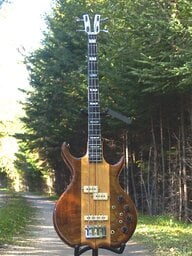
- Ergo 5 string Upright Electric Bass - Added string trees to the head stock to put a break angle on the strings, purchased and installed custom sized piezo pickups from K&K Sound, build a bunch of bridges to get something I liked tone and action wise, installed volume, tone, balance controls and added strap buttons to play it off the stand.
- 2015 Rickenbacker 4003 Jetglow - Just added a strap button up from the end pin button, added a strap button around the edge of the horn (about 2 inches) to help with neck dive, applied conductive paint to the control cavities to reduce hum and replaced the pickguard with a custom work of art from Alperious Pick Guards.
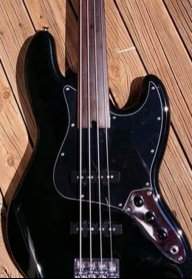
- 2017 MIM Geddy Lee Jazz - Replaced the pickups with Seymour Duncan Quarter Pounders, replaced the controls with a stack pot set from 920D, drilled holes and inserted tungsten rods under the tuners to elminate a dead spot on the E string and replaced the pickguard with a custom work of art from Alperious Pick Guards.
- MIA Tacoma Thunderchief - I repaired a crack in the neck by the head stock and replaced the bar piezo pickup with a K&K Sound under top piezo set.
- A Korean no-name sample uke bass from Rondo Music - I had to carve off a bit of the head stock to shorten it so it would fit in a Kala case.

Others have come and gone, but these ones have proven themselves over the years. All get used, depending on the music being played and the gig. All sound different.
 
  • Like
Reactions: SactoBass
Then again, rolling the edges of a fretboard is a 10 minute job, so this is pretty much a non-issue for me.

I think you and i have a different definition of rolled edges. There's no way you could achieve the amount of edge radius that Tom achieved on my Warmoth in 10 minutes.

Between every fret the board edge has to be sanded right up hard against the frets and then every single fret end needs to be filed to match the radius. Even on the fretless to achieve a good, even and consistent roll along the full length will take longer than 10 minutes.
 
I understand MIM and USA Fender basses are basically interchangeable (necks, PUs, PGs).

I have heard that Japanese Versions are not so. Does anyone know for sure? I am sure a P Lyte is different to some extent (and desirable), but what about a reissue? There are some nice reissues (eg the MIJ 62 Jazz), but are the neck pockets, pickups, PGs the same as USAs and MIMs (for interchangeability)?
 
Although I own both, I prefer the basses I've built. I'm a Warmoth guy. Their bodies are always flawless. Their neck are for the most part the best I've ever played. My only objection to them is on their maple fingerboard necks. They spray the finish over the frets. Before I knew better I'd get this weird buzz as the finish started to wear off just from playing. Now I get it off first before I string it. It's a little bit of work but well worth it because of the way these necks play. I like the idea of being able to choose what I want my bass to be. To be able to choose my own tonewood, hardware, pickups and electronics. The P-bass pictured below is all Warmoth, Seymour Duncan Quarter Pounder pickups, Obsidian Wire electronics, Schaller Tuners and a Gotoh high mass bridge. The P-J is also all Warmoth, Bartolini pickups, Obsidian Wire electronics, Schaller tuners and a Hipshot Kickass bridge. I have about $1000 in each for everything. They both look, play, and sound as good as any commercially produced bass in the $2000-$2500 range IMHO. Yes it takes time, but to me it's fun and really rewarding once its finished.
20200101_140837.jpg
20200101_140744.jpg
 
Although I own both, I prefer the basses I've built. I'm a Warmoth guy. Their bodies are always flawless. Their neck are for the most part the best I've ever played. My only objection to them is on their maple fingerboard necks. They spray the finish over the frets. Before I knew better I'd get this weird buzz as the finish started to wear off just from playing. Now I get it off first before I string it. It's a little bit of work but well worth it because of the way these necks play. I like the idea of being able to choose what I want my bass to be. To be able to choose my own tonewood, hardware, pickups and electronics. The P-bass pictured below is all Warmoth, Seymour Duncan Quarter Pounder pickups, Obsidian Wire electronics, Schaller Tuners and a Gotoh high mass bridge. The P-J is also all Warmoth, Bartolini pickups, Obsidian Wire electronics, Schaller tuners and a Hipshot Kickass bridge. I have about $1000 in each for everything. They both look, play, and sound as good as any commercially produced bass in the $2000-$2500 range IMHO. Yes it takes time, but to me it's fun and really rewarding once its finished. View attachment 3651145View attachment 3651148

Niiiiiiiiiice basses! :thumbsup:
 
I think that some basses need to stay stock .. I have a few Yamaha BB basses, the older MIJ ones stay stock because there is nothing I could do to make them better they are already better. The new ones do get some cosmetic changes but stock electrics and pickups stay but I am putting together a BB 5er that should be killer once finished and a Stingray that will also be a one-off monster bass. My Fenders do get some modding, pickups and preamps, bridges and nuts, My G&l's are stock.. if it ain't broke don't fix it. My collector's grade basses are stock but that speaks for its self. I am pleased to see you guys out there having fun with mods and builds as it is fun to do and a very satisfying hobby.
 
IMG_0011.JPG


So weird: I was looking at necks on Invalid Link Removed site, which are bought, they just don't know it yet, and this thread, sent by talkbass, popped up in my inbox. Spooky action at a distance. I like to make a bass body into a painting. Have GL L2000 as backup. This one is pretty much, almost, finished and in use, so now planning next one. Will get neck and a body blank with neck pocket already cut out this time, and maybe pickup routes, if I can figure out a combination that I want and that they (W) do. As example thinking of a double single coil setup but W doesn't offer the single coil route as a bridge option. CNC setup I guess, and an extra charge that ain't happening. I routed my own this time and they suck. Single coils wanted mostly for looks, ie more painting space, but probably not best for heavy playing, hard rock, low and loud, just guessing.
 
... just broke the £220 mark.... TV Jones pickup,Fender deluxe bridge and tort PG. £275.
How the hell do you do that? I got *given* an Australian kit bass, and my expenditure on tweaks, upgrades and my no means least materials for the finish etc means I fear its going to be the most expensive instrument I own, and I've used adequate quality far eastern replacements wherever I can...
 
Warmoth Mini P 1.JPG Okay... I voted the "carrot" option - because I'm a Carrots kind of guy, and always vote the straight Carrot Party ticket. Anyway..
I've done all 3 of the choices in the thread title. I mod stuff just for fun, or because the bass is just so beat up/nasty that it's necessary. I'll build a bass, but only if it's the only way I can get what I want - without buying an old, "vintage" piece of crap, or spending a small fortune. This Warmoth Mini-Precision, for example. There just aren't any decent mid-priced, 4-string, passive, solid body, short scale left handed basses. A fair number of cheapies, and a few custom builders who want more money than I want to give them; but nothing in the $1000-1500 range. So, I built one... But, I much prefer to simply buy what I want - when I can...:whistle:
 
How the hell do you do that? I got *given* an Australian kit bass, and my expenditure on tweaks, upgrades and my no means least materials for the finish etc means I fear its going to be the most expensive instrument I own
Finish is expensive Jim so you'll note I keep to the basics. The 50's slab was stained blue then sanded back, wax was top coat. Just went with Tung oil on the Cabronita.
 
  • Like
Reactions: Sands and SactoBass
9FD59348-BE9B-48F2-A149-D1B7C3E9B377.jpeg


Here is an American Vintage Hot Rod, Nitro CAR, 73 P Bass PU and a 74 Jazz was purchased and lost in the mail. I can’t remember what ended up there. My thought was to build a real hot rod. The neck was some aftermarket from reverb that was actually pretty nice but not solid as a 74. This was a super fun build until FedEx “lost” my PU.


13D3580E-B639-4669-9713-163A45D74A16.jpeg
 
If a bass is working well as it is, I leave it alone. On Fenders and Fender-style instruments, I may experiment with swapping out the pickups or bridge if I think the existing ones are inhibiting the bass from playing or sounding up to its potential. For example, my recently acquired Road Worn P-bass benefitted greatly from swapping the stock pickup out for a Lindy Fralin. I've replaced stock electronics and/or pickups on some active basses if I think that might create an improvement.

In assembling or building basses, I've found that it is a bit of a crapshoot - you can't predict exactly how one will play or sound, even if you think you know the characteristics of the woods and parts you're using. I would definitely recommend using top quality parts. I've assembled a few, including this P-bass, which has a Warmoth Cottonwood body, late '90's Fender replacement neck, Spitfire pickguard, Duncan Antiquity II pickup, and various hardware from my parts drawer. I finished the body myself (it was my first attempt). The color was originally Sonic Blue, but the yellowing of the nitro lacquer turned it pale green. Also, because I started wet sanding the clear coats a bit too early, it checked in a way that looks like an authentic aged finish. It sounds great, and for years it has been my #1 recording bass for an old school sound (the almost 20-year old Joe Osborne flatwounds are a big part of that).


Warmoth P body.jpg

Warmoth P sm.jpg
 
Last edited:
You need one more option: Buy custom basses.

I want specific things, but I don't have the tools nor space to make my own basses. I would rather leave the difficult stuff to an experienced luthier and just provide specs, design, specific materials, etc....

you don’t need a luthier, you can just order the body you want with the routing that you want, a neck, frets oof your choice installed,and in the various parts, a little bit of soldering and a screwdriver and you can do it at your kitchen table. I use Warmoth and can get most directly from them. Other choices in parts are easy to source.
 
Hey there TB'ers! :)

I've been playing bass since 1972, for most of those years, it never dawned on me to assemble my own basses. For some reason, my brain was programmed to think that buying production basses was the only viable option (for me, anyway).


View attachment 3647177

Good news...

Chicks REALLY like parts projects...
Brideoffrankenstein-1.jpg
 

Latest posts