- Feb 12, 2006
- 61,051
- 5
- 221,023
- Disclosures
- Development Engineer-Mesa Boogie, Development Engineer-Genzler (pedals), Product Support-Genz Benz
We knew this day would come:
Exicon was the last vendor of these lateral MOSFET parts that we used in all of our MOSFET based bass amps. When Renesas (the new Motorola division) acquired the linear semiconductor business segment from Hitachi, it became apparent to us that the lateral process that's the basis for the MOSFETs used in our amps would be subject to how much production Renesas would be able to sustain before it became impractical to continue supporting this unique semiconductor fab process.
Exicon bought wafer level inventory from Renesas, converted the wafers to die and packaged them for manufacturer use. About 5 years ago they discontinued all of the TO3 metal can packaged devices now they have discontinued the more popular plastic packaged parts. This was a fantastic part, but quirky, and availability in production quantities has always been a challenge. We went through 3 different vendors of these parts (Exicon is the 4th), each vendor had their issues and in the end it just wasn't worth the hassle and the higher than acceptable failure rates. I used the smaller versions of these parts in some other unrelated products, great devices but as I mentioned... quirky.
While we have a decent quantity of repair parts in stock, we have not been able to acquire all Vgs ranges so if the range is one we don't have stock of, all of the devices need to be replaced to maintain current balance (did I mention quirky?). This makes those repairs quite costly.
Since this applies to all of our own legacy lead sled products as well as many of our competitor's products, I want to be sure that this information is available to you all so that you don't find yourself in a position where you end up with an amp that may be uneconomical to repair, and that you understand why. Also, this particular part family, along with the vertical MOSFET family are absolutely riddled with counterfeit parts that are usually remarked parts of a different type and do NOT work acceptably in these circuits since their curves and Vgs levels are wildly different.
This is why we discontinued the MOSFET amps, we knew this was coming and didn't want to be in this position with our customers when it eventually happened.
There are still some buried in the distribution and manufacturing channels, and some legitimate factory alternate parts, but unless going through the authorized distribution channels there's no way to know what you are really getting because these are not tracable/auditable channels and counterfeits are plentiful.
These were the replacements that were tested and approved for our legacy amps, the alternate parts (one has been out of stock for a while) have NOT been tested or approved and we do not know what differences there might be.
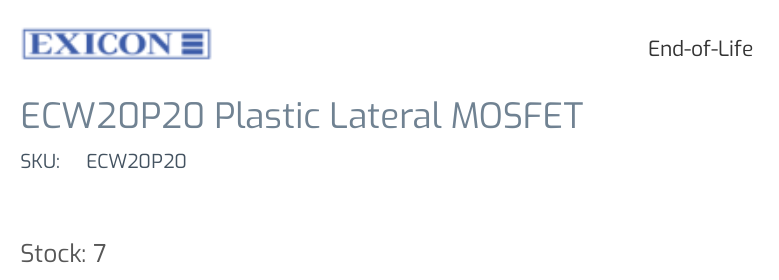
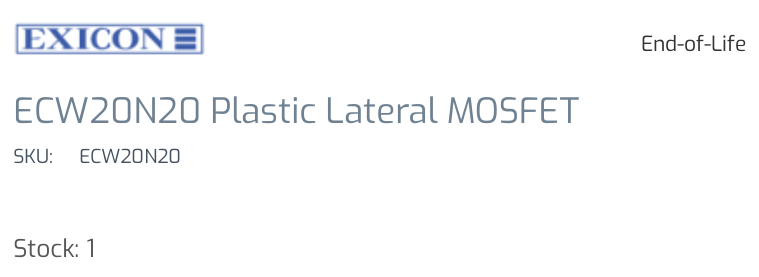
Exicon was the last vendor of these lateral MOSFET parts that we used in all of our MOSFET based bass amps. When Renesas (the new Motorola division) acquired the linear semiconductor business segment from Hitachi, it became apparent to us that the lateral process that's the basis for the MOSFETs used in our amps would be subject to how much production Renesas would be able to sustain before it became impractical to continue supporting this unique semiconductor fab process.
Exicon bought wafer level inventory from Renesas, converted the wafers to die and packaged them for manufacturer use. About 5 years ago they discontinued all of the TO3 metal can packaged devices now they have discontinued the more popular plastic packaged parts. This was a fantastic part, but quirky, and availability in production quantities has always been a challenge. We went through 3 different vendors of these parts (Exicon is the 4th), each vendor had their issues and in the end it just wasn't worth the hassle and the higher than acceptable failure rates. I used the smaller versions of these parts in some other unrelated products, great devices but as I mentioned... quirky.
While we have a decent quantity of repair parts in stock, we have not been able to acquire all Vgs ranges so if the range is one we don't have stock of, all of the devices need to be replaced to maintain current balance (did I mention quirky?). This makes those repairs quite costly.
Since this applies to all of our own legacy lead sled products as well as many of our competitor's products, I want to be sure that this information is available to you all so that you don't find yourself in a position where you end up with an amp that may be uneconomical to repair, and that you understand why. Also, this particular part family, along with the vertical MOSFET family are absolutely riddled with counterfeit parts that are usually remarked parts of a different type and do NOT work acceptably in these circuits since their curves and Vgs levels are wildly different.
This is why we discontinued the MOSFET amps, we knew this was coming and didn't want to be in this position with our customers when it eventually happened.
There are still some buried in the distribution and manufacturing channels, and some legitimate factory alternate parts, but unless going through the authorized distribution channels there's no way to know what you are really getting because these are not tracable/auditable channels and counterfeits are plentiful.
These were the replacements that were tested and approved for our legacy amps, the alternate parts (one has been out of stock for a while) have NOT been tested or approved and we do not know what differences there might be.
Last edited:



 ) and not doing a lot of repairs any longer so I probably have enough for what I need in the future.