• TalkBass has been independent since 1998. Add your voice.
    Create a free account to reply to discussions, view embedded media, and browse with fewer display ads.
    Join freeLog in
    Want zero display ads or expanded classifieds tools? Compare plans.

Double Bass Baby Bass megathread

Just for whatever it’s worth, here is my bridge, and a slightly blurry image of just the rubber (or plastic) piece showing daylight through the string slots. It appears to me that the string slots are notched just barely through the plastic.

IMG_0938.jpegIMG_0939.jpeg
 
What is the string after length below the bridge supposed to be on these? My string length is 41.25 inches and the after length is 10.25 inches. Is that too long? Should I try and shorten it to measure to 1/6 of the 41.25 string length?
 
Baby bajistas del mundo, saludos. Baby bassists of the world, hello.

I'm playing an Ampeg BB4 in a band that is making the transition to entirely in-ear monitoring. We have a Midas MR 18 for our monitor mixer. I was setting gain staging tonight, and the transients from the baby bass are HUGE. The gain coming out of the DI could only be 15db, yet still the louder notes can audibly clip the tone. I added 4:1 compression to the channel, and I can see it's active, but it also appears to be too slow to eliminate potential crunch on a loud transient, even on it's fastest response time. I'm considering redoing the signal chain on the bass, removing one of the four effects slots with a compressor configured as an insert on the bass, and perhaps not even using the compressor which is part of the default mr18 signal path.

Have any of you personally dealt with this on a Midas mixer? If so, I'd appreciate comparing notes.
 
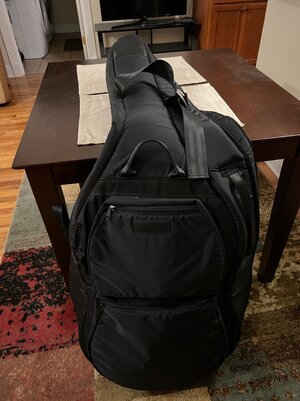
Anyone know of a decent padded gig bag for one of these and where to get one from? Thanks

I got mine at Mooradian. It's top notch. Although the company might be gone, I read on line that their chief seamstress and pattern manager is still in business. It wasn't cheap, but I've used it every week for ten years and it still looks and feels brand new.
 
  • Like
Reactions: billiard
I’m pretty sure that any processing in a digital mixer takes place after the A/D converter. So if the input is overloaded the A/D converter clips and no compression afterwards can make that undone.

Clipping can even take place in the analog world where you might not expect that. Once I recorded a concert on a portable DAT recorder. The recorder had three input selectors: mic 1 (most sensitive), mic 2 (less sensitive) and line.
I had a stereo electret mic with a battery adapter (but maybe some more electronics inside than that) and set the switch to mic 2 since condensers deliver a higher signal level.
The recording was overdriven when it got loud (was a gamelan ensemble). Next recordings I set it to line and these were OK.
I leveled it so that nothing got too loud in front of the A/D, but that only reduced the volume of the already overdriven signal.

I found out that the level switch was in front of the first amplifier stage that got overdriven, but the input volume knob was behind, so turning the level down showed visually that the level was OK but the input stage was overdriven which had no indicator.

So you need to either turn down the bass if it has a volume control or put a passive (resistive) attenuator (since it is a electromagnetic pickup) in front of the mixer.
 
I can tame the transients on the harder pulls, but in so doing I set up a 20:1 compression ratio. As a result the transients don't distort the signal, but the note has also lost some of us endearing bloom envelope. Such extreme compression sounds more digitized. This post is less about the baby bass and more about how to respect the sound of the baby bass in an IEM setup. I'll keep tweaking the signal chain as I learn more. If any of you have already done this and want to share your strategy, I'm all ears.
 
I’m pretty sure that the problem is related to setup (including pickup!), string choice and/or playing style, but if you keep using a compressor to solve the problem, you should set the threshold high enough that normal after attack volume should go through uncompressed. A 20:1 compression is very high and musically hardly useful other than as a rather hard limiter.
I hope you can also set attack and release time at the compressor manually as you need both rather short.
Setting up a compressor well is not an easy task.

 
  • Like
Reactions: Court Crawford
Burt, from Tallahassee,

I have an original Ampeg Baby Bass, from the ‘60’s, in excellent condition.
I come from a double bass background,
and only use the bass in a Salsa band.
I replaced the neck and fingerboard with one from Ray Ramirez (~$500), since the original one had grooves in the fingerboard and was thin.
The E string is weaker sounding than the others, so I use an Empress Bass
Para Eq, tuned to around 40 hertz.
This works well, and blends with the other strings. I use Spirocore Solos, and get a decent sound with an old Polytone III, or for loud gigs, a Carvin
head with two 15” cabs.
I have a nice padded cover made by Mooradian that I bought on-line ($350).

Pics attached.
 

Attachments

  • IMG_2425.jpeg
    IMG_2425.jpeg
    1.3 MB · Views: 20
  • IMG_2426.jpeg
    IMG_2426.jpeg
    1.2 MB · Views: 20
I’m pretty sure that the problem is related to setup (including pickup!), string choice and/or playing style, but if you keep using a compressor to solve the problem, you should set the threshold high enough that normal after attack volume should go through uncompressed. A 20:1 compression is very high and musically hardly useful other than as a rather hard limiter.
I hope you can also set attack and release time at the compressor manually as you need both rather short.
Setting up a compressor well is not an easy task.
You’re so right. I switched compressors to one modeled on the 1176, set it’s attack and release to their fastest settings, and was able to get a much better tone.
 
I can tame the transients on the harder pulls, but in so doing I set up a 20:1 compression ratio. As a result the transients don't distort the signal, but the note has also lost some of us endearing bloom envelope. Such extreme compression sounds more digitized. This post is less about the baby bass and more about how to respect the sound of the baby bass in an IEM setup. I'll keep tweaking the signal chain as I learn more. If any of you have already done this and want to share your strategy, I'm all ears.
Are you pulling hard on the strings? I think that there’s definitely a sweet spot with regard to the response of the pickup. I wonder if changing the touch might help? Are you using synthetic strings?