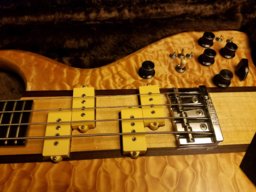
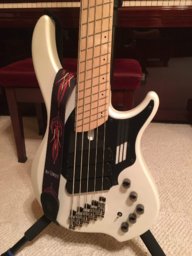
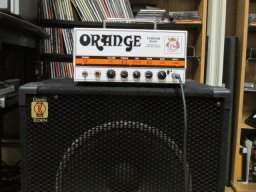
I've set the strap up to a position where it sits exactly (or as close as I can get it) standing as well as sitting. Honestly, I prefer the bass to sit a little higher. Quite frankly I'm old enough that I couldn't care less how 'cool' it looks (haha!) but rather, for comfort and ease of access.
I spoke to my instructor today and let him know how I am feeling - I was ready to give him the boot over the phone. I was a bit taken aback when I began telling him the things that I wasn't comfortable with about his instructions when he interrupted me to say that he too wasn't comfortable about how things were going. He said that he felt as though he was short changing me on the lessons and that if I wasn't ready to really 'learn' things the correct way that I should probably find someone else. Long story short, he agreed with everything I had to say and we've agreed to start all over as if I haven't had a single lesson. This coming Sunday in my next lesson with him and we're going to begin with fretting/plucking form and the other things we've been talking about in this thread. I am hopeful that since we've got this situation out in the open that things will change. The way that I figure it, $20 is worth the second chance to see how things will go in our next lesson.
I'll let you guys know what happens Sunday. Also, I really appreciate the support of the community with this - it's something that I have been struggling with for some time now.
Awesome, let's hope he picks up his game.
Just some suggestions so you can steer the lessons in the right direction.
First, have him teach you basic technique. You want to learn 1-2-4 fingering or one finger per fret, either or is acceptable. You will also want to work on plucking technique, you want to ensure you are not striking the strings down when playing. Also ensure you know the chromatic scale and how a bass works in the first lesson or two.
Next up you want to study basic chord structure, just major and minor not augmented and diminished. After learning basic chords move into scales, again, you just want to start with major and minor. Then you will want to get into intervals, the building blocks of music. If you find yourself in the modes before this you have found yourself a guitar player teaching bass.
You will also want to ensure your instructor can teach you
voice leading down the line, ensure they are familiar with this concept. You will get a better teacher assuredly.
Tossed in with the above you will want a decent rhythm education. Know how to count and keep the beat. You should also learn how to count odd rhythms and meters but don't stress that now.
If your end goal is to learn double tapping or pop and slap techniques ensure the teacher can show them to you but do not touch on any of that fancy stuff for at least 6 months. Focus on the foundations and you'll be a better player.
And, I cannot stress this enough, do not forget that learning happens between lessons. The lessons are only to show you new material and provide feedback or direction, the learning takes place on your time. Too many students expect me to just give them a magic scale to play awesome, it doesn't work like that. You need to learn how to put ideas in your own practice.
Lastly, if you were my student I wouldn't force reading on you since you're an adult. If you are under 18 I force reading on my students. It is a very useful skill but it is most important in higher educational material. If you want to be great it will be almost essential short of you being a one in a million talent. I would highly recommend being able to read a chord sheet (also called a fake sheet or a head) as it will be extremely useful to a working player, unlike reading staff.
Communication is essential, as you have just found out. Always tell your teacher of your concerns.
I hope that helps.