
Enjoy the benefits of a premium membership!
Upgrade Account
-
TalkBass has been independent since 1998. Add your voice.
Create a free account to reply to discussions, view embedded media, and browse with fewer display ads.
Join free Log in
Want zero display ads or expanded classifieds tools? Compare plans.
You are using an out of date browser. It may not display this or other websites correctly.
You should upgrade or use an alternative browser.
You should upgrade or use an alternative browser.
Badass - action too high
- Thread starter Burg
- Start date
More options
Who Replied?
Yeah, in that case look for a Badass II, Hipshot or similar bridge.I looked into shimming and it looks a great option. The main problem I would have would be in trying to shim a neck through bass, which is what the Toby Pro 4 is.
I probably should have mentioned that earlier.
Shim the heel. Plenty of info.
+1... When I replace the original bridge on my MIM fender jazz with a badass I had to shim the neck, I had the same problem with action... I like the badass bridge...
edit to my post : Its sad that you can't do that on a neckthrough... if you are really near to have what you want for the action you may try to file the saddles (I have seen some badass with filed saddles once...) but I would suggest you to change the bridge anyway and may be sell the badass or try it on an other of your basses...
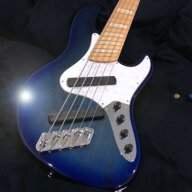
Sorry, I got here late...
I Was going to mention your bass is neck-through (shimming isn't an option)...
I think the original bridge on the Korean made toby's is one of these:
BLACK BASS BRIDGE FITS FENDER JAZZ P BASS GUITAR | eBay
You could check the dimensions to check if the string spacing looks O.K... and search the net for reference pictures.... I think if you remove the Badass, you'll find 4 holes in the locations shown on the ebay link...
There's likely some others on ebay as well - this is just the first one I found...
I Was going to mention your bass is neck-through (shimming isn't an option)...
I think the original bridge on the Korean made toby's is one of these:
BLACK BASS BRIDGE FITS FENDER JAZZ P BASS GUITAR | eBay
You could check the dimensions to check if the string spacing looks O.K... and search the net for reference pictures.... I think if you remove the Badass, you'll find 4 holes in the locations shown on the ebay link...
There's likely some others on ebay as well - this is just the first one I found...
As an eBay Associate, TalkBass may earn a commission from qualifying purchases.
i like the badassII I've got but I've had to shim the neck on both the jazzes I've installed them on and then filed the saddles on one to get the action low enough, simple job just take the filing slow and uniform, you can't really go too low on the filing as you can just raise the saddle a little to compensate later
This works too.Don't be afraid of shimming!
Remove 4 neck bolts.
Put in a piece of index card.
Reinstall 4 neck bolts.
Not any more difficult than replacing a bridge.
Done.
Then you can readjust your neck relief to where it ought to be, since neck relief is for relief, not action.

I had one of my techs take rat tail files to the saddles on one of my BA bridges once. It worked out well, in fact I sold it for a nice price because it was ready to go. Much like the Dremel solution.
If I had to chose between shimming and creating a groove in the saddles, I'd take the latter.
If I had to chose between shimming and creating a groove in the saddles, I'd take the latter.
I had one of my techs take rat tail files to the saddles on one of my BA bridges once. It worked out well, in fact I sold it for a nice price because it was ready to go. Much like the Dremel solution.
If I had to chose between shimming and creating a groove in the saddles, I'd take the latter.
Yeah, I'd rather spend a few minutes with a file than shim a neck... Granted, either approach will work, but I prefer not to use a shim if I don't absolutely have to - and in the case of a neck-thru, it's not an option...
I would actually rather use a file than a dremel in this situation - it's more controllable...
- georgestrings

What about just getting a standard Fender Vintage bridge. These have very thin bases so you will have a bit more play in the saddles.Interesting idea about the Dremel. Don't have any of that sort of kit though.
I've been looking at either a Schaller roller bridge (Think it's a 3-D 4 B) or Hipshot A bridge (FM2).
Think I'll go for the Schaller as I can get that a little cheaper and it seems to be well received on Talkbass.
Thanks again guys, you've been a big help.
Failing that, i guess if you measure the base of the BA and aim for something that has a thinner bases then you should be fine.

I can confirm it. The holes line up.As far as I know, the holes in a Gotoh/Fender bridge line up fine with the three in a Badass bridge. You just mount the replacement bridge with three instead of five screws. Can anyone confirm this?
I've never seen a shim work as intended. If a bridge doesn't go low enough, the extra 2 mm you gain at the end of the fretboard from a shim isn't going to fix it. You need a counter sunk bridge and/or deeper grooved saddles.

Warrior_Bass said:I've never seen a shim work as intended. If a bridge doesn't go low enough, the extra 2 mm you gain at the end of the fretboard from a shim isn't going to fix it. You need a counter sunk bridge and/or deeper grooved saddles.
Shims work great and I've added them to several instruments. It doesn't just add "2 mm at the end of the fretboard", it changes the angle at which the neck meets the body. Used at the heel of the neck pocket, it effectively tilts the neck back and necessitates raising the bridge saddles to achieve the same string clearance.
If your saddles cannot be lowered enough to attain the action you desire and your truss rod has been properly adjusted to straighten your neck, a shim is a quick, easy, efficient, reliable, and inexpensive way to gain a useful range of height adjustment in the saddles.
There is no reason to overengineer a solution. DO NOT route your body to lower the saddle height. That is like getting liposuction to make your belt fit. If the saddles have been filed to provide a proper witness point don't dig out a trench to lower your action.
Find some low grit sandpaper and cut a piece 1/2" wide to match the contour of the heel of your neck pocket. Place it grit-down at the heel of the neck pocket, which prevents it from slipping, and reattach the neck. Tune up and observe the action. If the saddles are still too high, remove the neck and replace the shim with one cut to the same shape but twice as thick (fold the sandpaper over itself) or just simply add an additional shim on top of it. One shim has generally done the trick for me, but sometimes it will take two or three layers; the "right" number is what provides you proper use of your bridge.
A shim is completely reversible, doesn't damage your instrument or any of its components, and doesn't affect its value. If you decide to get a different bridge in the future, take out the shim and observe the range of saddle movement on the new bridge; add a shim if necessary, sell the old unmangled bridge, and be happy you didn't have to fill the body to install your new hardware.

Lets not forget the OP has a through neck so all this talk of shimming isnt going to help.
Just thought i would point that out.
Just thought i would point that out.
Shims work great and I've added them to several instruments. It doesn't just add "2 mm at the end of the fretboard", it changes the angle at which the neck meets the body. Used at the heel of the neck pocket, it effectively tilts the neck back and necessitates raising the bridge saddles to achieve the same string clearance.
The angle of the neck meeting the body means nothing if your strings are still a good 3 mm higher than desired after a shim. My point is, if your bridge doesn't bring you relatively close, assuming relief is properly set-up, then a shim won't be a solution, it will just get you the thickness of your shim (2mm).
Honestly, if the bridge, neck and entire action is that way off, the instrument itself is not a well built one! Having said that, I'm having a bass built and we encountered this very issue! The bridge is a Hipshot B style and the saddles were all the way down so we decided to recess the bridge (I didn't want to spring for a different bridge). Don't worry, the body was unfinished. There are quite a few builders who recess their bridges.
Honestly, if the bridge, neck and entire action is that way off, the instrument itself is not a well built one! Having said that, I'm having a bass built and we encountered this very issue! The bridge is a Hipshot B style and the saddles were all the way down so we decided to recess the bridge (I didn't want to spring for a different bridge). Don't worry, the body was unfinished. There are quite a few builders who recess their bridges.
Every bass I've tried a high-mass bridge on reacts completely differently to it.
It comes down to the neck/pocket relationship. If the neck is set into a slightly deeper pocket, this forces the saddles to come down to match the depth.
I only kept a Badass on one bass, because the neck pocket is just shallow enough (and we're talking mm or 64th inch increments here) to allow the neck to sit high enough so the saddles don't have to be maxxed down.
Also, the shim debate is always a good one, even if it doesn't pertain to OP's bass, it pertains to high-mass bridges in general. I like to hear how people have made it work for them. If the shim is toward the bottom of the neck pocket, it can change the angle of the neck in support of raising the saddles. I don't like doing it, but it is one solution.

I don't think you understand how it works. You can reduce action by a HUGE amount with a shim.The angle of the neck meeting the body means nothing if your strings are still a good 3 mm higher than desired after a shim. My point is, if your bridge doesn't bring you relatively close, assuming relief is properly set-up, then a shim won't be a solution, it will just get you the thickness of your shim (2mm).

I don't think you understand how it works. You can reduce action by a HUGE amount with a shim.
Yes, it sounds like he is assuming a full pocket sized shim, not a heel shim.
OP needs to sell the Badass and get a heavy Fender style bridge. Gotoh 201, done.
dave_bass5 said:Lets not forget the OP has a through neck so all this talk of shimming isnt going to help.
Just thought i would point that out.
Thanks for pointing this out. I hadn't checked on this thread since yesterday morning, until I saw the redflag phrase "countersink the bridge". As for the OP, yes, a shim can't be used on a neck through. Buy a bridge with a lower profile and life will be grand.
However...
Warrior_Bass said:The angle of the neck meeting the body means nothing if your strings are still a good 3 mm higher than desired after a shim. My point is, if your bridge doesn't bring you relatively close, assuming relief is properly set-up, then a shim won't be a solution, it will just get you the thickness of your shim (2mm).
You are either referring to a full-pocket shim, which wouldn't be useful, or completely disregarding geometry. For the sake of those searching the forums for accurate information about shimming, a little math to demonstrate:
Neck pocket (Fender) = 3.875" = 98.425 mm
Shim height at heel = 2 mm
tan x = 2 / 98.425
x = ~1.16 degrees
sin 1.16 = y / 34" scale length
y = +0.69" saddle height adjustment to maintain same action
Therefore, using a 2 mm shim on a Fender neck pocket effectively lowers the bottomed out saddles by 0.69" = 17.526 mm. Probably more than is needed for most. A 1 mm shim will yield 0.345" = 8.763 mm. Raise the saddles for proper action, adjust the intonation, and you're good to go.
And remember, if you have the opposite problem in that you can't raise your saddles high enough, you can apply a shim at the head of the neck pocket to achieve inverse results.


