• TalkBass has been independent since 1998. Add your voice.
    Create a free account to reply to discussions, view embedded media, and browse with fewer display ads.
    Join freeLog in
    Want zero display ads or expanded classifieds tools? Compare plans.

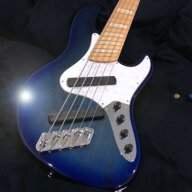
Badass - action too high

You are either referring to a full-pocket shim, which wouldn't be useful, or completely disregarding geometry. For the sake of those searching the forums for accurate information about shimming, a little math to demonstrate:

Neck pocket (Fender) = 3.875" = 98.425 mm

Shim height at heel = 2 mm

tan x = 2 / 98.425

x = ~1.16 degrees

sin 1.16 = y / 34" scale length

y = +0.69" saddle height adjustment to maintain same action

Therefore, using a 2 mm shim on a Fender neck pocket effectively lowers the bottomed out saddles by 0.69" = 17.526 mm. Probably more than is needed for most. A 1 mm shim will yield 0.345" = 8.763 mm. Raise the saddles for proper action, adjust the intonation, and you're good to go.

And remember, if you have the opposite problem in that you can't raise your saddles high enough, you can apply a shim at the head of the neck pocket to achieve inverse results.

I understand the use of a shim. Your math is correct, but that is assuming the angle for sin(x) is applied at the nut, which it is not. In fact, at the top of the neck pocket is where such angle is applied, which is a fulcrum and a point of reference for action that should be almost unchanged with a reasonably thick heel shim. However I think we know this is incredibly dumbed down (despite the trig) as we have to consider string tension and neck relief into the equation and it's no longer a triangle.

I'm not saying a shim doesn't work, but it's not a fix all solution, as has been my experience.
 
Bob Lo said:
Shims are just a temporary solution.Why would you compromise the neck/body connection just to use a certain bridge?Buy a bridge that fits.Hipshot model A's fit everything.And,you don't have to file the saddles...........;)

How is it temporary? Do you reasonably expect the grains of sand and paper backing to deteriorate? How would it do so and where would it go? If you have audio examples of a shimmed neck vs a non-shimmed neck on the same instrument to demonstrate the sonic deficiencies of such a compromised system, please share; else please cease spreading pseudo-science propaganda.

Warrior_Bass said:
I understand the use of a shim. Your math is correct, but that is assuming the angle for sin(x) is applied at the nut, which it is not. In fact, at the top of the neck pocket is where such angle is applied, which is a fulcrum and a point of reference for action that should be almost unchanged with a reasonably thick heel shim. However I think we know this is incredibly dumbed down (despite the trig) as we have to consider string tension and neck relief into the equation and it's no longer a triangle.

Pivoting the neck at the neck pocket pivots the neck as a whole. Dumbed down it is not, let alone "incredibly", sir. Calculations performed assuming the truss rod has been adjusted to obtain a straight neck - or slight relief, as you may prefer - prior to shimming; which you would not alter when adjusting action. Therefore neck relief is not a variable. String tension would remain the same at any angle at the same scale length. Therefore, also not a variable. Place the body of the instrument on a flat surface; your triangle exists from the witness point on the nut to the witness point on the saddle (hypotenus), from the witness point on the nut running parallel to the flat surface the body is resting to a 90 degree angle directly below the witness point on the saddle (adjacent), and from the aforementioned point to the witness point on the saddle (opposite).

I'm not trying to sound like a dick, but I can't idly watch the math and physics of such a simple system fall victim to false pretense and internet lore in a forum fostering technical knowledge.

That being said, if it sounds good and feels good it is good. I don't care how you instigate sound, but congrats on the mere act of doing so. Cheers to all and I hope you spend more time shaking walls than surfing forums.
 
Sorry, I got here late...

I Was going to mention your bass is neck-through (shimming isn't an option)...

I think the original bridge on the Korean made toby's is one of these:
BLACK BASS BRIDGE FITS FENDER JAZZ P BASS GUITAR | eBay

You could check the dimensions to check if the string spacing looks O.K... and search the net for reference pictures.... I think if you remove the Badass, you'll find 4 holes in the locations shown on the ebay link...

There's likely some others on ebay as well - this is just the first one I found...

Awesome stuff. I'll have to remove the Badass and have a look around. It seems you're suggesting the previous owner has drilled the extra holes for the Badass? If the bridge you linked to will fit then it looks to be the ideal option.


Interesting discussion about shimming as well, I've certainly learnt something new from it. I'm tempted to try it out on one of my other basses that isn't neck through just as an experiment.

Thanks everyone.
 
As an eBay Associate, TalkBass may earn a commission from qualifying purchases.
I'm not trying to sound like a dick, but I can't idly watch the math and physics of such a simple system fall victim to false pretense and internet lore in a forum fostering technical knowledge.

Hey, I'm with you on this. I actually agree with your concept, even though I disagree (still) on how you apply it (but it really is a moot point to our discussion). I am still of the opinion and experience (YMMV) that shims, although helpful, are temporary solutions, and have never gotten me the action I ultimately desire. My warrior bass has ultra low action that I've never had on the hundred or so basses I've had my hands on, and a shim has never gotten the action close enough by itself. It may help, but not enough for me.

That being said, if it sounds good and feels good it is good. I don't care how you instigate sound, but congrats on the mere act of doing so. Cheers to all and I hope you spend more time shaking walls than surfing forums.
+1 :bassist:
Peace
 
Burg said:
Awesome stuff. I'll have to remove the Badass and have a look around. It seems you're suggesting the previous owner has drilled the extra holes for the Badass? If the bridge you linked to will fit then it looks to be the ideal option.

Interesting discussion about shimming as well, I've certainly learnt something new from it. I'm tempted to try it out on one of my other basses that isn't neck through just as an experiment.

Thanks everyone.

I may have jumped the gun. I found some more pics online of Toby pro's & some of the stock bridges have what looks like a standard "Fender" 5-hole pattern. So the Badass probably dropped right in. On the bright side, there are lots of aftermarket options for Fender bridges & hopefully there's a lower profile one out there.

Good luck & let us know how it works out.
 
Curiosity got the best of me...

I was thinking of the Badass design - made to be a direct Fender replacement & how I've installed at least 4 & never had a height adjustment issue.

So I busted out a ruler & measured the lowest possible bridge adjustment on my Toby Pro 5. It was between 10 & 11 mm. Then measured the lowest possible adjustment on one of my Badass equipped Fenders. It's about 11mm.

The BA has a much thicker baseplate, but the saddles have a lower profile.

As long as the saddles are grooved, the BA can pretty much get as low as the stock Toby bridge.

Not great news.
 
How is it temporary? Do you reasonably expect the grains of sand and paper backing to deteriorate? How would it do so and where would it go? If you have audio examples of a shimmed neck vs a non-shimmed neck on the same instrument to demonstrate the sonic deficiencies of such a compromised system, please share; else please cease spreading pseudo-science propaganda.


Pivoting the neck at the neck pocket pivots the neck as a whole. Dumbed down it is not, let alone "incredibly", sir. Calculations performed assuming the truss rod has been adjusted to obtain a straight neck - or slight relief, as you may prefer - prior to shimming; which you would not alter when adjusting action. Therefore neck relief is not a variable. String tension would remain the same at any angle at the same scale length. Therefore, also not a variable. Place the body of the instrument on a flat surface; your triangle exists from the witness point on the nut to the witness point on the saddle (hypotenus), from the witness point on the nut running parallel to the flat surface the body is resting to a 90 degree angle directly below the witness point on the saddle (adjacent), and from the aforementioned point to the witness point on the saddle (opposite).

I'm not trying to sound like a dick, but I can't idly watch the math and physics of such a simple system fall victim to false pretense and internet lore in a forum fostering technical knowledge.

That being said, if it sounds good and feels good it is good. I don't care how you instigate sound, but congrats on the mere act of doing so. Cheers to all and I hope you spend more time shaking walls than surfing forums.


Good post...


- georgestrings
 
As mentioned earlier, just cut your saddles deeper unless you want to sell it later. I've cut the saddles down on one of mine almost to where the lower tang starts, works fine. Note: If you think you may want to resell it, this will ruin it's resale value.
 
As mentioned earlier, just cut your saddles deeper unless you want to sell it later. I've cut the saddles down on one of mine almost to where the lower tang starts, works fine. Note: If you think you may want to resell it, this will ruin it's resale value.

Unless you sell it to someone who knows how beneficial the grooves can be.

I sold my grooved Badass for a nice price.