Enjoy the benefits of a premium membership!
Upgrade Account
-
TalkBass has been independent since 1998. Add your voice.
Create a free account to reply to discussions, view embedded media, and browse with fewer display ads.
Join free Log in
Want zero display ads or expanded classifieds tools? Compare plans.
You are using an out of date browser. It may not display this or other websites correctly.
You should upgrade or use an alternative browser.
You should upgrade or use an alternative browser.
Double Bass Bass scooting away on end pin carpet when playing standing
- Thread starter John D. Foster
- Start date
More options
Who Replied?

How about using an endpin rest instead of a piece of carpet?
Like Rock Stop/Sure Stop Bass Endpin Rest (Cup, Holder)
Like Rock Stop/Sure Stop Bass Endpin Rest (Cup, Holder)

There are non-skid "fabric" materials you can purchase to keep things from slipping, potentially you could figure out a way to attach some of that material to your carpet. It only works if the "floor" surface is clean and smooth though, and once the non-skid material gets dirty it won't work again until it is washed clean.
I think @Francois Blais' suggestion is going to be more reliable.
I think @Francois Blais' suggestion is going to be more reliable.

I'm not a fan of rockstops - easy to lose and they skid as often as anything. At least, the cheap ones I used to use 20 years ago did, until I switched to sitting with a Xeros style strap.
Nowadays, I like the rubber ball endpin tips on my New Harmony or Saddle Rider endpins. If you're using a carpet, I'd actually suggest a carpet big enough that you can stand (or in my case, sit) on it.
Nowadays, I like the rubber ball endpin tips on my New Harmony or Saddle Rider endpins. If you're using a carpet, I'd actually suggest a carpet big enough that you can stand (or in my case, sit) on it.


My favorite solution was always to make sure the rug was big enough for me to stand on, with the bass endpin.
Ain't nothing gonna stop things sliding like this fat arse will
Ain't nothing gonna stop things sliding like this fat arse will

My favorite solution was always to make sure the rug was big enough for me to stand on, with the bass endpin.
Ain't nothing gonna stop things sliding like this fat arse will
Righteous!
Embellishment: position your shoes in your normal “bass stance” on the carpet, staple from beneath with a Bostitch. Secure a rubber cup furniture caster thru the carpet into the underlayment with a drywall screw. Position bass and slide into your loafers…nothing is going anywhere.My favorite solution was always to make sure the rug was big enough for me to stand on, with the bass endpin.
Ain't nothing gonna stop things sliding like this fat arse will
Riis
"Not on the rug.....man!" Get a ball for your endpin. Keep it clean. Having to carry around a rug is not the answer.

I’ll second the Rockstop. I use one when I’m on a slippery stage floor or any other slick surface. They’re easy not to lose by keeping it in the pocket of your bass bag. They’re cheap enough to have a couple. I have one for my EUB also.
I use a rug in my house on a particularly skiddy wood floor. I haven’t had to carry anything special to any venue I play in 15 years. The last one I can remember was an orchestra gig in church with a marble floor. Nothing stuck to it."Not on the rug.....man!" Get a ball for your endpin. Keep it clean. Having to carry around a rug is not the answer.

YMMV, but crutch tips bug me. Consider the shape:How about just a rubber crutch tip on the endpin?
It has a great surface area to grab the floor as long as the endpin of the bass is straight up and down. But who plays the bass with the endpin straight up and down? I sure don't, and I don't know anyone who does.
So, now that nice flat surface is tilted above the floor and you're riding the bass hard on that sharp corner; even with a little deformation, it is an awkward interface. What's the use of that?
I like the rubber ball tips because no matter what the angle of the bass, the interface between the floor and the tip is exactly the same. With a little deformation of the ball (because the rubber is soft) you get a nice little flat circle where the ball meets the floor at any angle.
No matter what, you still might get some sliding as the angle goes further and further from vertical, but that's because the further from vertical you get, you're translating the downward weight of the bass into horizontal forces, and as the horizontal forces increase, the coefficient of static friction can be overcome. But that's the same whether you have a crutch tip designed to support a vertical bass or a rubber ball.
The rubber balls are good, but on concrete or asphalt (like during transport) they can get ruined in a rather short time.
I have the attachable/detachable version twice, one for the ball on stage, and one with a cheaper tip rounded rubber for transport. I hardly use the ball now since the cheap tip is almost as good as the rubber ball.
For extreme cases (or when playing seated (mostly with EUB), I use the Xeros strip with a (height-)modified drum throne.
I have pictured the holder with the cheap tip elsewhere here.
I changed the angled Clevinger EUB endpin (pointing straight up below the bridge) to be in line with the body like a traditional endpin. With the angled foot the bow catches the instrument to be moved sideways.
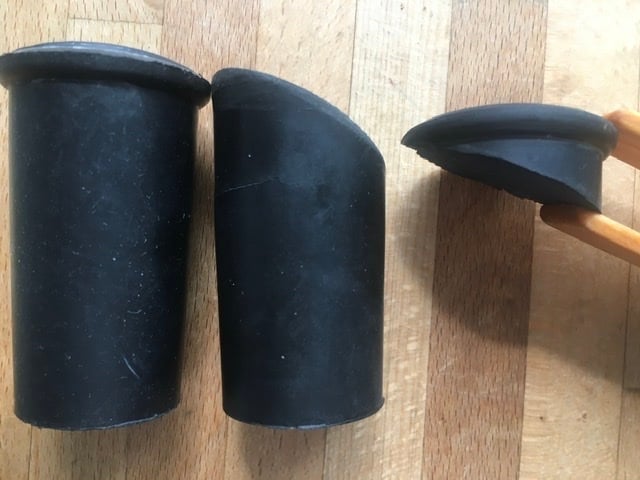
As the endpin is now much more angled to the floor (like an acoustic DB), I got a new crutch rubber foot (largest I could get, inner diameter 22 mm, the endpin tube is a bit larger, full rubber below the hole is 25 mm) and cut the rubber to fit the typical angle to the floor and rounded it a bit while cutting to have some variability in the angle. Then I filed it a bit to make it more smooth and also to rough the surface a bit up. The first one broke after a few years because the tube was larger and the rubber was stressed at the bottom of the hole.
In my next version I widened it more slowly by putting something inside that widened it slowly to the tube diameter. You can even see where the full rubber part ends by the crack in the middle part at the bottom of the hole.
I have the attachable/detachable version twice, one for the ball on stage, and one with a cheaper tip rounded rubber for transport. I hardly use the ball now since the cheap tip is almost as good as the rubber ball.
For extreme cases (or when playing seated (mostly with EUB), I use the Xeros strip with a (height-)modified drum throne.
I have pictured the holder with the cheap tip elsewhere here.
I changed the angled Clevinger EUB endpin (pointing straight up below the bridge) to be in line with the body like a traditional endpin. With the angled foot the bow catches the instrument to be moved sideways.
As the endpin is now much more angled to the floor (like an acoustic DB), I got a new crutch rubber foot (largest I could get, inner diameter 22 mm, the endpin tube is a bit larger, full rubber below the hole is 25 mm) and cut the rubber to fit the typical angle to the floor and rounded it a bit while cutting to have some variability in the angle. Then I filed it a bit to make it more smooth and also to rough the surface a bit up. The first one broke after a few years because the tube was larger and the rubber was stressed at the bottom of the hole.
In my next version I widened it more slowly by putting something inside that widened it slowly to the tube diameter. You can even see where the full rubber part ends by the crack in the middle part at the bottom of the hole.
Last edited:
The rubber balls are good, but on concrete or asphalt (like during transport) they can get ruined in a rather short time.
I have the attachable/detachable version twice, one for the ball on stage, and one with a cheaper tip rounded rubber for transport. I hardly use the ball now since the cheap tip is almost as good as the rubber ball.
For extreme cases (or when playing seated (mostly with EUB), I use the Xeros strip with a (height-)modified drum throne.
I have pictured the holder with the cheap tip elsewhere here.
I changed the angled Clevinger EUB endpin (pointing straight up below the bridge) to be in line with the body like a traditional endpin. With the angled foot the bow catches the instrument to be moved sideways.
As the endpin is now much more angled to the floor (like an acoustic DB), I got a new crutch rubber foot (largest I could get, inner diameter 22 mm, the endpin tube is a bit larger, full rubber below the hole is 25 mm) and cut the rubber to fit the typical angle to the floor and rounded it a bit while cutting to have some variability in the angle. Then I filed it a bit to make it more smooth and also to rough the surface a bit up. The first one broke after a few years because the tube was larger and the rubber was stressed at the bottom of the hole.
In my next version I widened it more slowly by putting something inside that widened it slowly to the tube diameter. You can even see where the full rubber part ends by the crack in the middle part at the bottom of the hole.
View attachment 7244346
This is clev[ing]er, but you still have to be mindful of the orientations. Nothing beats the simplicity of a rubber ball. I have been using the same one for a year or two and it's worn down a smidge but not too badly, and I have a couple of spares lying around. I don't do anything specifically to protect it during transport.
I use the orientation so that the Clevinger falls towards me in the right orientation, so it is to my favor.
The leg/endpin cannot rotate around its length axis on the Clevinger, so I always can be sure that if falls to me where I want it to be.
But that won‘t work the same way on a typical DB endpin that can rotate around its axis.
The leg/endpin cannot rotate around its length axis on the Clevinger, so I always can be sure that if falls to me where I want it to be.
But that won‘t work the same way on a typical DB endpin that can rotate around its axis.
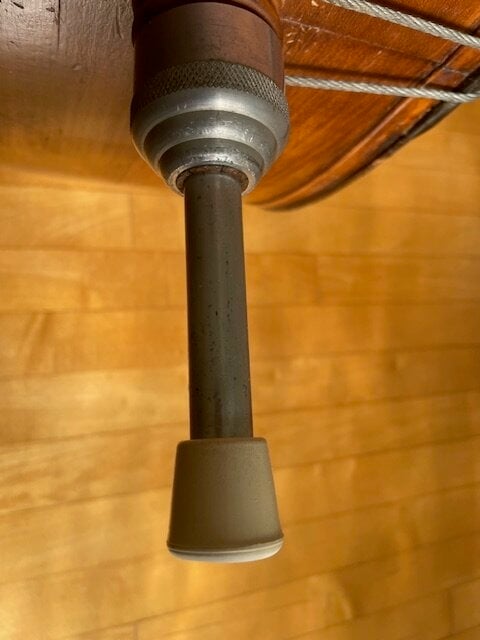
Here is another approach to minimizing end pin scoot that was developed by the late luthier Paul Toennigas. He had a unique design that uses a threaded metal fitting to tighten the end pin into the bass, and, because it has a thicker pin, it just uses a rubber chair leg cushion that fits on the end of the pin. I gave never had a problem with end pin scoot with this bass.