• TalkBass has been independent since 1998. Add your voice.
    Create a free account to reply to discussions, view embedded media, and browse with fewer display ads.
    Join freeLog in
    Want zero display ads or expanded classifieds tools? Compare plans.

Bass Sustain Comparison Tests

My first build (Jaybird - posted earlier) had much better sustain levels than I was used to on my regular bass (a Vintage fretless). So I was curious to see if I could measure it.

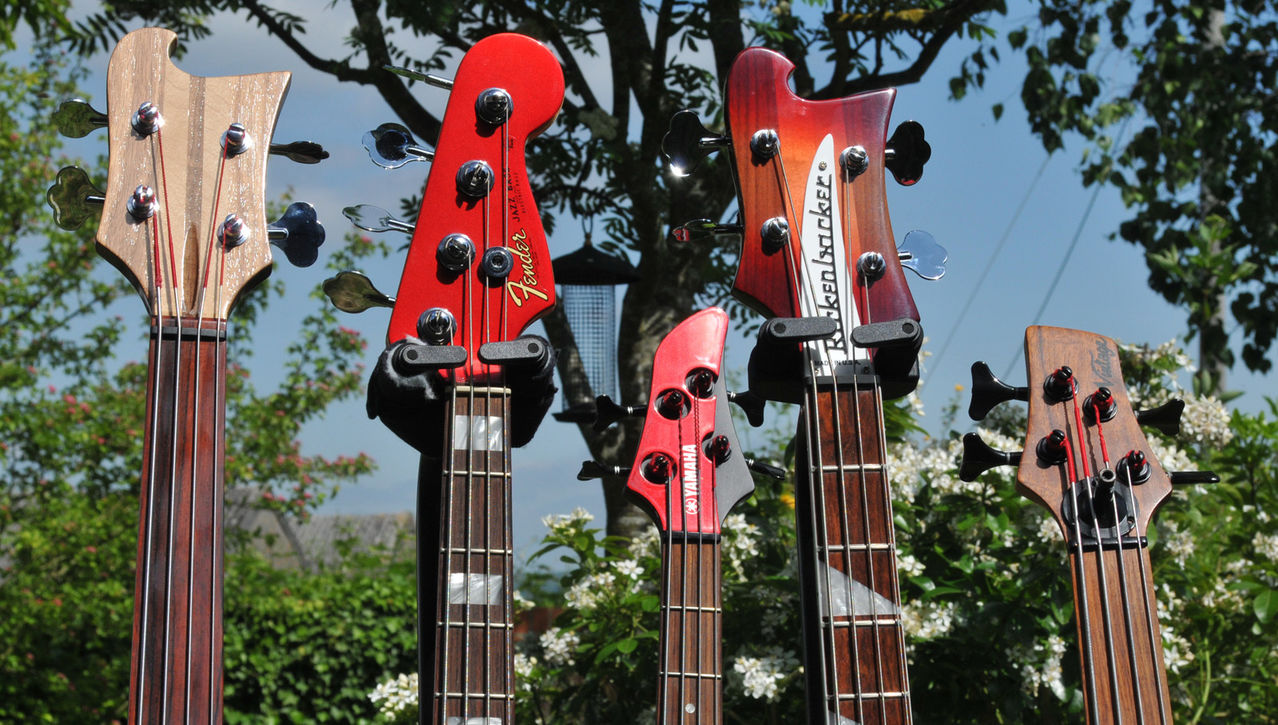
I could beg, steal or borrow five basses for the comparison:

Rickenbacker 4003
Fender 50th Anniversary Jazz
Yamaha RBX 374 - an active bass
Vintage V950FL - my regular, fretless, also active

... and my new build, Jaybird, also fretless ...
1002013060101_A.jpg


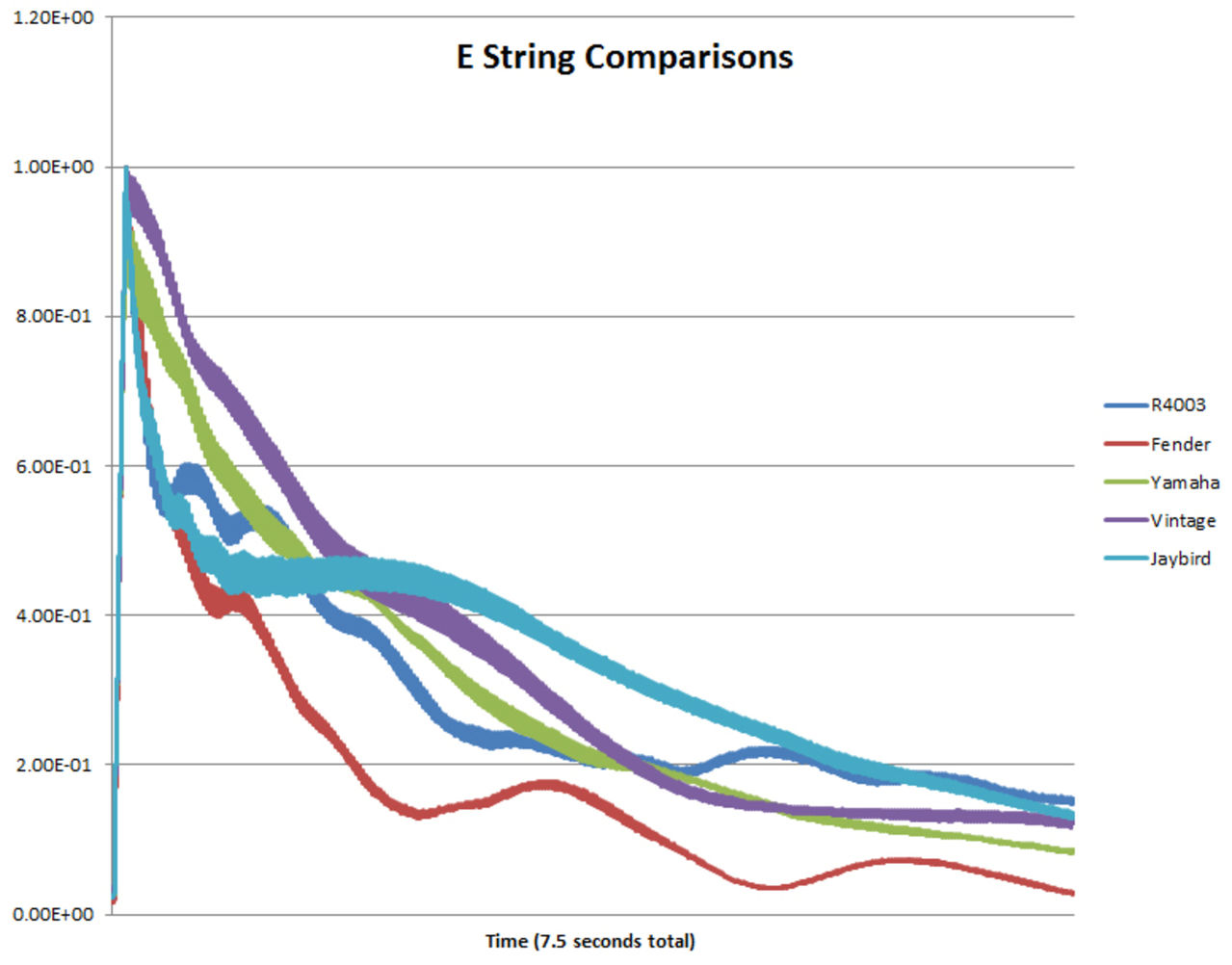
I took 5 samples of each string of each bass and averaged those to get a representative amplitude versus time graph over 7.5 seconds and then compared them against each other.
101_E_String_Sustain.jpg


The full set of comparisons are here: http://imgur.com/a/iVucx

Conclusions? My Jaybird was pretty good across the range (especially on the D string) and certainly better than the Vintage. I don't know why the D string sustains so well.
The Fender was very damped on E.

Hope this is of some interest.

Paul
 
Interesting... what was the method you used?

I used Audacity (free) to capture and save as a WAV file; then extracted from the WAV file to a TXT array. After that is was just processing the data - which can be done in spreadsheets like Excel. The processing was basically taking a moving average of the absolute values (a low pass filter can also be used and gives very similar results).

Paul
 
I used Audacity (free) to capture and save as a WAV file; then extracted from the WAV file to a TXT array. After that is was just processing the data - which can be done in spreadsheets like Excel. The processing was basically taking a moving average of the absolute values (a low pass filter can also be used and gives very similar results).

Paul
Thanks Paul, as a researcher, I was looking for the methodology employed to gather the data as opposed to how the data was processed. For example, what were the room conditions, how were the strings activated, what controls were in place in order to correct errors and limit variable, etcetera - that kind of thing. All the details necessary for the experiment to be replicated.

If there were no controls in place, and this was done, for example, by yourself, playing each bass with your fingers or pick through a cable/interface into your computer, that has major implications for any interpretation of the results due to the wide variability present in that measurement scenario. Just wanted more detail so that the results can be contextualized...
 
Exactly. It requires a plucking machine, with its position parameters well controlled. And fresh sets o the same strings on each bass. And even then you'd want to take ten samples on each string, and average them out. Your traces seem to all be normalized to the peak values, so it is absolutely essential that the attack be carefully controlled. An alternative might be to normalize to an offset of maybe 50 ms from attack. And then you could generate a T60​ to that offset.

Plus there's the matter of pickup placement. You can get a higher or lower energy level depending whether the favored harmonics of the string work well or poorly with that pickup position. IOW, you would expect to get different results with a J-neck and a J-bridge based solely on that position factor, electrical aspects aside.
 
Pickup height would matter too, since some pickups have a reputation (whether true or not) of being too magnetic, harming sustain. I'd run a bunch of rounds of tests just for checking this....start at a fixed distance below the E and G strings (like 1/4" or something), and decrease the distance by 1/64" between each test, testing each string to see how it (potentially) affects them each differently. Do this with several different sets of pickups, and several iterations per pickup set, with a plucking machine of course.
 
Did you use any mechanism to give a consistent initial pluck each time?

I suspended each bass using a Hercules stand (so they could hang from the headstock without the body touching anything). I used the same pick to pluck at the midpoint (12th fret) so that the amplitude did not saturate in Audacity. I normalised each WAV file to ensure there wasn't any bias from one string to the next. And I also did an average of five WAV files per string, which was a bit tricky as I had to align them up.

Paul
 
Exactly. It requires a plucking machine, with its position parameters well controlled. And fresh sets o the same strings on each bass. And even then you'd want to take ten samples on each string, and average them out. Your traces seem to all be normalized to the peak values, so it is absolutely essential that the attack be carefully controlled. An alternative might be to normalize to an offset of maybe 50 ms from attack. And then you could generate a T60​ to that offset.

Plus there's the matter of pickup placement. You can get a higher or lower energy level depending whether the favored harmonics of the string work well or poorly with that pickup position. IOW, you would expect to get different results with a J-neck and a J-bridge based solely on that position factor, electrical aspects aside.

Also in answer to others including Beej ...

I did both a moving average on each of the five samples of each string, and then normalised - so that would be similar to what you suggest. Only after that did I align the five samples before getting a final average for each string.

I am not sure that pickup placement would affect the experiment. However, another poster is correct about the strings. I did not put new strings on all basses.

Finally, I was just really fooling around, but at the same time trying to be experimentally rigorous enough to get an idea of comparison. Everything I did was identical for each string on each bass so the results were as unbiased as I could manage without getting out the lab coat and hiring an anechoic chamber ;-)

Paul
 
Interesting study! Its cool to see how basses line up head to head. Did they all have the same type of strings on them?


Same here, foam and old flats on all my basses!

No - the strings were different.

Both fretlesses had flatwounds, the others roundwound. The 4003 strings are fairly fresh, Jaybird's were new, the other three were older strings.

Paul
 
Pickup height would matter too, since some pickups have a reputation (whether true or not) of being too magnetic, harming sustain. I'd run a bunch of rounds of tests just for checking this....start at a fixed distance below the E and G strings (like 1/4" or something), and decrease the distance by 1/64" between each test, testing each string to see how it (potentially) affects them each differently. Do this with several different sets of pickups, and several iterations per pickup set, with a plucking machine of course.

I see the point about pickup heights. Thanks. But, sorry ... I really don't have the time for this - sounds exhausting, if not exhaustive!

Paul
 
Yes, I understand that this was done for curiosity's sake, and not with full scientific rigor in mind. Thanks for doing as much as you did!

If you happen to do it again though, one more suggestion -- plucking at the 12th fret is probably the worst possible choice. Doing so produces something close to a square wave, all odd-numbered harmonics with the even harmonics nearly (or if theoretically perfect, entirely) absent.

Also, hanging from the headstock changes the normally cantilever aspect of the neck beam. Better to hang it from the strap pegs.