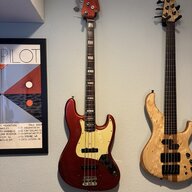
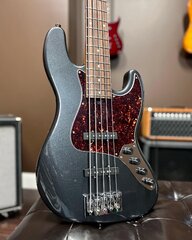
Can we agree that all Jazz and Pbasses are all between 8-9lbs.
Not even close. I have built 4 string basses as light as 6.6 pounds. My
5 string jazz is 7.3
If you want to understand what controls sustain (the thing that "heavier" is alleged to help), you need to first understand the Physics of what's going on. When you pluck a string, there is a certain amount of energy in that string. Anytime energy leaves the string, you reduce sustain. People that talk about "coupling energy into the body" have it
precisely backwards - if you efficiently couple the energy of the string into the body or neck, you take away ALL the sustain. For sustain to happen, the energy has to remain in the string - the goal is to keep the energy in the string.
OK, to keep energy in the string, what do you do? Well, first, there are three places the string loses energy. First is into the air - the string does lose a bit of energy directly vibrating the air around it. But, you can't do anything about that, assuming you are going to play in places with air, so let's set that aside.
The other two places are the ends of the string. For energy to remain in the string, you want the "end conditions" of the string to be infinitely stiff and infinitely massive. Neither of those is strictly true, so let's take off our Physicist's hats and put on our Engineer's caps. There are (as said before) two ends to the string. Neither is special - both contribute equally to keeping (or losing energy) - if they are the same. Are they the same?
OK, if you[re thinking along with me, you probably realize the two ends of the string are not the same. On one end, the string is anchored in a massive block of metal, and that is screwed to a massive block of wood. On the other end, your finger (which is not all that stiff) is holding the string against a tiny metal strip, and that is anchored in a relatively thin piece of wood. Where are the most losses going to occur? Yes, that's right, at the neck/fret end of the string. Dead spots (when you have very little sustain) occur because at that point, and at that frequency, energy does couple into the neck well - it leaves the string, and goes into the neck (some of it subsequently goes into the body through the neck). For other notes, the situation is not as severe, but the fret/neck end of the string is where the most losses occur. So, if you want more sustain you fix the problem end, you don't work on the end where the problem isn't. A heavier, stiffer body isn't the solution. A heavier, stiffer bridge also isn't the solution. A heavier, stiffer neck is. Pick up a bunch of J basses (with thin necks). Play them. Then go and pick up some 5's with big necks (a thicker neck is more massive and much stiffer - the geometry gives you stiffness as well as mass). Play those. Note which has more sustain.
I build my own basses. They are 5 strings - all under 8 pounds. Light bridges, light bodies, the necks are thick (made with roasted maple), they have graphite rods making them stiffer (roasting the maple also makes them stiffer). I work on other people's basses (not a lot, but a few here and there, and some of them have "noodle necks" - skinny Ibanez's and the like. A good thick, stiff neck is what you want for good sustain.