• TalkBass has been independent since 1998. Add your voice.
    Create a free account to reply to discussions, view embedded media, and browse with fewer display ads.
    Join freeLog in
    Want zero display ads or expanded classifieds tools? Compare plans.

basscyclist thread picture thread

I recently got a new B17.

A few observations-

they finally come in a sort of usable box instead of the "almost a box" they used to come in.

This one is much harder than the last one I got- but I *may* have over-conditioned that one when I first got it.

But it'll break in nicely.

Brooks 2023 by Dave The Golden Boy, on Flickr
I used a B17 for years, great saddle. Currently have the Swift w/ Ti frame and it's very light. Also have the newer Brooks rubber saddle. Sadly both are like new and neither are being used. Need to find them a good home.
 
Unfortunately Brooks have discontinued what in my mind were their two best saddles:

B68 was the wide flat hard top of the B67 but no springs, just plain rails
B72 was the same top but the rails had a loop in them to supposedly provide a modicum of faint springiness.

Even though I don't LOOK like a pear shaped man walking down the street, my sit bones are quite far apart and even a B17 is a little too narrow. Also as a spinner not a hammerer, I put more weight on the saddle, and there's a fair amount of it (not a 150 lb whippet any more, unfortunately).

The B67, wide, flat, hard, is in my view ALMOST the perfect saddle, but for road use I don't need the springs, and despite my mockery of the "weight weenies" I'd just as soon not haul around 2 lbs of coil springs if I didn't have to. Yeah, it's a little cushier with the springs, but not worth the weight and complexity, not to me. Also, every B67 I've had has needed some reassembly and insertion of washers at a key location to keep the rear rail stable (sorry, can't remember the exact details but I can remember it was a right pain in the youknowwhat to disassemble and reassemble the springs area).
 
Unfortunately Brooks have discontinued what in my mind were their two best saddles:

B68 was the wide flat hard top of the B67 but no springs, just plain rails
I don't know if you follow such things- but it looks like Rivendell is getting B68s- but only for OEM on Rivendells.

On the other hand- it may be opening a door for a more widespread release.
The Brooks B68 returns... sort of.
Grant wanted Brooks to bring back this saddle for years but the only way we were able to do it was as an original equipment item, meaning, we can only sell it with a bike. He explains it best:
"First, we have to be clear about this. 'Only with a new bicycle purchase' is to be taken literally, in the old-fashioned, original definition of the word. If you took delivery on a bike YESTERDAY, we can't sell it to you.

Because that's the agreement we made with Selle Royal, the Italian parent of Brooks. It's the agreement which allowed us to get these B.68 saddles. All of our other models, we get through a U.S. distributor of Brooks, and we can .. sell them normally. They didn't stock the B.68 and for their own reasons which we are not questioning, they had no interest in importing it. Selle Royal didn't want to interfere with the U.S. distributor's sales (loyalty and support is admirable), but agree to sell these to us OEM, which is industry abbreviation for "original equipment for the manufacturer." When a bike maker or car maker or probably any other kind of maker puts something together out of many parts, and has the complete assembly done elsewhere, the parts are shipped in "easy to grab" fashion. These parts are OEM.

Big companies have different sales channels. OE (the M is often dropped) sales people have their own tasks, and wholesalers have their own. In this case, the guy there who went to bat for us was the OE sales guy, Carlo. An Italian Carlo who is not Carlo Ponti, but close: Carlo Piovan. He said he'd take care of us as long as we didn't sell them "aftermarket,"--retail. As long as we sold them only as OE on new bicycles. IF we do otherwise, Carlo looks bad and gets sad, then mad. So that's the story and that's what we're doing. I think we've said enough about that, so now...

About the B.68

It dates to the early 1900s. It's about 200mm wide, a bit more than an inch wider than a 170mm B.17, so it's better for upright riding. It's honey brown with black rails, no other options. It doesn't come in an aftermarket box with a congratulatory note for picking Brooks. It comes with "OE" packaging, which means minimal, so they're fast to grab on an assembly line. You still get the saddle, it won't come to you the standard overly fancy Brooks box; it'll be in the box if we're shipping to you, or on your new bicycle if you come by for pickup."
-------------

We got the shipment in today but these won't be on our site and I'm not totally sure how we'll make it an option for people buying bikes, but that's a next week problem. If you have a bike in the works here and want one, email whoever you've been working with and we can arrange it. They're only available in Honey, and the price is TBD, but it'll only be a little more than what a B67 costs.
 
I used a B17 for years, great saddle. Currently have the Swift w/ Ti frame and it's very light. Also have the newer Brooks rubber saddle. Sadly both are like new and neither are being used. Need to find them a good home.
I've got one other B17, a few of the older 'cloth and rubber' C17s and one of the fancy Berthoud saddles.

I like the B17- The Cambiums are great- and I need to put more miles on the Berthoud- but that thing is HARD.

Thing is I have 4 bikes that I regularly ride and have a few more that are sorta occasional. I haven't been riding enough to get the Berthoud broken in yet- I think it's been 2 years or so. I've seen issues of the 'cloth and rubber' Cambiums wearing and breaking- but mine have NOWHERE near the miles on them to do that.


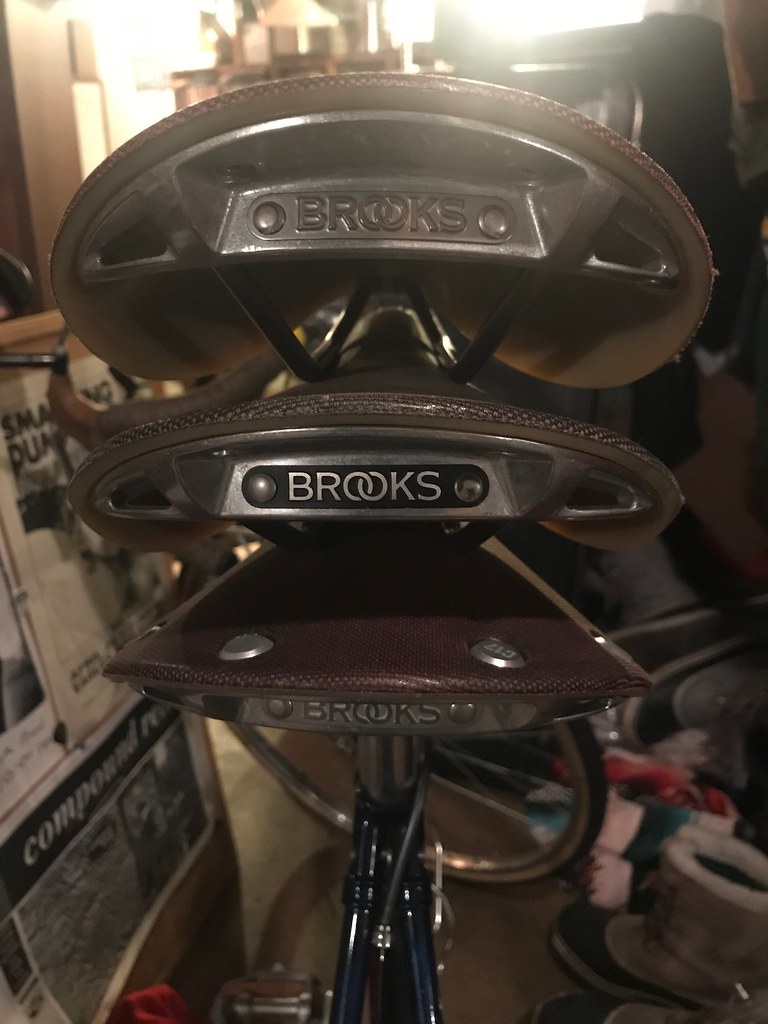
I didn't realize this until just now... I'm becoming a saddle hoarder... Really- who does that? Normal people hoard basses or guitars or 70s stereo gear or bikes... but saddles???

Brooks Saddles by Dave The Golden Boy, on Flickr

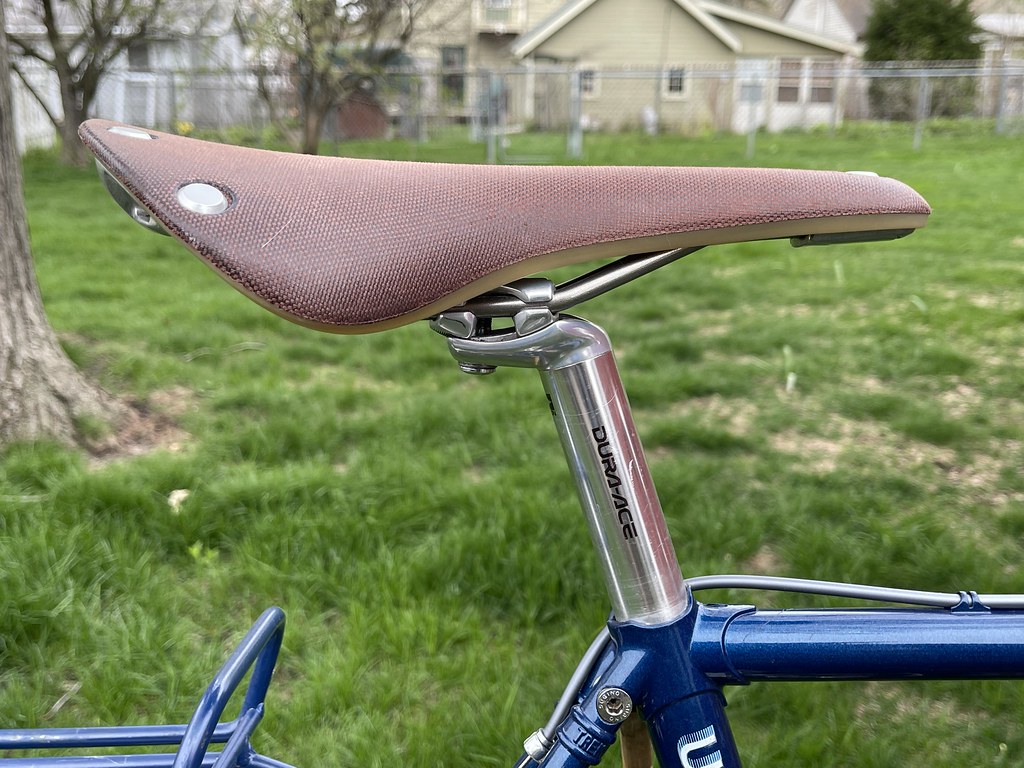
IMG_1744 by Dave The Golden Boy, on Flickr

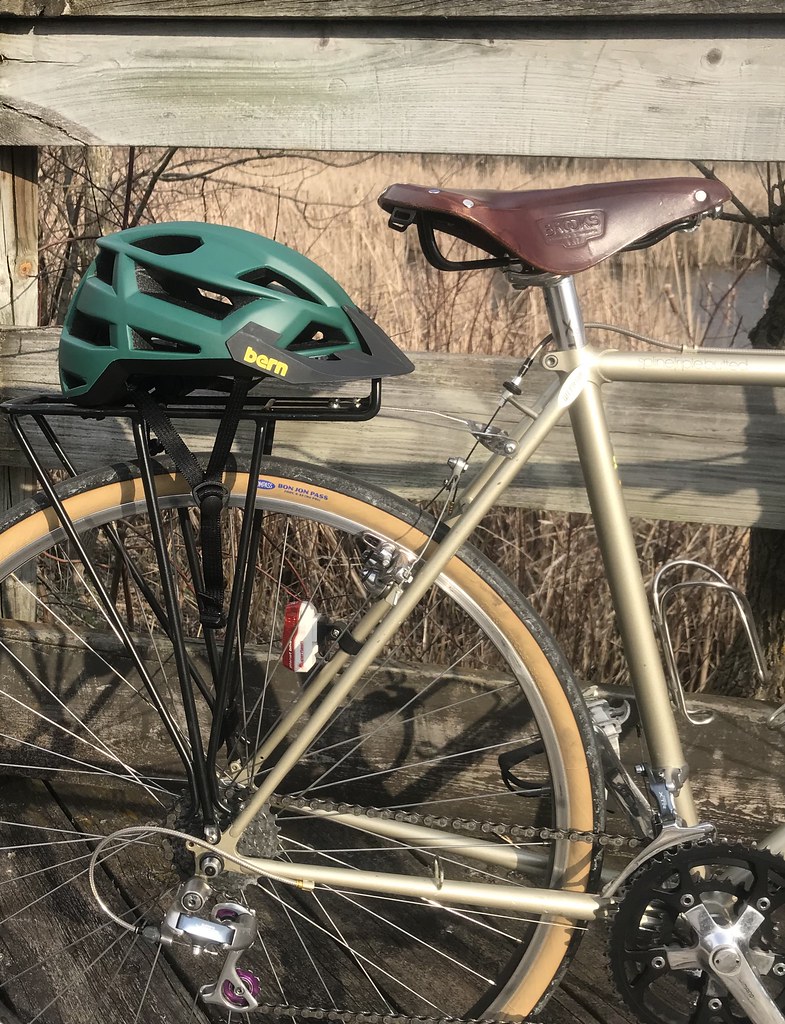
New Hat by Dave The Golden Boy, on Flickr

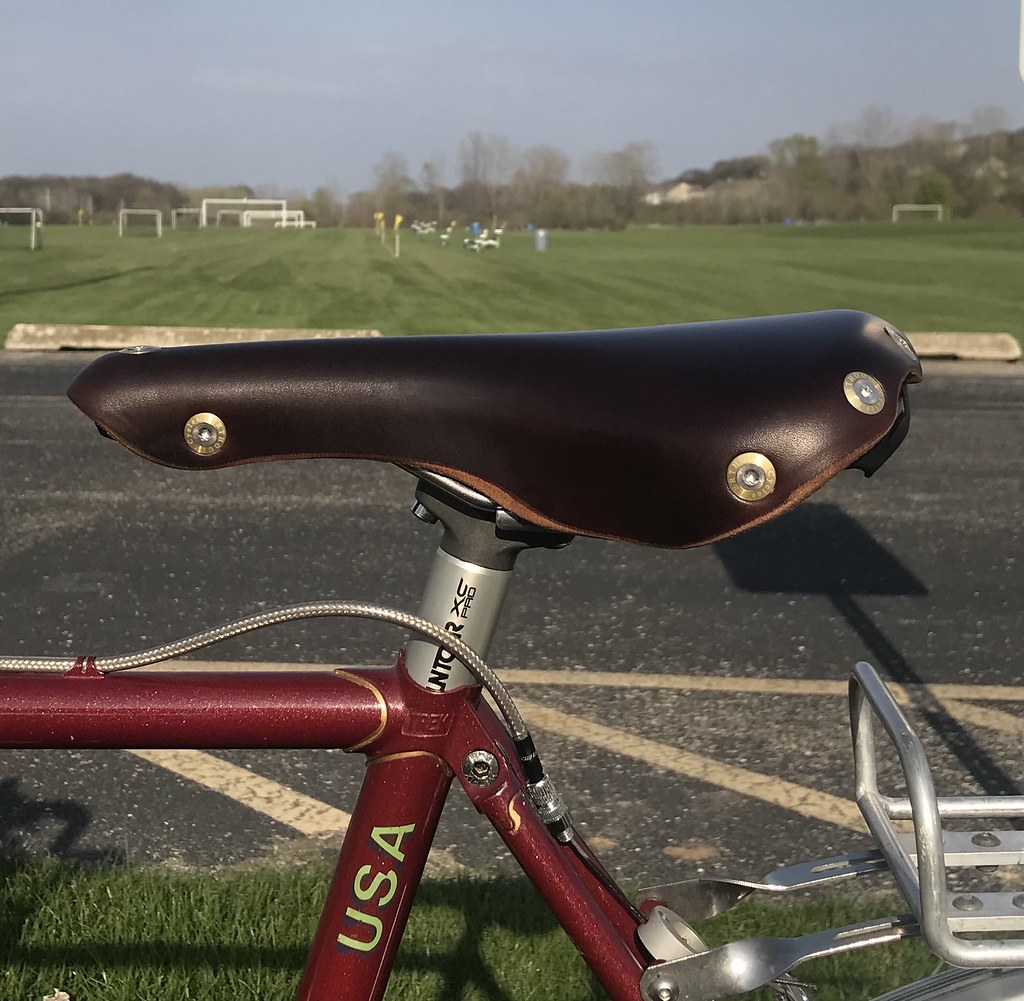
Berthoud Saddle on Trek 720 by Dave The Golden Boy, on Flickr
 
I've got one other B17, a few of the older 'cloth and rubber' C17s and one of the fancy Berthoud saddles.

I like the B17- The Cambiums are great- and I need to put more miles on the Berthoud- but that thing is HARD.

Thing is I have 4 bikes that I regularly ride and have a few more that are sorta occasional. I haven't been riding enough to get the Berthoud broken in yet- I think it's been 2 years or so. I've seen issues of the 'cloth and rubber' Cambiums wearing and breaking- but mine have NOWHERE near the miles on them to do that.


I didn't realize this until just now... I'm becoming a saddle hoarder... Really- who does that? Normal people hoard basses or guitars or 70s stereo gear or bikes... but saddles???

Brooks Saddles by Dave The Golden Boy, on Flickr

IMG_1744 by Dave The Golden Boy, on Flickr

New Hat by Dave The Golden Boy, on Flickr

Berthoud Saddle on Trek 720 by Dave The Golden Boy, on Flickr
Apparently I'm a saddle hoarder too.:roflmao: But I don't want to be. I'd rather have these go to someone who could put the proper miles in them.


My current road bike setup.
7-21 angle.JPG
 
I'm sorry Surly have climbed on the straight-bladed fork bandwagon. Traditional bikes have curved fork blades for a reason and they work very well. Eliminating that one bending operation is foolish economy.
What's the benefit? I could see how the curve would make it more springy, and thus a more comfortable ride. You can see the difference in the my two bike pictures on the previous page. The Diamondback straight blades, the other thing has a really curvy fork. Now it was perfectly economical -- I paid $1 for it, and I found the rest of the frame on the curb last year. ;)
 
20230224_181537.jpg

Finished overhauling my commuter just in time for more snowfall. It needed new brake pads, other than that the rear derailleur was just gummed up. I put the front derailleur on again just to keep the chain in place.

I also moved the milk crate to the front rack - with my work stuff it doesn't affect handling as much as on the rear, and I don't need to stretch my leg over the crate to get on the bike anymore.
 
Last edited:
What's the benefit? I could see how the curve would make it more springy, and thus a more comfortable ride. You can see the difference in the my two bike pictures on the previous page. The Diamondback straight blades, the other thing has a really curvy fork. Now it was perfectly economical -- I paid $1 for it, and I found the rest of the frame on the curb last year. ;)
I have no real evidence, but I think I've read Sheldon Brown discussing how they'd use manufacturing techniques to creatively vary the thickness of the steel along the bend of the fork to create a point where it'll actually bend a bit during use and absorb a bit of road noise/vibration from bumps and such. Probably calculated to be within the stress limits of the tubing based on forces from a rider of a certain weight going through certain conditions.

I can't speak to its efficacy, and I don't want to assume that they don't plan conceptually similar things for straight bladed forks. But I will say that my trek is made with triple butted steel, and in spite having similar geometry and the same size of wheels and tires, has a much different feel and it has a more "traditionally" curved fork with tubing that's skinnier in diameter towards the drop-outs than towards the crown as opposed to the CCM which has a similar diameter throughout.
 
Last edited:
Unfortunately Brooks have discontinued what in my mind were their two best saddles:

B68 was the wide flat hard top of the B67 but no springs, just plain rails
B72 was the same top but the rails had a loop in them to supposedly provide a modicum of faint springiness.

Even though I don't LOOK like a pear shaped man walking down the street, my sit bones are quite far apart and even a B17 is a little too narrow. Also as a spinner not a hammerer, I put more weight on the saddle, and there's a fair amount of it (not a 150 lb whippet any more, unfortunately).

The B67, wide, flat, hard, is in my view ALMOST the perfect saddle, but for road use I don't need the springs, and despite my mockery of the "weight weenies" I'd just as soon not haul around 2 lbs of coil springs if I didn't have to. Yeah, it's a little cushier with the springs, but not worth the weight and complexity, not to me. Also, every B67 I've had has needed some reassembly and insertion of washers at a key location to keep the rear rail stable (sorry, can't remember the exact details but I can remember it was a right pain in the youknowwhat to disassemble and reassemble the springs area).

oUItGJ5.jpg


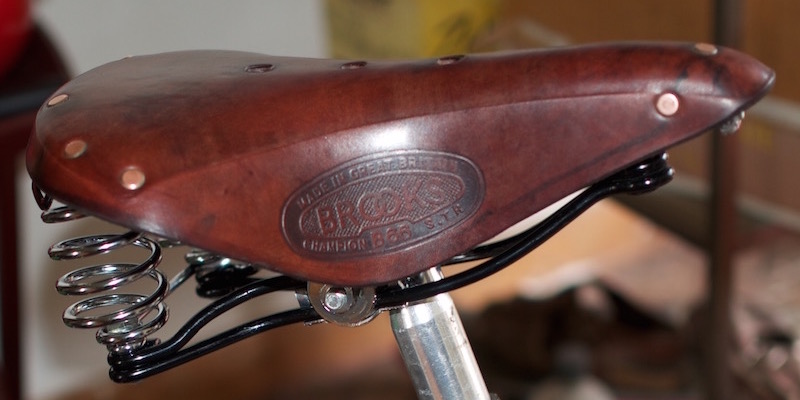
I was lucky to get a NOS B66 Champion.

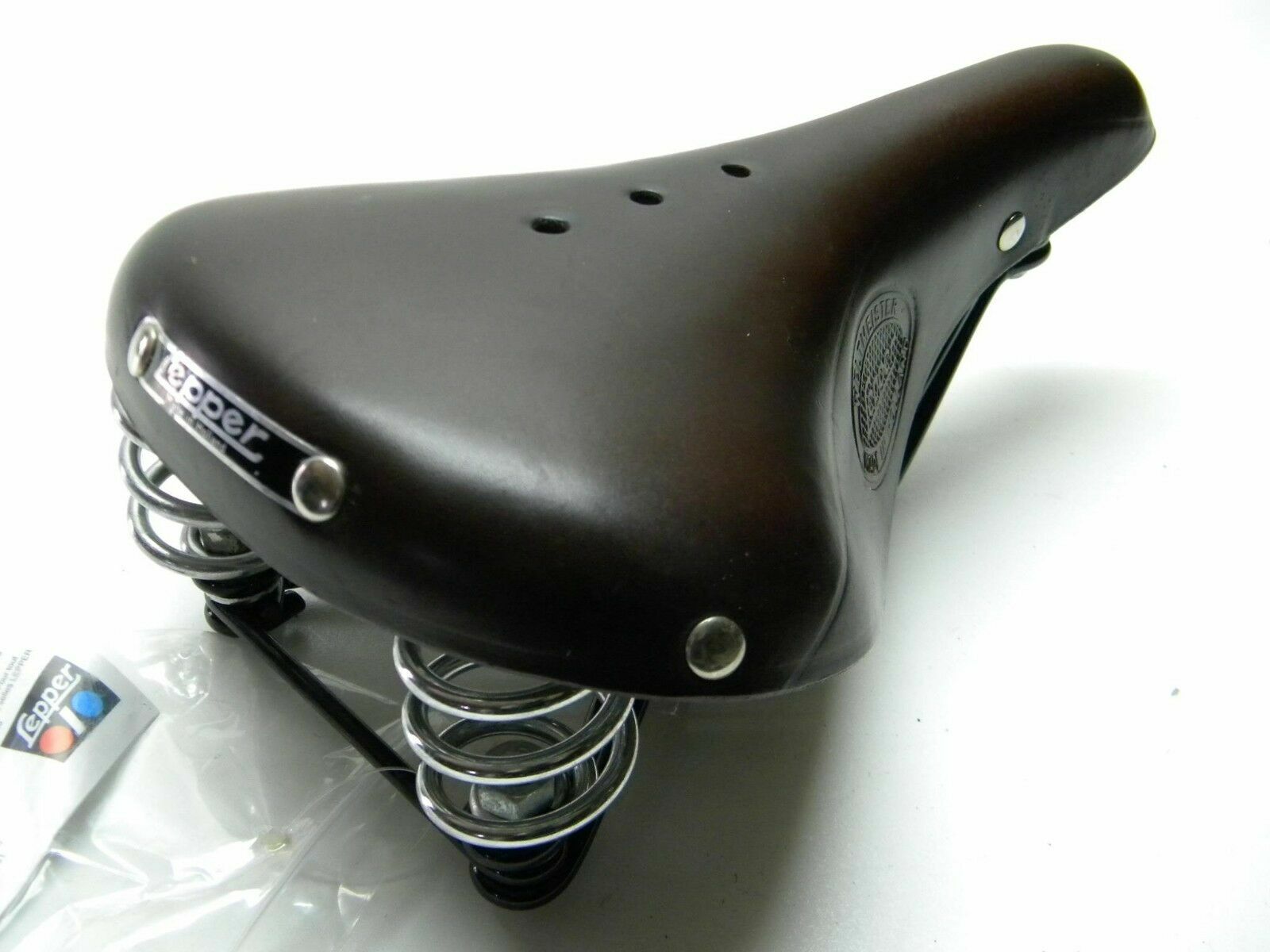
Overhere one might bump into a Lepper Weltmeister, which is similar.
s-l1600.jpg

I've had one of those for years and I liked it.

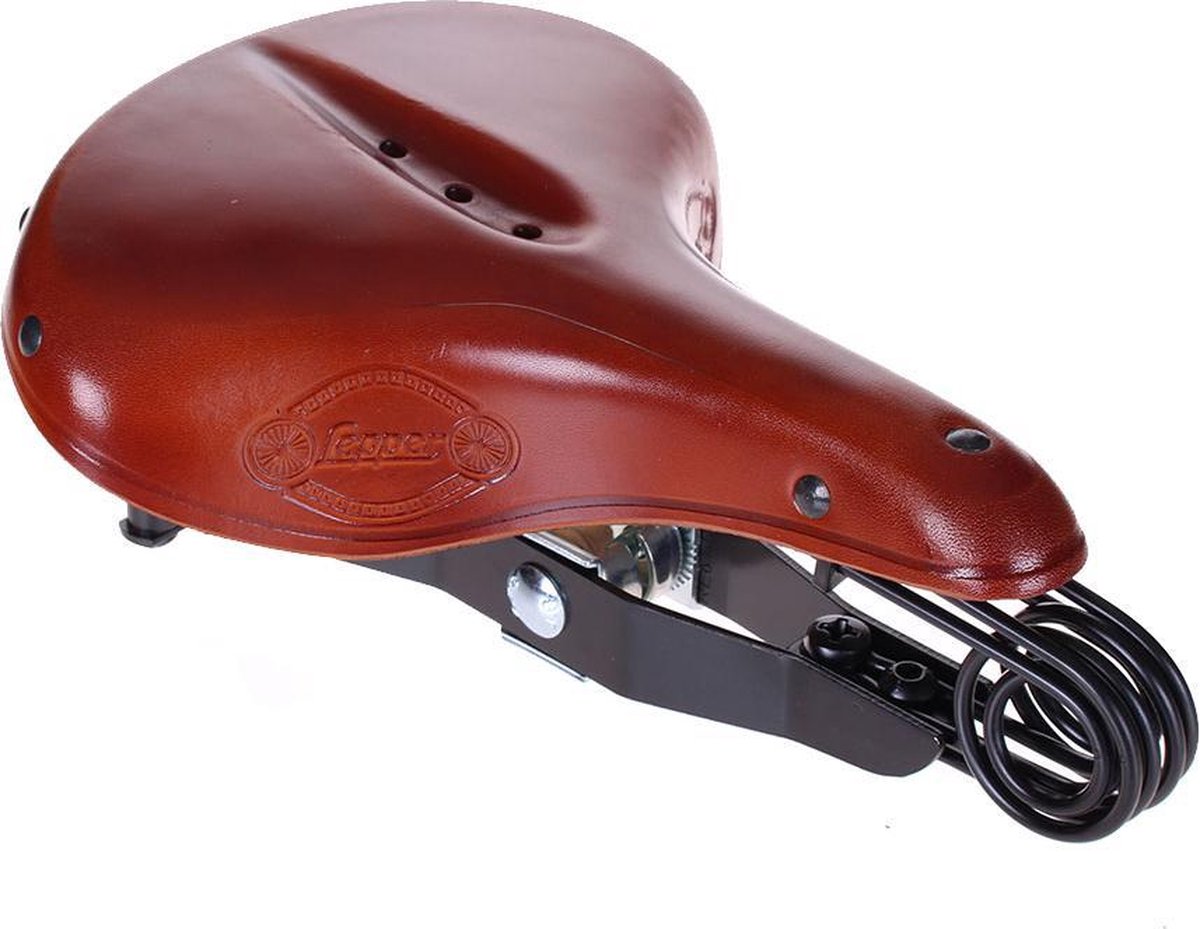
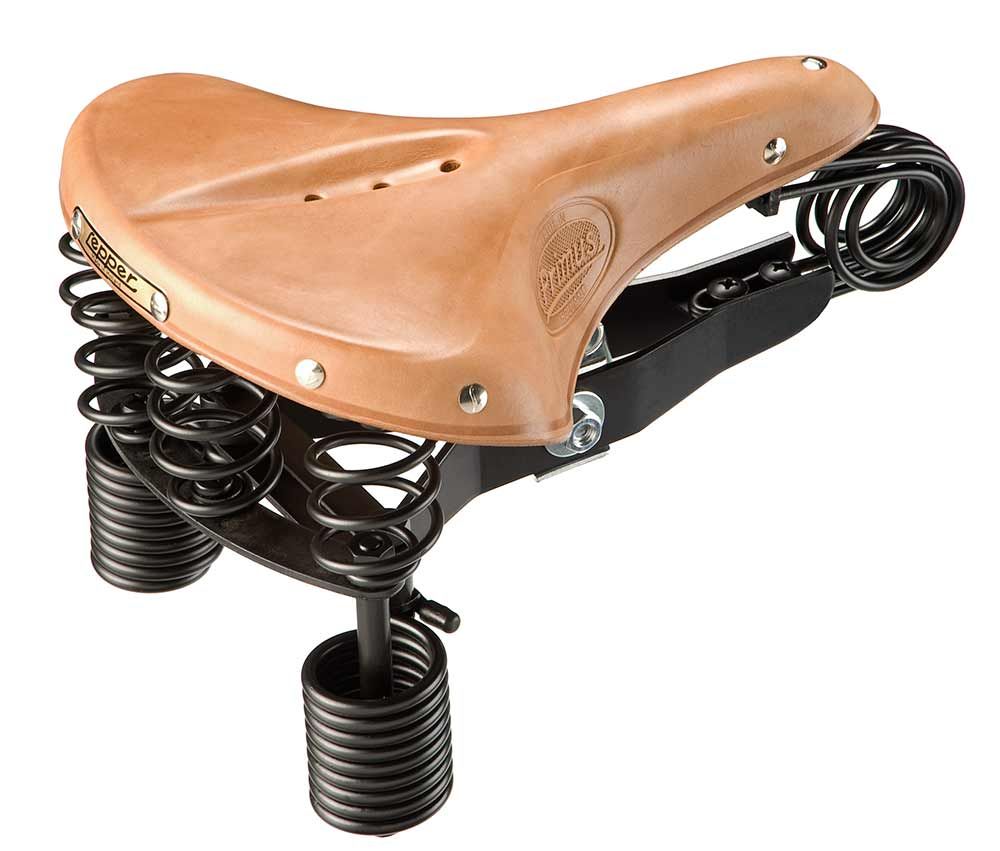
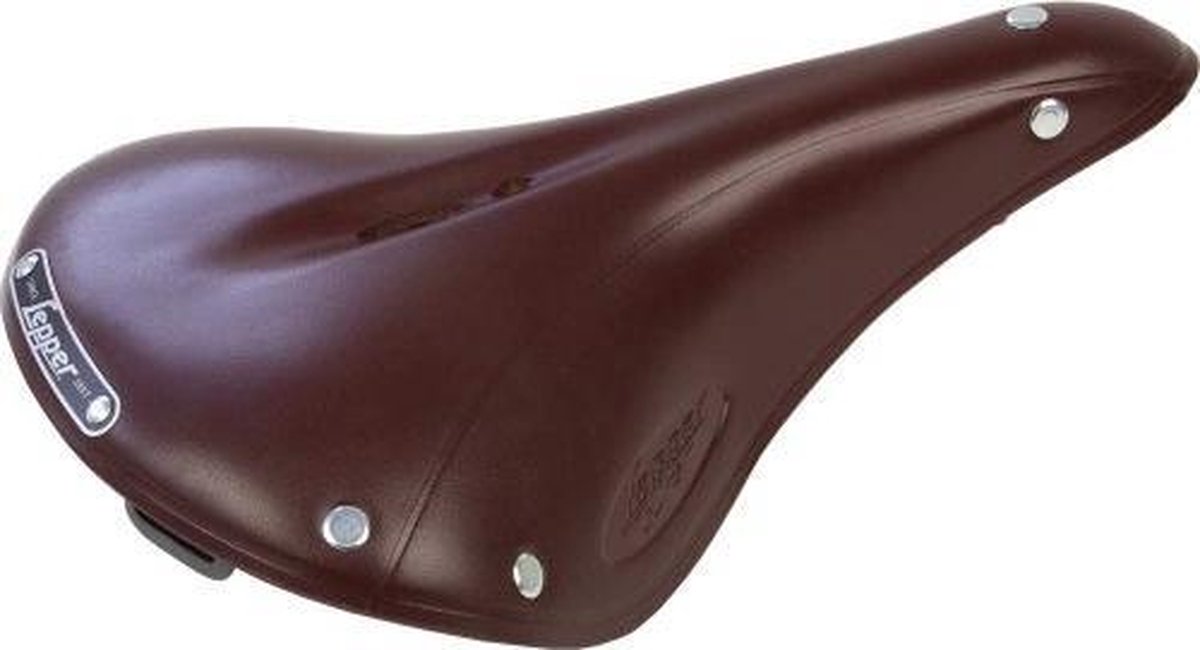
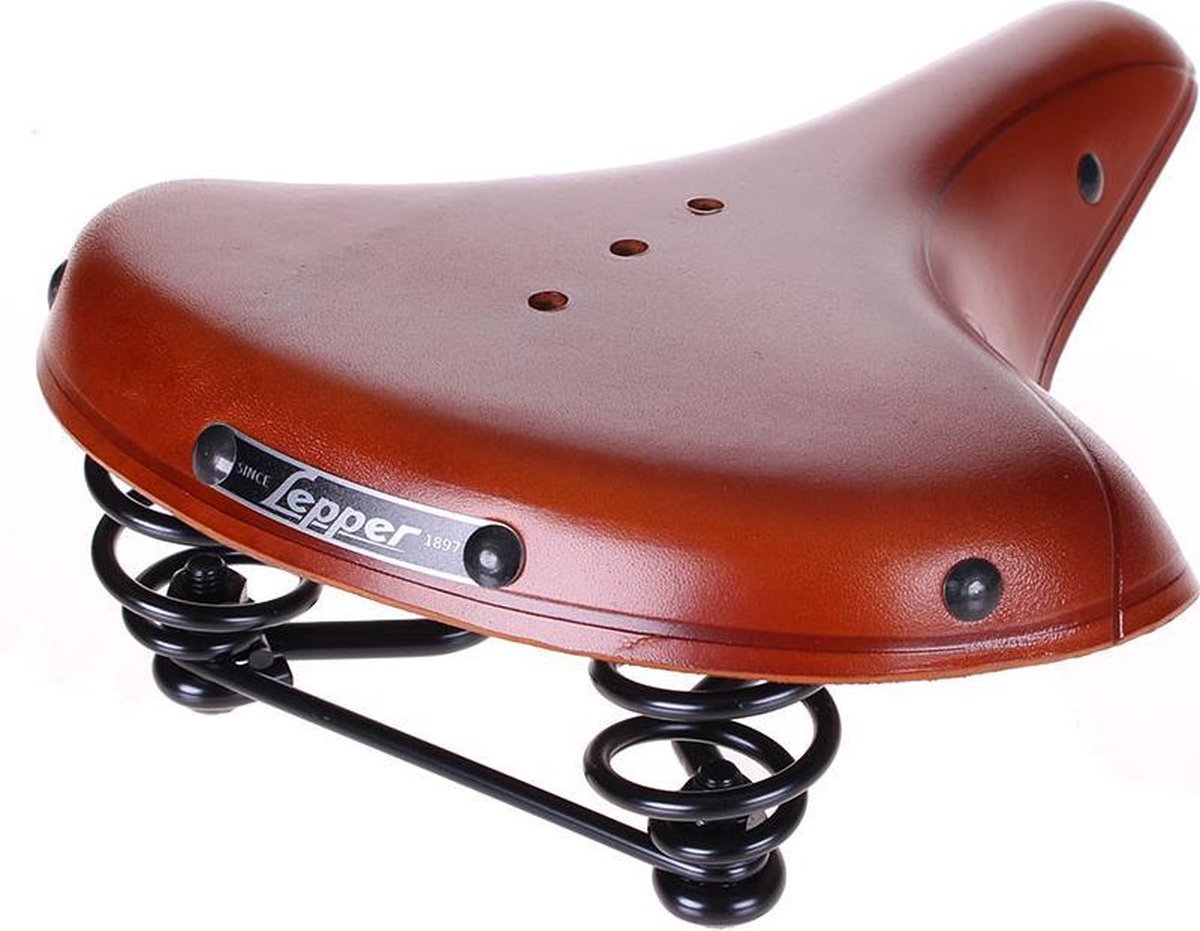
If "your sit bones are quite far apart" you might give these Lepper models a try:

1200x929.jpg

Lepper 3-spring


8715957264758-max-w700.jpg

Lepper Hammock

21320205fe6cba48fefa.jpg

Lepper Primus

More sporty: Lepper Tourer

1200x650.jpg


Or if you prefer springs, a Lepper Concorde 800.
1200x931.jpg
 
Last edited:
What's the benefit? I could see how the curve would make it more springy, and thus a more comfortable ride. You can see the difference in the my two bike pictures on the previous page. The Diamondback straight blades, the other thing has a really curvy fork. Now it was perfectly economical -- I paid $1 for it, and I found the rest of the frame on the curb last year. ;)

I have no real evidence, but I think I've read Sheldon Brown discussing how they'd use manufacturing techniques to creatively vary the thickness of the steel along the bend of the fork to create a point where it'll actually bend a bit during use and absorb a bit of road noise/vibration from bumps and such. Probably calculated to be within the stress limits of the tubing based on forces from a rider of a certain weight going through certain conditions.

I can't speak to its efficacy, and I don't want to assume that they don't plan conceptually similar things for straight bladed forks. But I will say that my trek is made with triple butted steel, and in spite having similar geometry and the same size of wheels and tires, has a much different feel and it has a more "traditionally" curved fork with tubing that's skinnier in diameter towards the drop-outs than towards the crown as opposed to the CCM which has a similar diameter throughout.

The primary reason for the curvy fork is to increase "rake" or "fork offset." This has the ability to affect overall wheelbase length as well as affecting "trail," both of which affect handling of the bike. If you want a fun rabbit hole to go down just read some articles about "high trail vs low trail." I sort of get the concept, but I really don't understand it- all my bikes are pretty medium trail and I'm happy with that, but there's a subset of people that are militantly "low trail."

Back in the day, it was easier to have the steerer, fork crown and the fork legs all along the same plane- then the fork legs bent to achieve the amount of fork offset desired. It was pretty easy to spot a bent fork- as it was relatively easy to draw that plane between the head tube and the fork legs. Nowadays, that offset is built into the fork crown.

And there's a whole shift when butted forks became available- and then when OVALIZED butted forks were available... (btw- "butting" is the process of having a tube having different wall thicknesses, so you'll see wall thickness as something like 9/6/9 or 8/5/8... where the tube is thicker at the ends, where more strength is needed, and thinner in the middle- but still keeping the same outer diameter)
 
The primary reason for the curvy fork is to increase "rake" or "fork offset." This has the ability to affect overall wheelbase length as well as affecting "trail," both of which affect handling of the bike. If you want a fun rabbit hole to go down just read some articles about "high trail vs low trail." I sort of get the concept, but I really don't understand it- all my bikes are pretty medium trail and I'm happy with that, but there's a subset of people that are militantly "low trail."

Back in the day, it was easier to have the steerer, fork crown and the fork legs all along the same plane- then the fork legs bent to achieve the amount of fork offset desired. It was pretty easy to spot a bent fork- as it was relatively easy to draw that plane between the head tube and the fork legs. Nowadays, that offset is built into the fork crown.

And there's a whole shift when butted forks became available- and then when OVALIZED butted forks were available... (btw- "butting" is the process of having a tube having different wall thicknesses, so you'll see wall thickness as something like 9/6/9 or 8/5/8... where the tube is thicker at the ends, where more strength is needed, and thinner in the middle- but still keeping the same outer diameter)
I'll tell you one thing about forks - I'm pretty sure that most bikes need them. So I guess I'm militantly pro fork.
 
The primary reason for the curvy fork is to increase "rake" or "fork offset." This has the ability to affect overall wheelbase length as well as affecting "trail," both of which affect handling of the bike. If you want a fun rabbit hole to go down just read some articles about "high trail vs low trail." I sort of get the concept, but I really don't understand it- all my bikes are pretty medium trail and I'm happy with that, but there's a subset of people that are militantly "low trail."

Back in the day, it was easier to have the steerer, fork crown and the fork legs all along the same plane- then the fork legs bent to achieve the amount of fork offset desired. It was pretty easy to spot a bent fork- as it was relatively easy to draw that plane between the head tube and the fork legs. Nowadays, that offset is built into the fork crown.

And there's a whole shift when butted forks became available- and then when OVALIZED butted forks were available... (btw- "butting" is the process of having a tube having different wall thicknesses, so you'll see wall thickness as something like 9/6/9 or 8/5/8... where the tube is thicker at the ends, where more strength is needed, and thinner in the middle- but still keeping the same outer diameter)
The Diamondback shown above has about 1.5 inches of fork rake. It's subtle, but the joint between the fork and the steerer is angled. The winter bike has about 2.5 inches of rake, which is more than I've ever seen. The folklore I've read is that having more rake makes the bike more twitchy. I'll probably never know about that, so long as I'm riding that bike with heavy studded tires.
 
  • Like
Reactions: pie_man_25
I've got one other B17, a few of the older 'cloth and rubber' C17s and one of the fancy Berthoud saddles.

I like the B17- The Cambiums are great- and I need to put more miles on the Berthoud- but that thing is HARD.

Thing is I have 4 bikes that I regularly ride and have a few more that are sorta occasional. I haven't been riding enough to get the Berthoud broken in yet- I think it's been 2 years or so. I've seen issues of the 'cloth and rubber' Cambiums wearing and breaking- but mine have NOWHERE near the miles on them to do that.


I didn't realize this until just now... I'm becoming a saddle hoarder... Really- who does that? Normal people hoard basses or guitars or 70s stereo gear or bikes... but saddles???

Brooks Saddles by Dave The Golden Boy, on Flickr

IMG_1744 by Dave The Golden Boy, on Flickr

New Hat by Dave The Golden Boy, on Flickr

Berthoud Saddle on Trek 720 by Dave The Golden Boy, on Flickr
All those Cambium saddles have the faddishly popular arched convex top, that removes material from under the sitbones and puts it under the sensitive nerves of the perineum.

The B67/68/72 are wide and flat. The B17 is narrower, but it's still generally FLAT.

I don't know why it's so hard for a saddle manufacturer to make a saddle that's wide, hard, and FLAT, with a narrow nose. Don't need the springs (they're a little bit nice, but they creak and weigh), and those horrible pillowy things they sell to first-timers are guaranteed to create numbness and pain becasue the sitbones sink down into them and all that padding, that seems like such a good idea at first, presses up on the sensitive parts.

The bifurcated molded plastic ones would be great, but they won't make them WIDE and FLAT. They're all ass-hatchet narrow, or they're all puffy like the seats of a 1990 Mercury Grand Marquis.
 
  • Like
Reactions: Hot Rats
I like the looks of the Lepper products, but their web presence is essentially nil, there seems to be exactly ONE retailer that sells them, and the scuttlebutt is that the company waas purchased and closed a couple years ago.
 
The primary reason for the curvy fork is to increase "rake" or "fork offset." ..
And shock absorption!

Rake and trail can be achieved by several means, but a sizeable curved fork rake provides a degree of shock absorption that straight blades don't. In general, "sporty" bikes have been moving more and more toward a harder-riding, more fragile (20 spoke radial wheels vs. 36 spoke three cross, for example), twitchier, less comfortable kind of design, although with no evidence that people other than elite racers actually derive any advantage from these designs.

Where the more traditional road bike design (say, Raleigh Professional, Mercian Olympic, Colnago Mexico, or today's Surly Cross-check) was like driving a Camaro compared to the Buick sedan of the Raleigh International of old or the Surly Long Haul Trucker of today, today's straight-fork-blade 76 degree angle plastic frame with the fewest possible spokes, radial spoking, 15mm wide tires at 140 psi, etc., etc., etc. is like trying to drive an Indy car on the road. In theory very fast, but in practice quite a bit less functional than the older designs.
 
:hyper::hyper::hyper::hyper::hyper::hyper::hyper::hyper::hyper::hyper::hyper::hyper:

Canyon Bikes is running a crazy sale and this is headed my way. I love my Trail Smurf but I've been riding it since 2006 and it'll be nice to ride a modern bike!

View attachment 4978645

Sweet! That's a Neuron, I think? I think you'll find that the newer geometry and 29" wheels does both climbing and descending better. That's how I felt when I left my 26" 2011 Tracer 2 for my 27.5" 2017 Troy. It wasn't subtle and things have progressed quite a bit since 17 too. Hopefully a new bike for me this year as well. Probably will be the fall before I move on it, though.

I rode this for a while a few weeks back. Bit of a departure for me bike-wise. It was hard to wheelie and bunnyhop. :D
Still fun though. Any guesses as to where this is? Hint: there are a lot commuter bikes around.

6e76dqxpxOXBuS12P1zEJDyk4imiQ3tJY3xqlXq9P1RD2JIx-7gyPTjuOrS_YkSv1hNceAl3e6QdkWwfzcTBDr8UmXM377e1pz7z4x22uWZTwIDIqgeSqRpBFvBC6aonzsS3Jk7ZgQRYpqKvCwGgsuAxvFR72g6k-WaOni4_njDgaOSGM4sgtniJXE7ndwfr3FMYr7eC1iIMBaOy9g5YcQG_cuCG-ANyscL6zqdu8eRxAXOc8DSxzWH0Ylx3iFz02wiEf3RcM4cxEP2hVo_-nie72Xi7fCPupMmskWVZXyekUEThlg01C3AzbOYokjQUVQhvFPJirIi1SaymboDwWqkRAV2jyzloq6ELHLyZZpuxnTQ1hGSzkkQQtNI27EL3Uy3cza-7jwx8i2jElFQ7s1KFP4h8jfF23gjTadGpCERluIjtAUq3Jo23pdRMaiBR9f84dTOzMRyYv9BNExtNuk1Va3WvjeCwfMOyISusxHgm2oBYLgF2muPEm_I6ZNDqpd8fU03tn4jURaNpgcvw30Ec46ubqmPfEj1J6QuWloJr9cTh2mWYUcMwOwSWNrv6QwlUevIKZ6-sqQDZIBiIGUfyixwP5SdudWY0QqcsvvtmpDb9QVvu6u52lgzIJRAo-KrYkA6X1QD3FRuPYk_GHdY2Ok7eHO4SkeORAnfGcUQpspsgDlvXA-esqqQMN5-xRhC9ZWeLd1Y_PtF_n5VqbSon5o4YxAO06ywYln0b-Br81sGUC0SKaFJ62cnYTAO2LcMXRVSHKR06cf1bC9NrQwHbvQ7h_HDk8yFiZtNlvjebtoYAx6h67OIo6u8Hs_e5Cg-1Q4wxKrVKRGuSyU-ZPgvVG5-P_eirRY8o6mLqvLyExXkN_PNQo8ZVgidh3ahJUkhPgQR5q0qH6f2AqOwde5EHH3TEohzeJwTABEP28b_MC7UWuw=w708-h943-no
 
  • Like
Reactions: pie_man_25

Latest posts