
Enjoy the benefits of a premium membership!
Upgrade Account
-
TalkBass has been independent since 1998. Add your voice.
Create a free account to reply to discussions, view embedded media, and browse with fewer display ads.
Join free Log in
Want zero display ads or expanded classifieds tools? Compare plans.
You are using an out of date browser. It may not display this or other websites correctly.
You should upgrade or use an alternative browser.
You should upgrade or use an alternative browser.
basses for newbies (SX batch build thread)
- Thread starter chunger
- Start date
- Status
- Not open for further replies.
More options
Who Replied?
either way fine with me Chung. But play that sucker should be interesting when I pluged it in over in Tokyo I was surprised at the sound bought it right then and there.And got a nice hook up for more stuff in the future. They got a nice store in Ikebukuro a short walk for the train station with a freaken 6 story Starbucks. And get this I could not find a seat when I got my coffee just jammed

I don't have time to read all the pages, but can someone catch me up on this thread? When it started, it was a single re-build of a bunch. Sounds like it's far beyond that now. What's the latest?

I don't have time to read all the pages, but can someone catch me up on this thread?
sounds like you need a personal assistant eh?



You could at least read all the pages that have picturesI don't have time to read all the pages, but can someone catch me up on this thread? When it started, it was a single re-build of a bunch. Sounds like it's far beyond that now. What's the latest?

He started with the re builds and then did some experimentation and now he's got a deal with some shop so that he can use a fancy "PLEK" machine. Stuff like that. This thread is worth the read though.
Hey,
I'm using 250K audio taper pots for everything. . . I hear that linear taper pots might be better for the volume controls, but I looked at original Fender specs and figured 250K audio taper would be fine, and I haven't had any problems with this setup.
Alright, thanks for the info.
Nice things here
so how do these things sound? they gig and live worthy after a remake?
Look back through the thread and you will find a lot of audio clips showing exactly how these things sound. We have been absolutely gigging the crap out of these basses and they are holding up quite well. To put things in perspective, after roughly a week of gigging and studio sessions in the field, #4 needs replacement strings, and those are DR Xtra life coated strings.
The only complaint I have on these SX's besides the obvious assembly issues that will not be an issue on my spec basses. . . is the softness of the fret wire. You will only notice this if you really beat on them, but I have been noticing premature wear on the frets on the 2 most beat on samples (#3 and #4).
Another point of irritation probably has more to do with non-reinforced non-laminated Fender type bass necks in general and is not specific to SX. . . when dialed in to very tight tolerances (low action), the truss rod needs a bit more tweaking periodically to keep the action happy. On the 3 piece laminated graphite reinforced necks I was previously building/working with, this was not an issue. I would just set the rod and leave it for years on end.

There's never a need for a condom. If there is, it means that there's no need for the specific sexual partner.
Next.
Interesting approach...

Are the basses being built for you going to fix that issue at all? I didn't figure they would seeing as that would probably drive the price point up higher than you'd like.Another point of irritation probably has more to do with non-reinforced non-laminated Fender type bass necks in general and is not specific to SX. . . when dialed in to very tight tolerances (low action), the truss rod needs a bit more tweaking periodically to keep the action happy. On the 3 piece laminated graphite reinforced necks I was previously building/working with, this was not an issue. I would just set the rod and leave it for years on end.
From what I've heard from luthiers around here, as long as the necks are sufficiently dried the warping issues aren't as severe.
Are the basses being built for you going to fix that issue at all? I didn't figure they would seeing as that would probably drive the price point up higher than you'd like.
From what I've heard from luthiers around here, as long as the necks are sufficiently dried the warping issues aren't as severe.
It is an area of debate. . . yes, I can do 3 piece laminated quarter sawn necks and stability increases, but it drives cost up a bit. And definitely the fret wire issue is resolved on the new production instruments.
In general, what I'm seeing from this particular factory is a bit of pride in the build process that I don't see in the SX's.
I am scheduled to PLEK Tuesday Aug. 31 and will attempt to do 8 instruments. There have been some changes in the business I am dealing with as they have moved the PLEK machine to another music shop. The machine is still owned by the original person I spoke with, but he has a contract agreement with the new music store for use of the PLEK. This complicates things a little bit, but it seems all has been sorted out and he will honor our original agreement. I will be taking lots of pictures and posting because I'm very interested in learning about the PLEK process and I'd like to bring some positive exposure to this new store and perhaps drive more business their way if all goes well.
Another kink is PLEK is raising their license pricing per instrument by a certain amount in September, so my 2nd batch will end up costing a bit more. It's not ridiculous (no more than $20 ea.), but an increase none the less.
I was looking at this again and I really like the dixie cup mod. I think I like it better than the fender style headstock. I like the simple design.Emailed Kurt at Rondo music today. . . I'm letting him know that if he implements the SamTheButcher's famous "Dixie Cup" mod into the current SX line, I'm back in the game and will buy new SX's.
The following pic is not mine, nor is the mod.
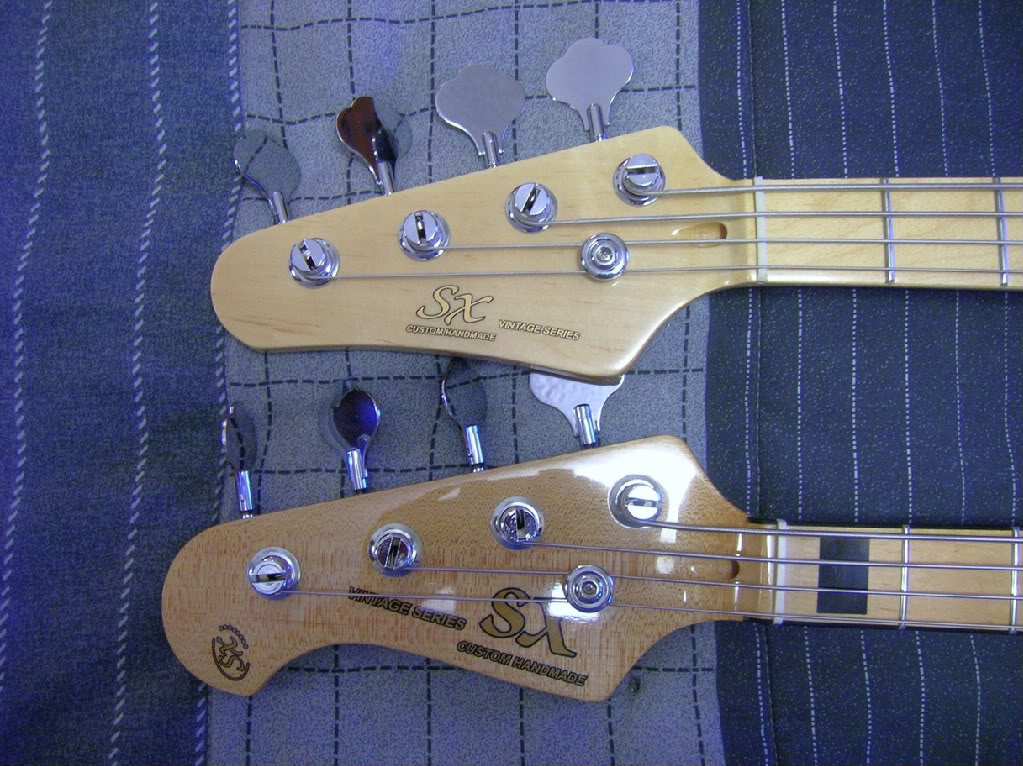

I was looking at this again and I really like the dixie cup mod. I think I like it better than the fender style headstock. I like the simple design.
I like it too.
Well, it was an eventful day in chunger bassland. . . finally, a post with actual content again.
So, PLEK adventures today. I woke up about 45 minutes later than I wanted to because my cell phone alarm didn't go off for some reason But, as it turns out driving to Sacramento is reverse traffic and I made it to the shop about 20 minutes early. Luckily, Mikey who was working at the music store opened shop early, so I was able to take a peek around.

Unfortunately, he knew nothing of my PLEK appointment, but a quick call to his boss Roger cleared things up. We started making service tags for all 8 instruments I dragged in.
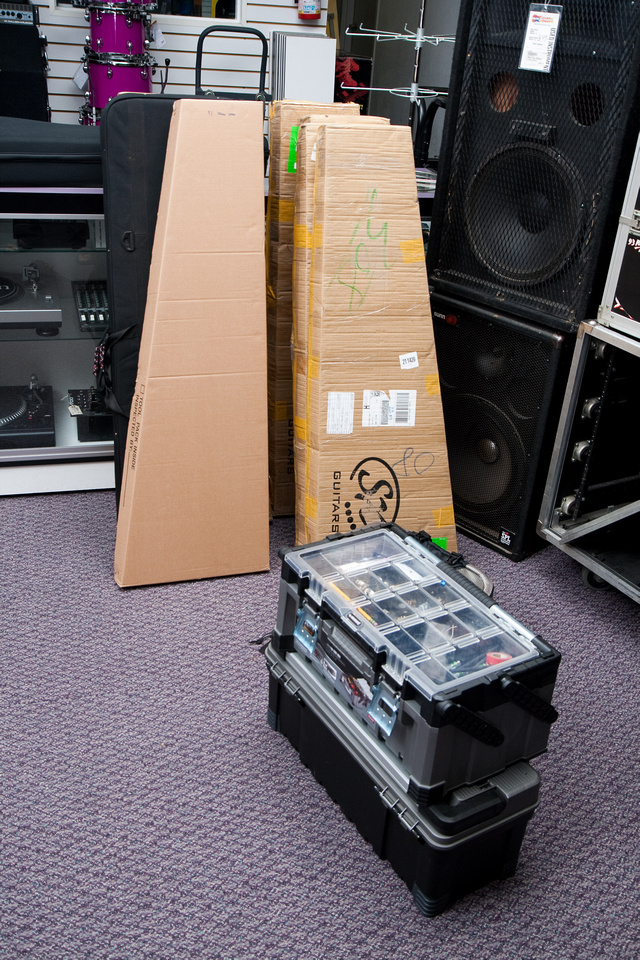
So, what had happened with the PLEK machine was the owner of the machine, Don Wright, has recently suffered serious heart related health problems and subsequently had opted out of the music business due to the stress it induced on his life. So, partnerships have been shifting around quite a bit, and it was decided that his business partner Mike (PLEK technician/luthier) would team up with Roger who owns this Music-Go-Round franchise and consolidate their efforts to add robust guitar repair service to the store as well as place the PLEK machine there and operate it through the store's financial structure. . . . so, there was some confusion about what I was doing because I had spoken with the original owner, but after meeting, speaking with, and working with Mike (plek tech) and Roger (store owner) for the majority of the day, everything has been ironed out, and we had a great time. They now understand that it is my goal to make things as smooth as possible for them as they are giving me a wholesale manufacturer's rate on PLEK services. Another plus is they are encouraging me at this point to bring in more bass guitars for PLEK (not just my production batches) to support my customers should I choose to.
Music Go Round
5413 Sunrise Boulevard
Citrus Heights, CA 95610-7806
(916) 961-1020
Mike is the repair tech now operating out of this store. After speaking with him and watching him work for the better part of a day, if you are in the area and have guitar repair needs, I would not hesitate to bring your stuff to him. He is meticulous.
So, PLEK adventures today. I woke up about 45 minutes later than I wanted to because my cell phone alarm didn't go off for some reason
But, as it turns out driving to Sacramento is reverse traffic and I made it to the shop about 20 minutes early. Luckily, Mikey who was working at the music store opened shop early, so I was able to take a peek around.Unfortunately, he knew nothing of my PLEK appointment, but a quick call to his boss Roger cleared things up. We started making service tags for all 8 instruments I dragged in.
So, what had happened with the PLEK machine was the owner of the machine, Don Wright, has recently suffered serious heart related health problems and subsequently had opted out of the music business due to the stress it induced on his life. So, partnerships have been shifting around quite a bit, and it was decided that his business partner Mike (PLEK technician/luthier) would team up with Roger who owns this Music-Go-Round franchise and consolidate their efforts to add robust guitar repair service to the store as well as place the PLEK machine there and operate it through the store's financial structure. . . . so, there was some confusion about what I was doing because I had spoken with the original owner, but after meeting, speaking with, and working with Mike (plek tech) and Roger (store owner) for the majority of the day, everything has been ironed out, and we had a great time. They now understand that it is my goal to make things as smooth as possible for them as they are giving me a wholesale manufacturer's rate on PLEK services. Another plus is they are encouraging me at this point to bring in more bass guitars for PLEK (not just my production batches) to support my customers should I choose to.
Music Go Round
5413 Sunrise Boulevard
Citrus Heights, CA 95610-7806
(916) 961-1020
Mike is the repair tech now operating out of this store. After speaking with him and watching him work for the better part of a day, if you are in the area and have guitar repair needs, I would not hesitate to bring your stuff to him. He is meticulous.
. . . so, when Mike arrived, we didn't waste any time and started running basses through the machine.
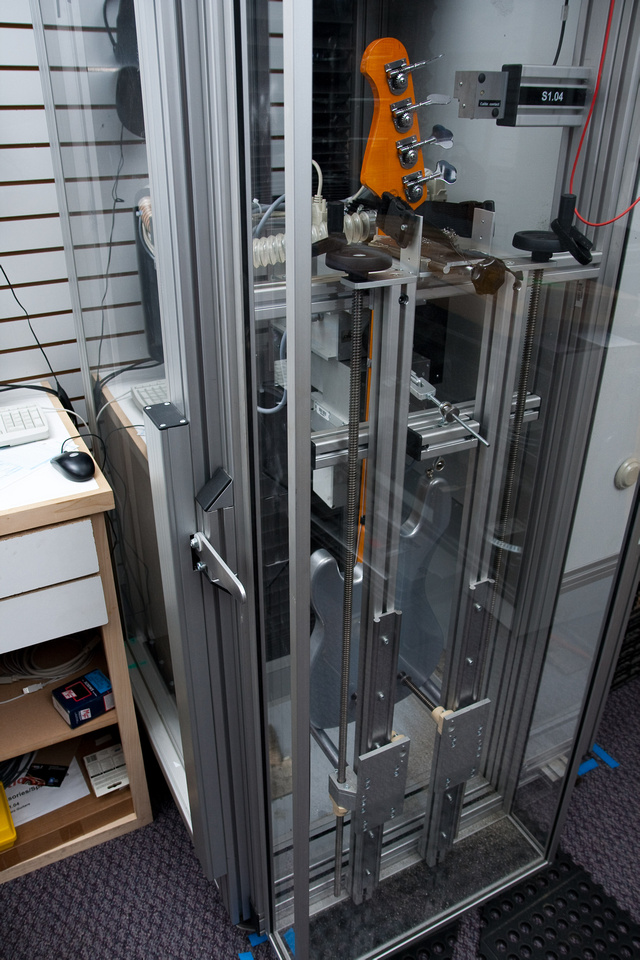
And, as luck would have it, I discovered a little known feature of the PLEK machine. . . it can also serve as a very efficient string remover if the strings are not secured away from the fretboard. The cutter head can catch one string and then grab all the other ones and shear them all in half in a second. . . so. . .
And the aftermath
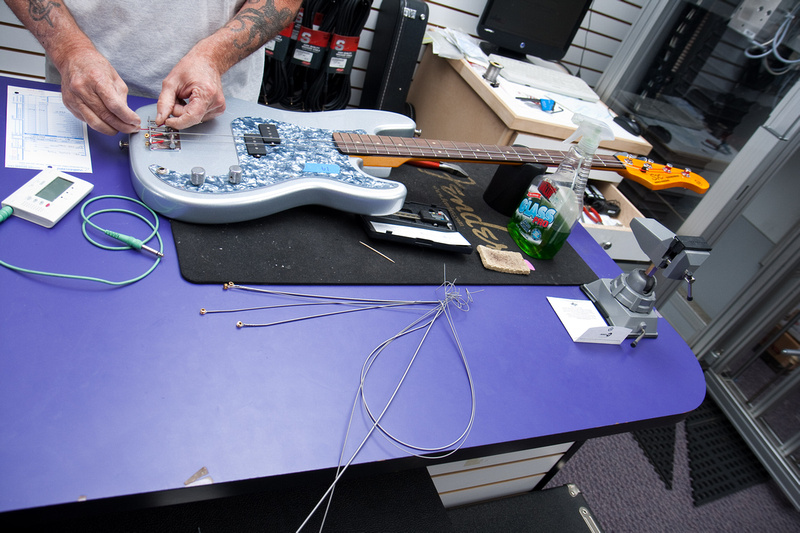
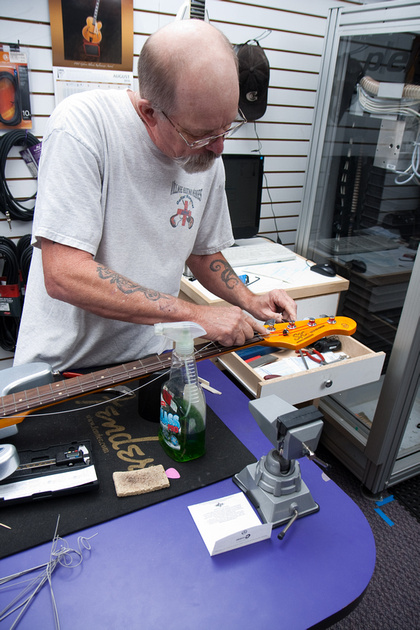
Since I had used up all of my current supply of Dunlop strings, Mike grabbed a set of Rotosound SS strings and we slapped those on post haste and began again. . . this time making sure to tape the strings down. I was up until 4:00am the previous night, and Mike had late band rehearsal. We were both operating machines without being fully awake.
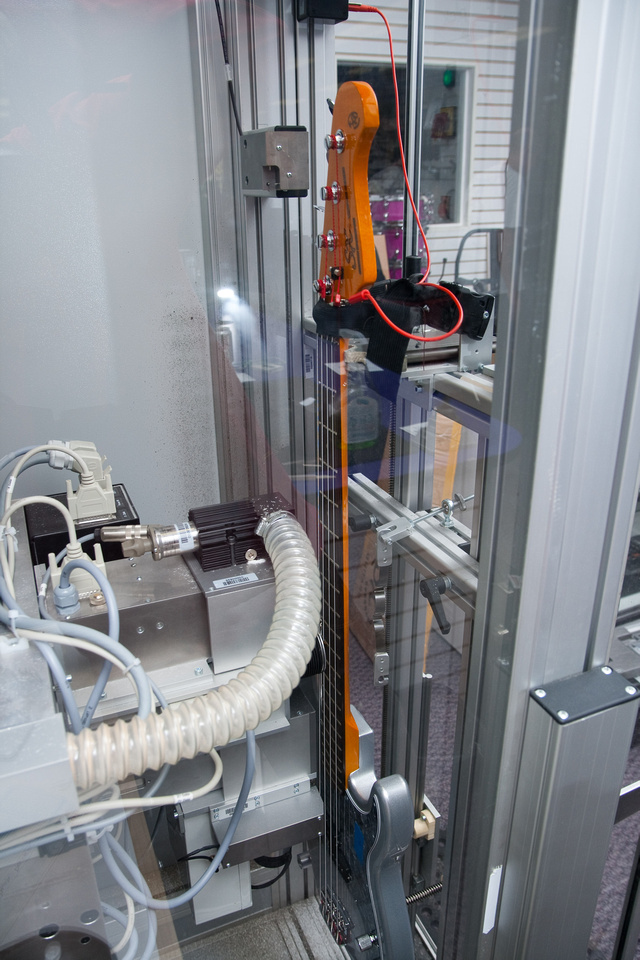
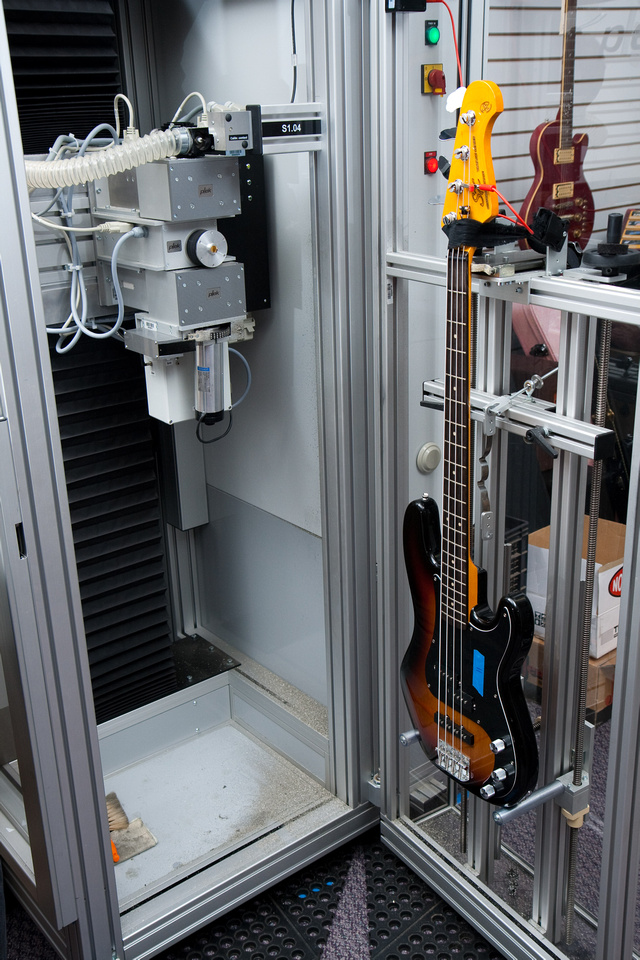
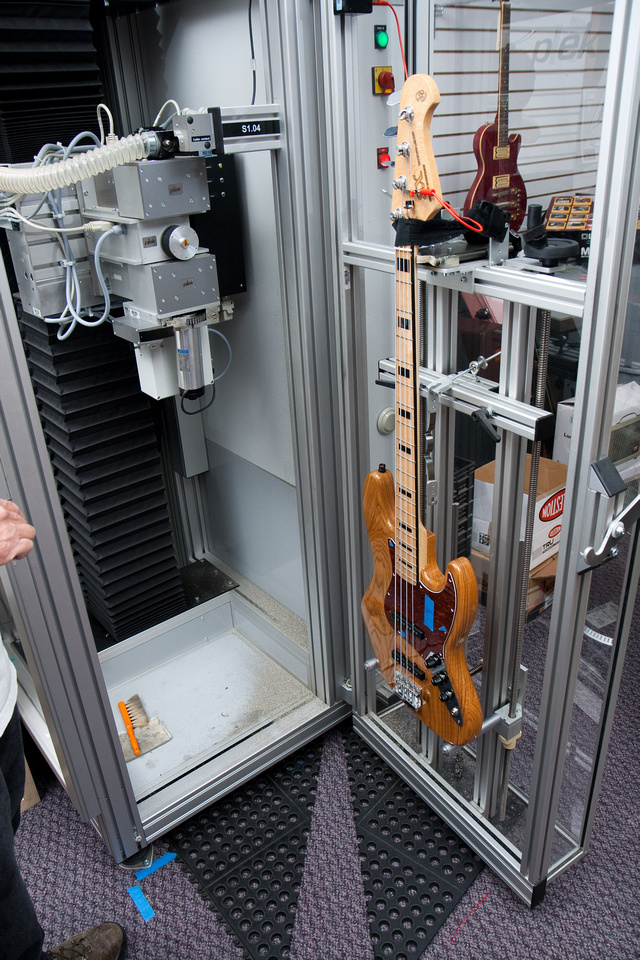
The PLEK machine works in a few steps. . . first, a few critical measurements are entered into the machine (fret width, distance from nut to 1st fret, string gauges, etc.). Then, the bass is placed into the holding cradle built into the swinging door of the PLEK machine. Once closed, a feeler arm measures all of the critical dimensions of the fretboard (width at nut, width at 12th fret, profile of the fretboard, location and heights of each fret along the string paths, etc.)

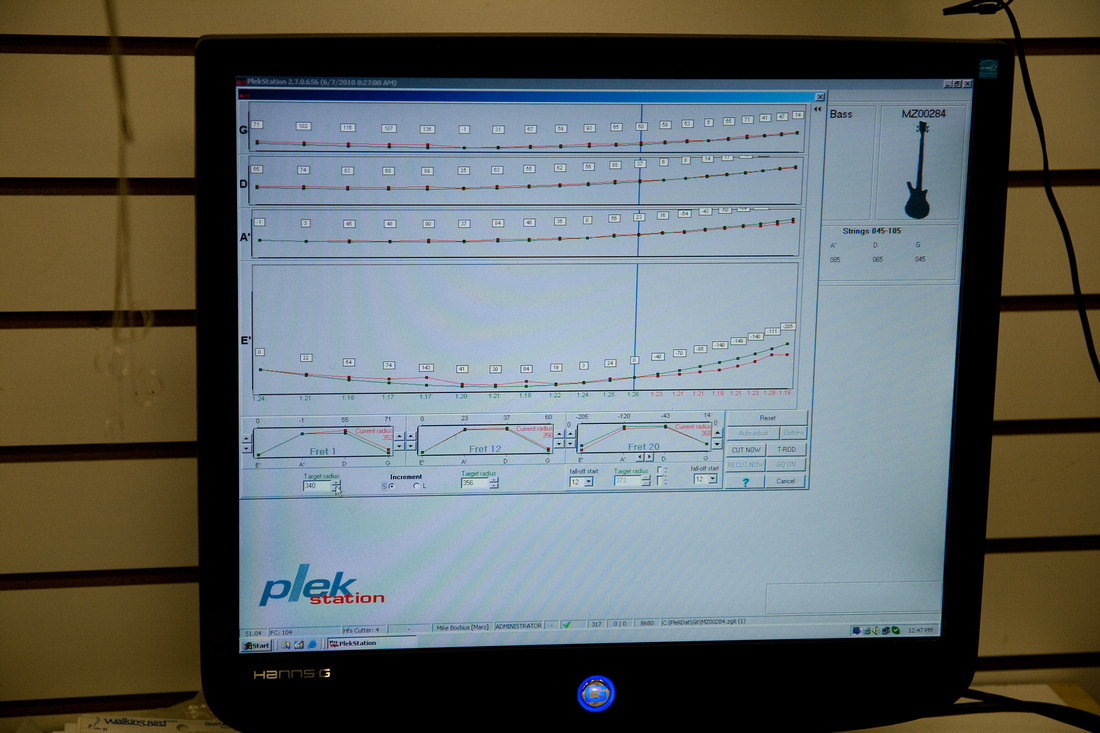
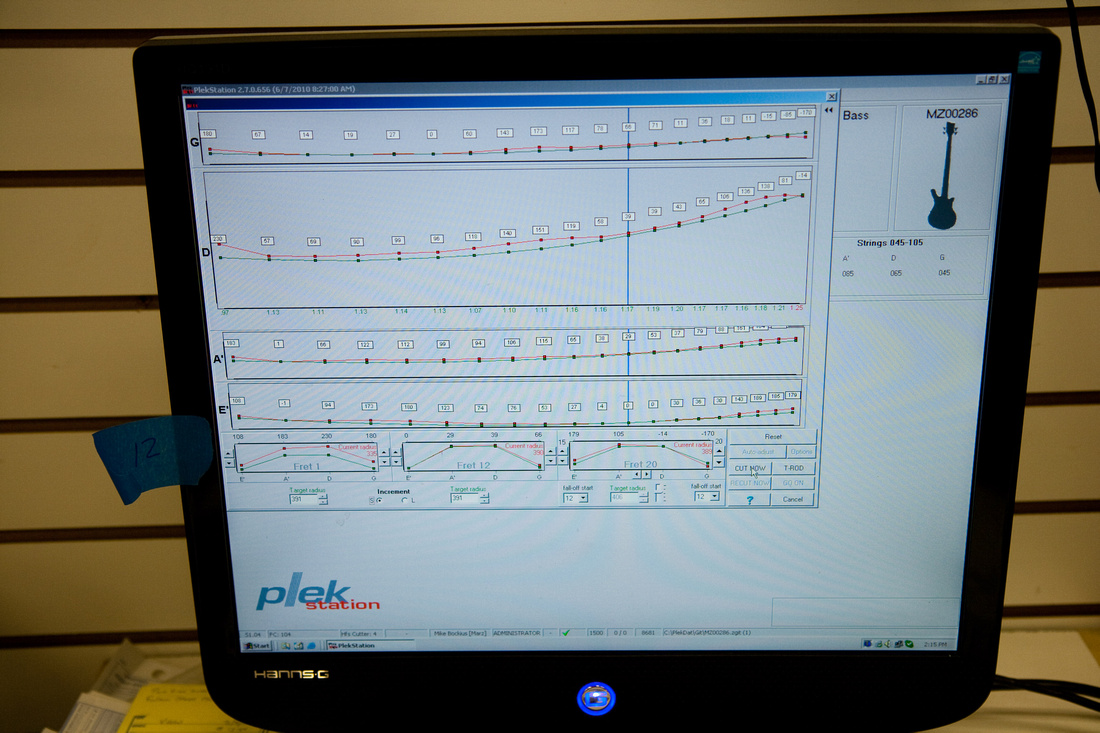
After this information is gathered, the operator uses built-in programs and algorithms to determine the best way to level the frets by manipulating cut depth at each string path, radius at 1st and 12th frets, fall off angle, and a host of other variables that can be massaged. If the truss rod needs a tweak, the machine is opened, an adjustment made by the operator, and then a new scan is made when the door is closed.
Once a cut "program" is determined for the bass, the door is opened, and the strings are loosened and moved away from the fretboard.
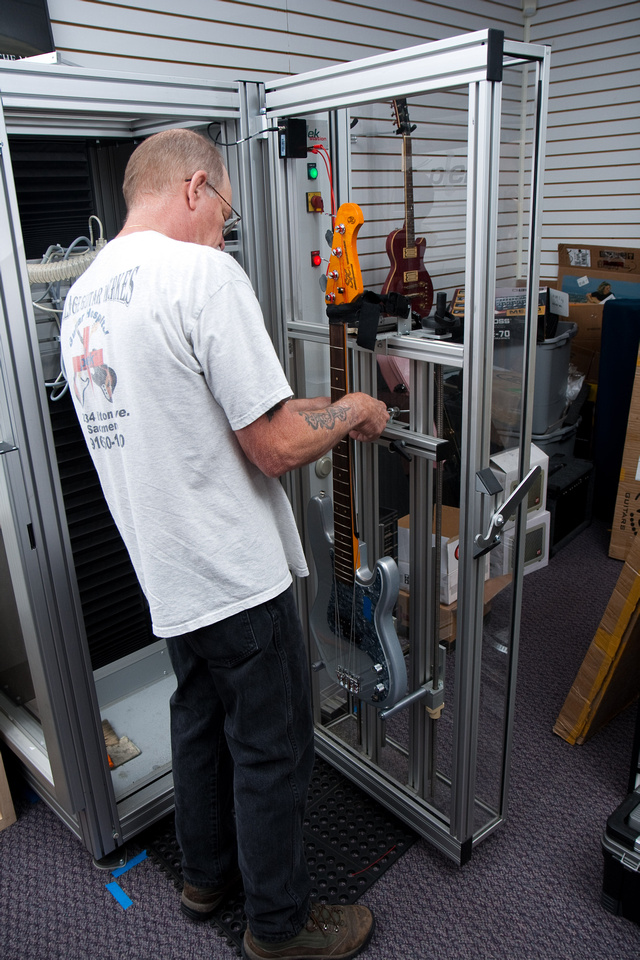
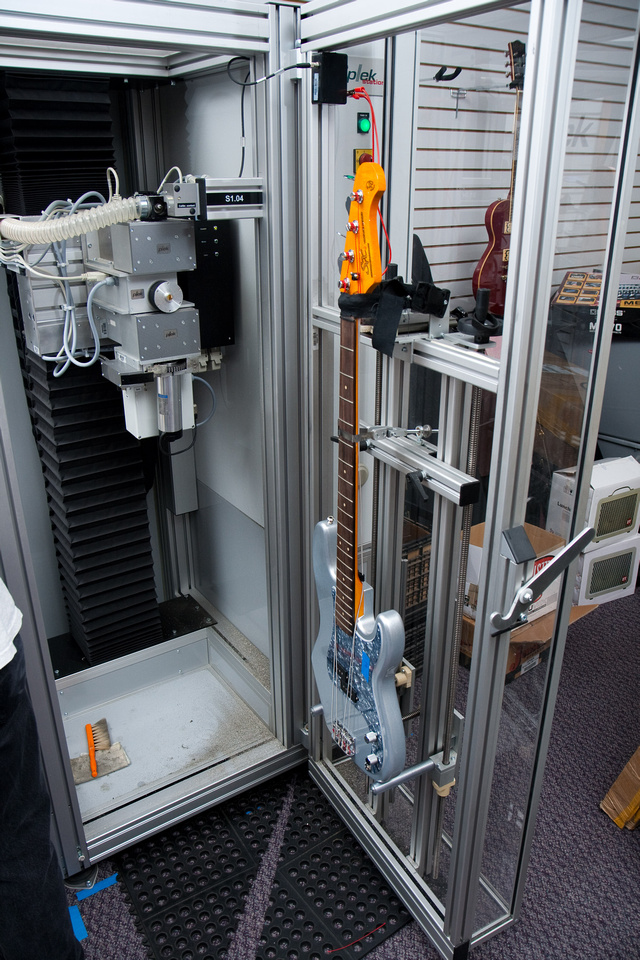
When the door is closed again, the machine re-measures the fret board to determine the new positions of the frets and then proceeds to cut the frets with a cutting wheel. It will take several passes on the frets that need more material removed.
After the machine is done cutting, the door is opened again, and the instrument re-strung and tuned to pitch. The machine then verifies that the actual cut matches the program that was entered in.
After this, final polish on the frets is accomplished by hand and the instrument can be set up.
And, as luck would have it, I discovered a little known feature of the PLEK machine. . . it can also serve as a very efficient string remover if the strings are not secured away from the fretboard. The cutter head can catch one string and then grab all the other ones and shear them all in half in a second. . . so. . .
And the aftermath
Since I had used up all of my current supply of Dunlop strings, Mike grabbed a set of Rotosound SS strings and we slapped those on post haste and began again. . . this time making sure to tape the strings down. I was up until 4:00am the previous night, and Mike had late band rehearsal. We were both operating machines without being fully awake.
The PLEK machine works in a few steps. . . first, a few critical measurements are entered into the machine (fret width, distance from nut to 1st fret, string gauges, etc.). Then, the bass is placed into the holding cradle built into the swinging door of the PLEK machine. Once closed, a feeler arm measures all of the critical dimensions of the fretboard (width at nut, width at 12th fret, profile of the fretboard, location and heights of each fret along the string paths, etc.)
After this information is gathered, the operator uses built-in programs and algorithms to determine the best way to level the frets by manipulating cut depth at each string path, radius at 1st and 12th frets, fall off angle, and a host of other variables that can be massaged. If the truss rod needs a tweak, the machine is opened, an adjustment made by the operator, and then a new scan is made when the door is closed.
Once a cut "program" is determined for the bass, the door is opened, and the strings are loosened and moved away from the fretboard.
When the door is closed again, the machine re-measures the fret board to determine the new positions of the frets and then proceeds to cut the frets with a cutting wheel. It will take several passes on the frets that need more material removed.
After the machine is done cutting, the door is opened again, and the instrument re-strung and tuned to pitch. The machine then verifies that the actual cut matches the program that was entered in.
After this, final polish on the frets is accomplished by hand and the instrument can be set up.
bass 11 initial scan:
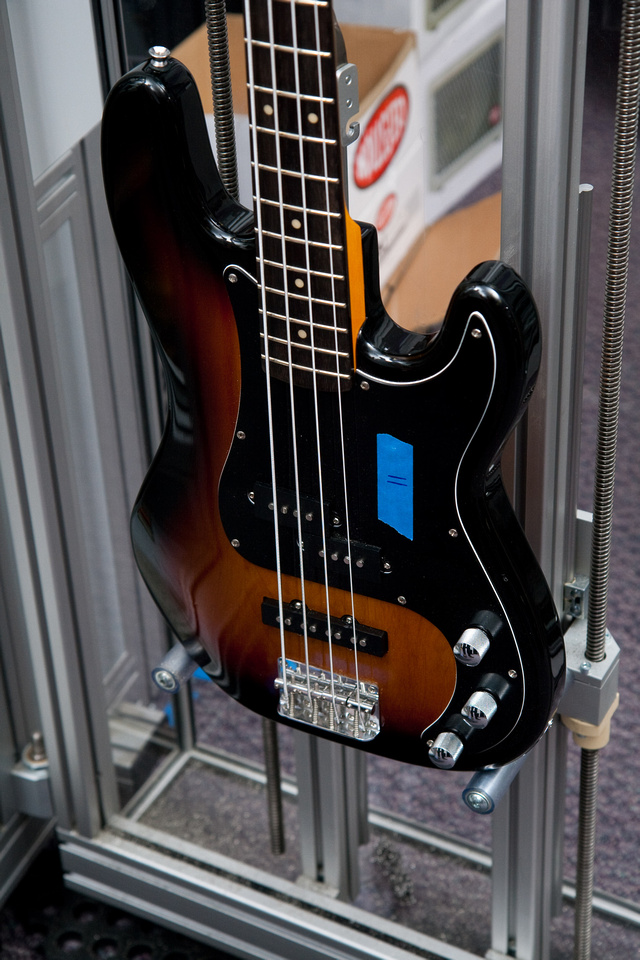
bass 11 in the cradle
Bass 12. . . green line indicates prescribed "program" to cut. . . red line indicates current fret heights.
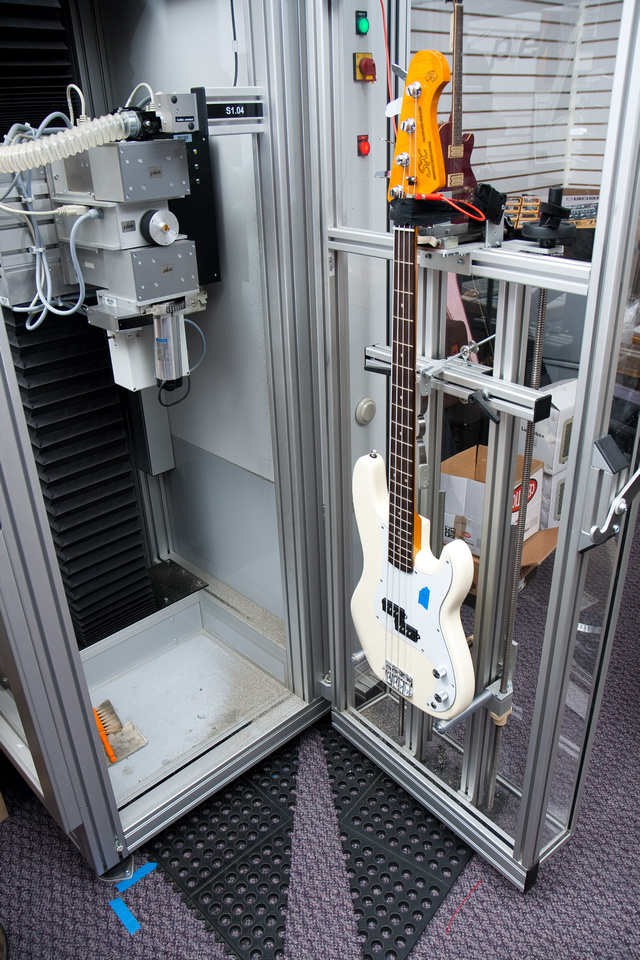
#12 in the "fridge"
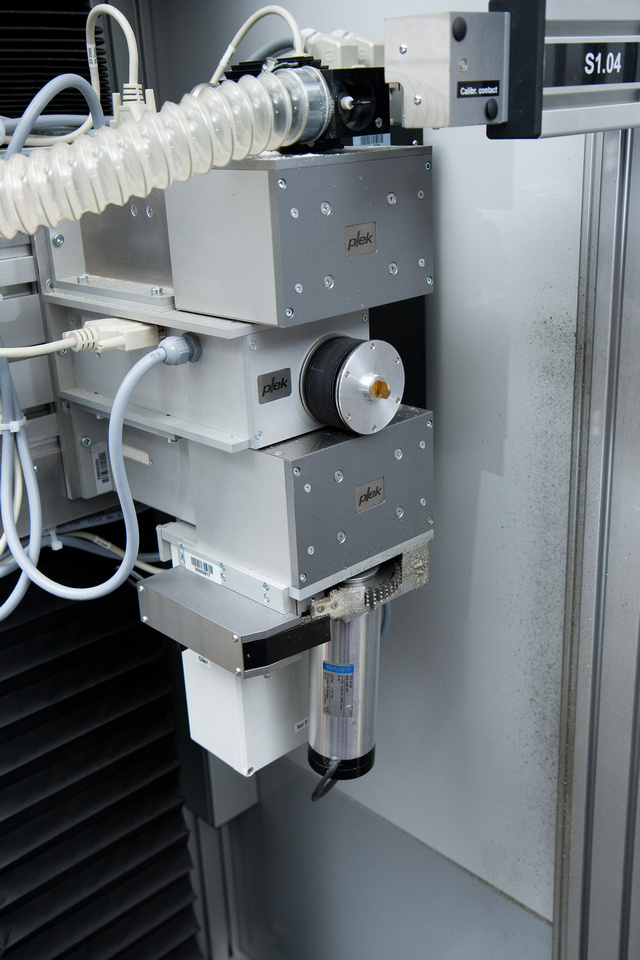
A closer look at the 3 tool heads. . . top: nut slot cutting head. . . middle: sensor head. . . bottom: fret cutting head.
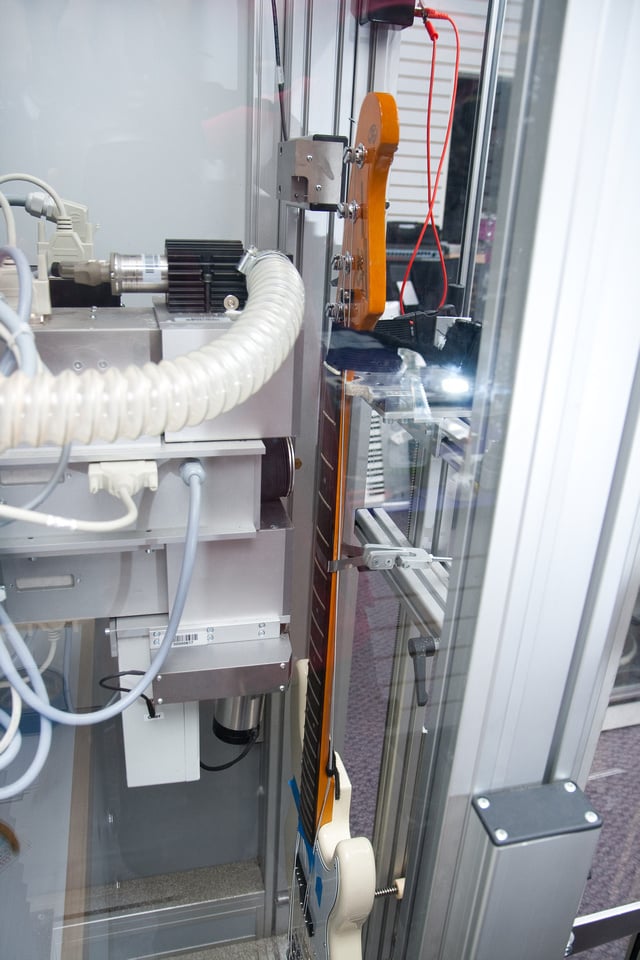
bass 11 in the cradle
Bass 12. . . green line indicates prescribed "program" to cut. . . red line indicates current fret heights.
#12 in the "fridge"
A closer look at the 3 tool heads. . . top: nut slot cutting head. . . middle: sensor head. . . bottom: fret cutting head.
Mooselumps' bass going in:
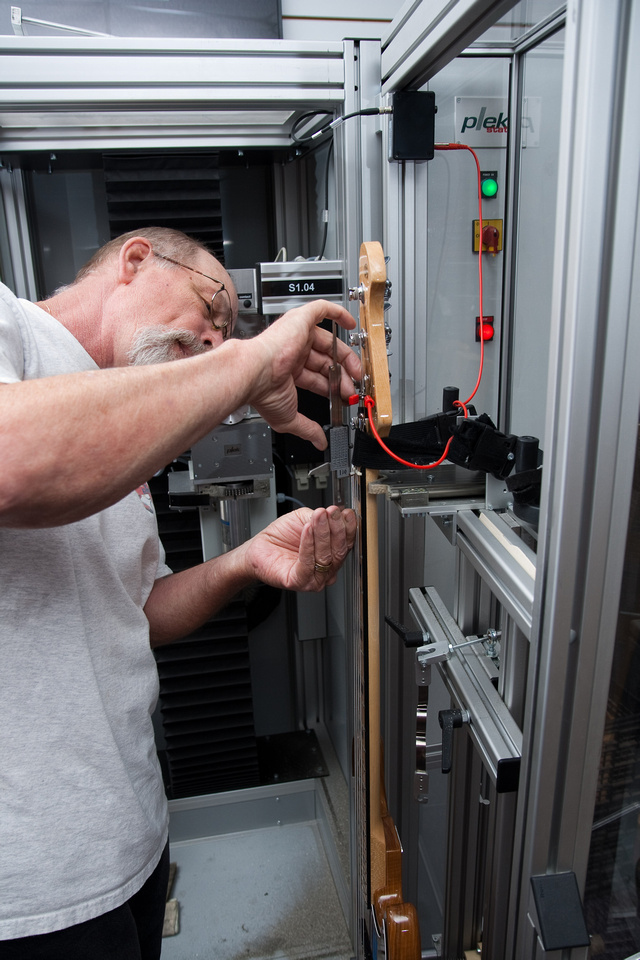
critical measurements being made and entered into the machine manually:
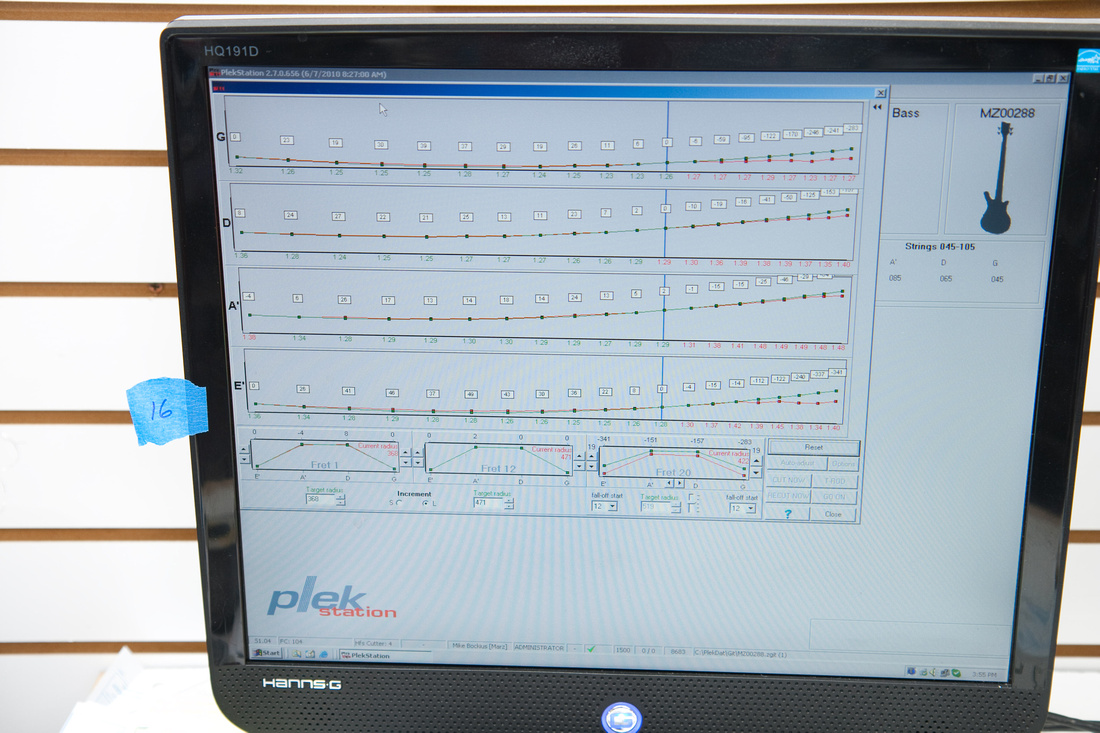
Last SX into the machine this batch:
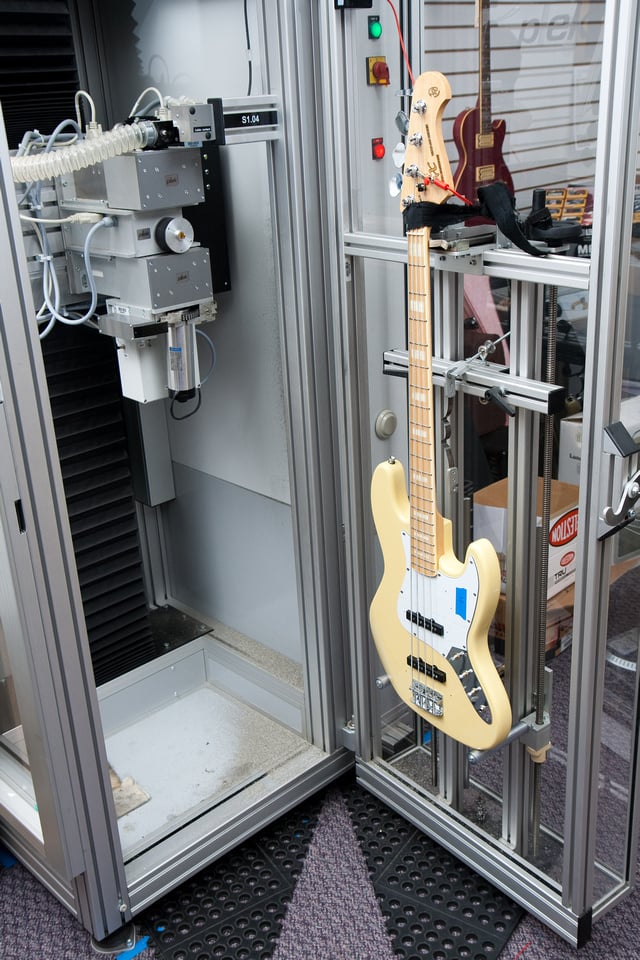
critical measurements being made and entered into the machine manually:
Last SX into the machine this batch:
All was going great at this point. . . the PLEK does what takes me 3-11 hours in ~30 minutes. A few observations. . . hand leveling helped me understand a lot of the variables that were being tweaked on the PLEK machine, and I was able to make a few correct suggestions on those variables especially concerning fall-off cuts. . . Mike usually sets the angle to 15 degrees. . . I requested that be increased to 20 degrees with 25 degrees being the maximum the state-side rep recommends and 30 degrees being the machine's max (in the programmed algorithm).
I was NOT able to get the Dunlops to run any lower with a PLEK'd bass than with my hand leveled instruments. I have mixed feelings about this. . . I'm a bit disappointed because I wanted these strings to be able to run stupid fast action, but I'm also happy because this means my hand-leveling skills are squeezing near-maximum potential from the fretboards I work on.
Speaking of stupid fast action, the bass that we put the rotosounds on is like that. I am seriously considering switching to a higher tension hex core string like the Roto or the DR low riders as standard. The Dunlops feel pretty good and sound good, but really are unforgiving to set up for if your goal is to get the bass low, which for me, it is.
On my best day, I can get a bass into the same ball-park as the PLEK can, but I can't diagnose problems nearly as quickly or precisely as the PLEK can. . .in the ball-park. . . it would be very presumptuous to say "better". The PLEK can also fix problems without removing as much fret material as I need to. It often takes me a few tries at a neck before it is "right". Given ideal conditions, the PLEK can get it right the 1st time 90% of the time, and if it is not right, you will know exactly what failed right away.
OK. . . so PLEK is definitely faster, probably better the majority of the time, and certainly more consistent. I have not, however attempted to use my new neck jig though. But, the PLEK has limitations as I discovered with the last bass of the day, Billy's pretty new Fender from Japan.

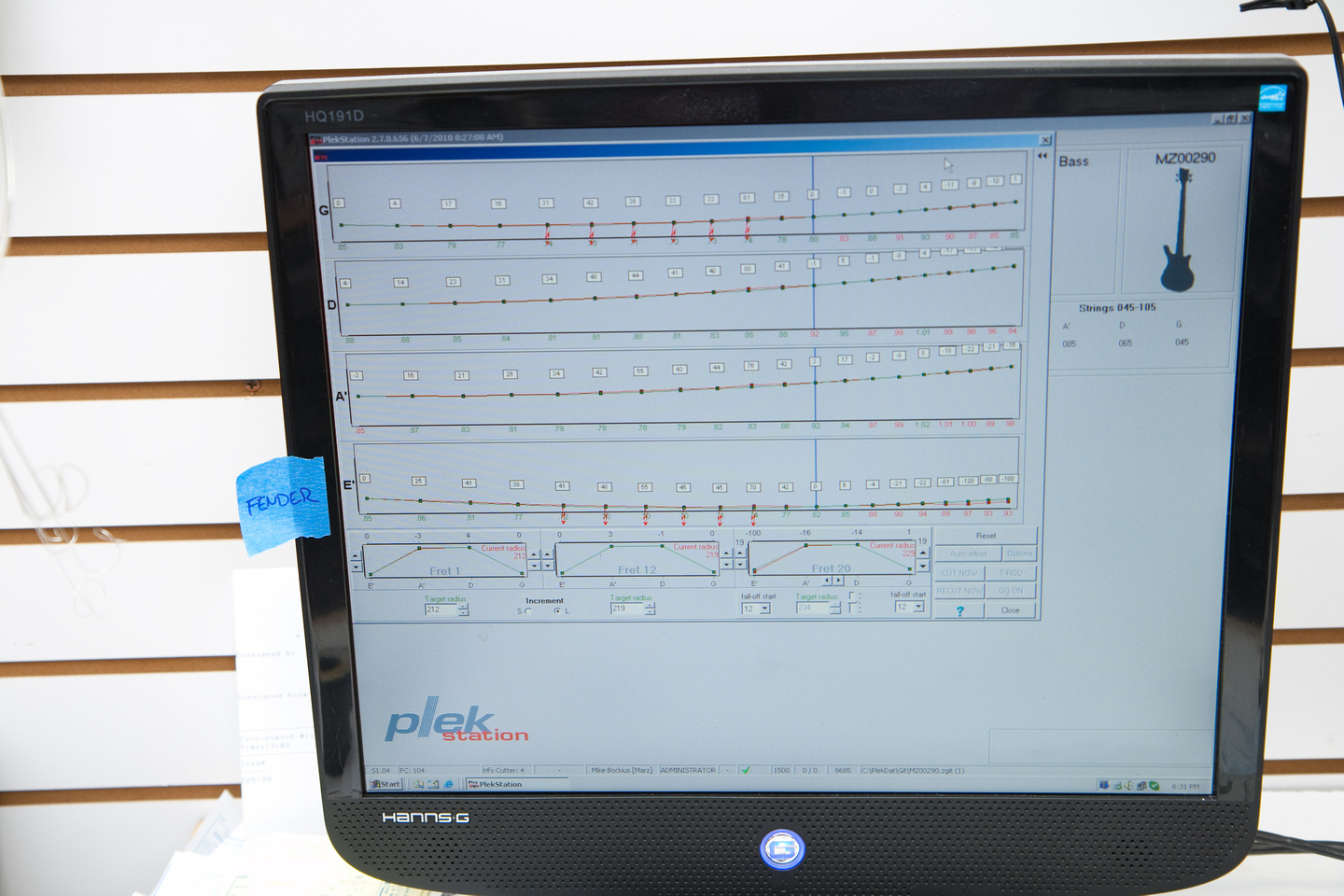
I ran this bass through the program 2x, and whether it's the super slim frets or the thin, floppy neck not returning to the original position, the PLEK could not get it right. There were gross errors that were detectable by my hand tools each time and playability was not where it should have been. We ended up correcting a few of the major issues by hand, but I left knowing that on this particular bass, a hand leveling would have been superior. I will write to the people at PLEK about this issue. I'm not sure if the cutter head needs to spin slower or the sense arm needs to move slower, but I would NOT plek a bass with the really really thin fret wire. It just doesn't work right. I will have to sit with this bass some more and see if I should go over it again by hand. The frets are really small though, so I decided to step away from the machine and think about it a bit.
So, 7 great trouble free jobs, and one frustrating one. Given the right conditions, PLEK rules. Given the wrong conditions, it can be very frustrating.
Final scan of the Fender showing high 10th fret particularly on the G string side.
I was NOT able to get the Dunlops to run any lower with a PLEK'd bass than with my hand leveled instruments. I have mixed feelings about this. . . I'm a bit disappointed because I wanted these strings to be able to run stupid fast action, but I'm also happy because this means my hand-leveling skills are squeezing near-maximum potential from the fretboards I work on.
Speaking of stupid fast action, the bass that we put the rotosounds on is like that. I am seriously considering switching to a higher tension hex core string like the Roto or the DR low riders as standard. The Dunlops feel pretty good and sound good, but really are unforgiving to set up for if your goal is to get the bass low, which for me, it is.
On my best day, I can get a bass into the same ball-park as the PLEK can, but I can't diagnose problems nearly as quickly or precisely as the PLEK can. . .in the ball-park. . . it would be very presumptuous to say "better". The PLEK can also fix problems without removing as much fret material as I need to. It often takes me a few tries at a neck before it is "right". Given ideal conditions, the PLEK can get it right the 1st time 90% of the time, and if it is not right, you will know exactly what failed right away.
OK. . . so PLEK is definitely faster, probably better the majority of the time, and certainly more consistent. I have not, however attempted to use my new neck jig though. But, the PLEK has limitations as I discovered with the last bass of the day, Billy's pretty new Fender from Japan.
I ran this bass through the program 2x, and whether it's the super slim frets or the thin, floppy neck not returning to the original position, the PLEK could not get it right. There were gross errors that were detectable by my hand tools each time and playability was not where it should have been. We ended up correcting a few of the major issues by hand, but I left knowing that on this particular bass, a hand leveling would have been superior. I will write to the people at PLEK about this issue. I'm not sure if the cutter head needs to spin slower or the sense arm needs to move slower, but I would NOT plek a bass with the really really thin fret wire. It just doesn't work right. I will have to sit with this bass some more and see if I should go over it again by hand. The frets are really small though, so I decided to step away from the machine and think about it a bit.
So, 7 great trouble free jobs, and one frustrating one. Given the right conditions, PLEK rules. Given the wrong conditions, it can be very frustrating.
Final scan of the Fender showing high 10th fret particularly on the G string side.
- Status
- Not open for further replies.


