
I'm a metronome addict. I use it every time I have a practice session with the bass. I've got a bunch of exercises that i practice, like a range of BPM's, simple and compound meters, note subdivisions, polyrhythms. I use it to practice different bass guitar techniques. I totally recommend getting into the habit of practicing with one, but I don't think it's a disadvantage not using one.

Enjoy the benefits of a premium membership!
Upgrade Account
-
TalkBass has been independent since 1998. Add your voice.
Create a free account to reply to discussions, view embedded media, and browse with fewer display ads.
Join free Log in
Want zero display ads or expanded classifieds tools? Compare plans.
You are using an out of date browser. It may not display this or other websites correctly.
You should upgrade or use an alternative browser.
You should upgrade or use an alternative browser.
Bassists who learned without the metronome
- Thread starter scrubhelmet
- Start date
More options
Who Replied?
Years ago I worked with a drummer who's tempo always seem to drift around. One day I heard him practicing to a metronome, so I knew the time was stable but it still sounded like he was speeding up and slowing down. From this point I could hear that the problem was with beat symmetry. Basically his placement of beats varied randomly so the shape of each measure was a bit different. He could definitely play with the metronome but it didn't seem to help much.
I want to point out that measures don't necessarily have to be perfectly symmetrical. It can be okay if beats are off a bit, but the pattern needs to be stable and consistent within a section of music. There are lots of songs where it sounds like the drummer is laying back on 2, and the groove is super deep!
Setting the click too slow can cause the problem I described in the top paragraph. Half notes might be okay, but IMHO using one click per bar can definitely be too slow. I worked with one drummer who insisted the best choice was one click every other bar. When he used a click, his time was all over the place. Basically there was too much time between clicks for accuracy. The slower the click the more problematic this tends to be. Here's a relevant video:
This characteristic that you are describing is used by shred guitar players to squeeze more notes into a phrase. They call it “falling down stairs but landing on your feet.” When you hear that style of guitar playing, then listen to a player that places even symmetrical notes…there is a difference that is difficult to describe.
The symmetrical playing sounds so much faster, and the player sounds more in control. Even if the asymmetrical playing has more notes in a phrase. The world class players can do both, and will use asymmetrical playing very sparingly…just to add a sort of frenzied intensity to a song. These are the players that will often get everyone in an entire music store to stop what they are doing to listen.

This characteristic that you are describing is used by shred guitar players to squeeze more notes into a phrase. They call it “falling down stairs but landing on your feet.” When you hear that style of guitar playing, then listen to a player that places even symmetrical notes…there is a difference that is difficult to describe.
The symmetrical playing sounds so much faster, and the player sounds more in control. Even if the asymmetrical playing has more notes in a phrase. The world class players can do both, and will use asymmetrical playing very sparingly…just to add a sort of frenzied intensity to a song. These are the players that will often get everyone in an entire music store to stop what they are doing to listen.
As long as it sounds good
 .
. I never learned how to play them, but there is notation for quintuplets and septuplets:
Have only seen old pictures of them and obviously never used one, but wonder why you just don't play along with a recording then you are concentrating on the note and the plucking techique without adding something extra?When I was trying to learn how to play the bass, I just watched the covers and live videos of a few bassists (Buddy Zabala, Flea, Tony Kanal, Stuart Zender) and their bands and learn their songs. I also tried to learn other songs as soon as people knew I was playing bass and hire me up for their band. I also have a bit of music theory knowledge when I was learning the guitar, and I think it helped with improvisation and composing. Recently I'm also trying to learn jazz bass and have read books such as Ed Friedland's Building Walking Bass Lines.
However, the idea of practicing with a metronome only came up recently to me because I'd read it in forums such as this. So in a way I don't know how to utilize it. But I think it didn't affect my bass playing negatively. I know that bassists in general are in demand so I won't count this as an evidence of me being able to play properly; but on the other hand, there are several instances when I'd play with a drummer and lock in with them, and both of us would want to play with each other again due to the mutually good experience.
Anyway, so are there other bassists here who had the same lack of knowledge about the metronome as me? And if you went from not using the metronome to using it, what are the improvements that you felt?
EDIT: In lieu of the metronome, I think that I just have a feel for rhythm and groove, to the point that it makes me tap my foot or dance while playing.

I have never owned a metronome, but do use the DAW ones when recording, but not always. For some timings it's easier to just program a super dry snare and play to that and then dump the "metronome" snare track (or use it; Beatles have a metronome on Blackbird).When I was trying to learn how to play the bass, I just watched the covers and live videos of a few bassists (Buddy Zabala, Flea, Tony Kanal, Stuart Zender) and their bands and learn their songs. I also tried to learn other songs as soon as people knew I was playing bass and hire me up for their band. I also have a bit of music theory knowledge when I was learning the guitar, and I think it helped with improvisation and composing. Recently I'm also trying to learn jazz bass and have read books such as Ed Friedland's Building Walking Bass Lines.
However, the idea of practicing with a metronome only came up recently to me because I'd read it in forums such as this. So in a way I don't know how to utilize it. But I think it didn't affect my bass playing negatively. I know that bassists in general are in demand so I won't count this as an evidence of me being able to play properly; but on the other hand, there are several instances when I'd play with a drummer and lock in with them, and both of us would want to play with each other again due to the mutually good experience.
Anyway, so are there other bassists here who had the same lack of knowledge about the metronome as me? And if you went from not using the metronome to using it, what are the improvements that you felt?
EDIT: In lieu of the metronome, I think that I just have a feel for rhythm and groove, to the point that it makes me tap my foot or dance while playing.
I have played to a physical metronome but it was 25+ yes ago at lessons in high-school. I've never had issues syncing to drummers, even with weird divisions like 5/4 with 19/16 and 21/16 measures thrown in. It seems like a lot of the value for metronome use is getting your right hand speed up.
I don't think I'd have a platinum record had I been all about metronomes but it wouldn't have hurt. Definitely don't "need" it though. That said, never having tried one would be weird as a bassist.
Metronomes did exist when I was learning but not the small electronic versions we have now many built into tuners. So yeah, I had to learn tempo and how to keep a groove by feel. In the long run that seems to have helped me.
There's been lots of answers since I checked this website. XD I'm happy to read all of them.
So yeah overall I'd say that there should always be a reference to time, may it be a metronome or drum track or even the clap of hands.
There's someone who mentioned about using the metronome for complex time signatures but I forgot to quote it. I think it'd help me in that aspect. One of my bands recently played a song in 7/4 and I was struggling to keep the beat until I resorted to memorizing the drum pattern before the performance.
It's more like I wasn't just convinced the way you phrased your answer. However, I found some answers that did, such as the following two quotes:You seem intent on finding reasons not to use a metronome. A healthier approach is to understand the reasons it’s beneficial and then decide where you want to spend your time.
use metronome with my students pretty often, mostly in these situations:
1) studen't can't play a riff cleanly, because he's trying to learn it at the original speed. This happens very often, almost always. Solution:
1a) find the original tempo and write it down, let's say it's 120
1b) set the metronome to say 50 and learn the riff (this step takes ca 80% of the time spent on the riff)
1c) when you can do it at least 3x in a row, raise the tempo to 60
1d) etc. till the original tempo.
2) student is fluent in playing in metronome, but his rhythm is too strict and dead, because he plays all notes at the same volume. Solution:
2a) show the student what the metre is and how the natural accents are dealt with.
2b) play with metronome beating on 2nd and 4th beat only (example: song in BPM 100 -> metronome BPM 50)
3) student can't hold the tempo on his own, hence is not helping the band to have a steady rhythm. Solution:
3a) listen to the tempo for a while, then turn the metronome off
3b) play the etude
3c) listen to the tempo again and compare, whether you sped up.
The purpose of a metronome is to verify consistency in tempo. The remaining aspects of “good time“ come from elsewhere. This causes some people confusion.
Also, I realized that there's something wrong with my initial premise. While I didn't really practice with metronome before, I always practice along the recording of the song, which also has the drum track and as well as the other instruments that can give me a reference of time! And even in live settings, there'd be drums and we'd both work to keep the time together.This makes no sense. It’s like saying g that learning music theory will kill your creativity.
Working with a metronome can only improve your timing. Being able to play in time doesn’t kill your groove, it helps your groove.
So yeah overall I'd say that there should always be a reference to time, may it be a metronome or drum track or even the clap of hands.
There's someone who mentioned about using the metronome for complex time signatures but I forgot to quote it. I think it'd help me in that aspect. One of my bands recently played a song in 7/4 and I was struggling to keep the beat until I resorted to memorizing the drum pattern before the performance.

Live bands, drummers, backing tracks an drum loops are 'forgiving' to the ear, and will fill in the gaps left by my mistakes and shortfalls.
A metronome will expose the gaps shortfalls. Whether I want to face them and own them is up to me.
A metronome will expose the gaps shortfalls. Whether I want to face them and own them is up to me.

JazznFunk
Supporting Member
Everyone should have, independently, a concept of time that exists and is accurate without the drummer or any other 'clicky' percussion reference. Ideally. In Jazz, the bassist is the timekeeper.... so you've gotta have your collective caca together. That only happens by practicing with a metronome or other time reference, knowing how it feels and sounds, and then practicing with and without it until your internal 'metronome' is refined. And that is always a work in progress.The drummer is there for a reason......

I played with a drummer who didn't want to use a metronome because he didn't want to sound "sterile" - if only his time was good enough to sound sterile! Instead, he sped up all the time and the groove/pocket just was not there.

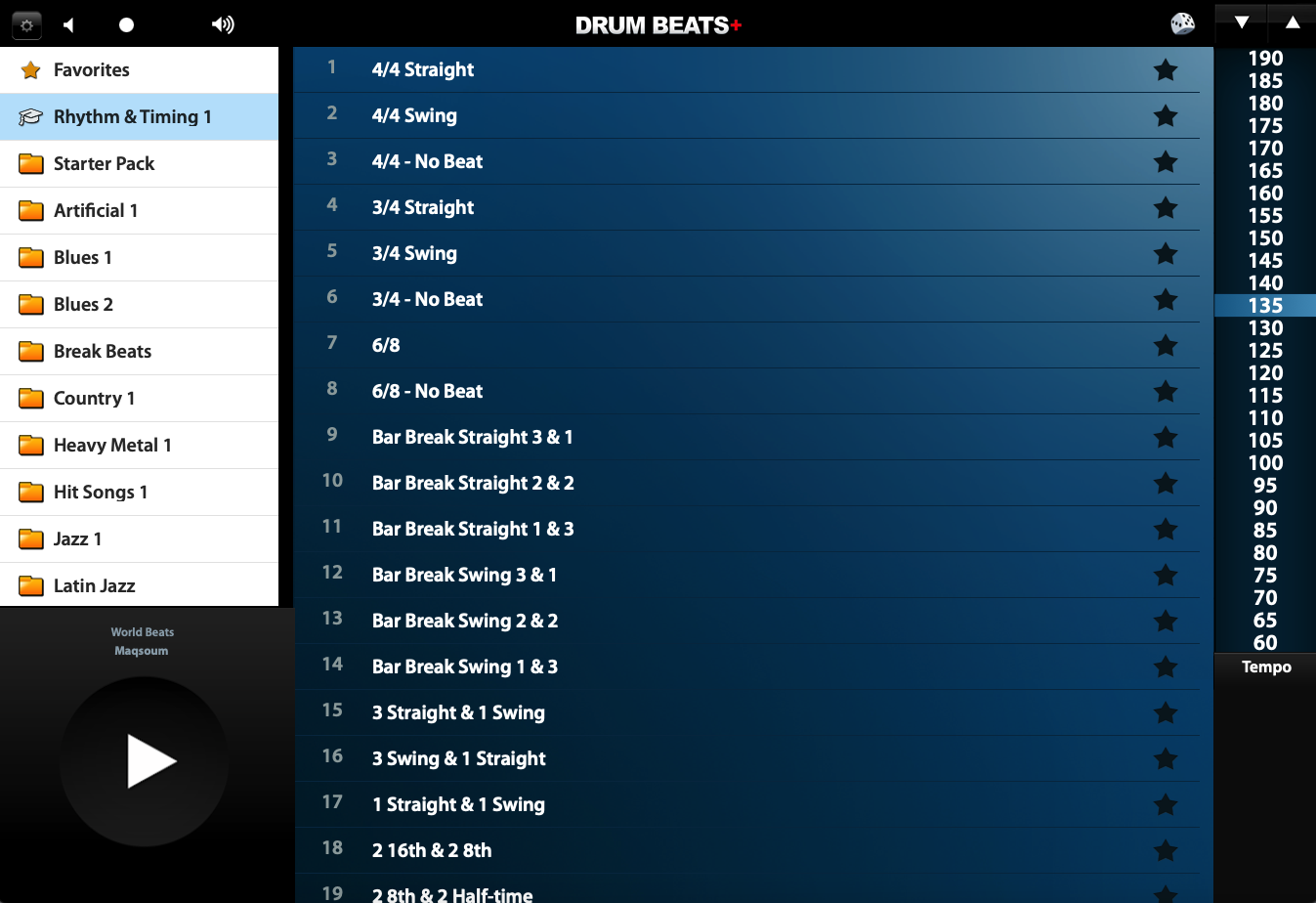
An alternative to a metronome is a drum loop app with adjustable tempos. I love the Drum Beats+ by NineBuzz Software. This one has rhythm and timing exercises and a wide range of drum beat styles.
Last edited:


Exactly.Live bands, drummers, backing tracks an drum loops are 'forgiving' to the ear, and will fill in the gaps left by my mistakes and shortfalls.
A metronome will expose the gaps shortfalls. Whether I want to face them and own them is up to me.
- Learn to use a metronome as a microscope into the accuracy of your timing.
- learn to play long to click tracks LIVE. You need to be able to stay true to the click when the other instruments waver off from the beat.
- also helps when recording to a click. I think it’s an essential to skill to be able to play IN TIME and WITH FEEL. The two can/do go together well.
This looks very useful.An alternative to a metronome is a drum loop app with adjustable tempos. I love the Drum Beats+ by NineBuzz Software. This one has rhythm and timing exercises and a wide range of drum beat styles.
D
I listened to so much music my whole life. I dont worry about timing, i know its fine.
Didnt even know metronomes were a thing with rock bands when i started out.
Didnt even know metronomes were a thing with rock bands when i started out.
I had the same experience with you, although it seems like we are the minority in this forum.I listened to so much music my whole life. I dont worry about timing, i know its fine.
Didnt even know metronomes were a thing with rock bands when i started out.

There's no harm with trying out something new tho.
You may be misunderstanding the use of a metronomeDidn't even know metronomes were a thing with rock bands when i started out.
changes in tempo are unavoidable in a live band, to one degree or another
live musicians listen and adjust to the tempo produced
metronome practice is not simply to practice perfect tempo
it's most usefully to practice listening and adjusting
JazznFunk
Supporting Member
I don't remember the exact quote, but when asked why he practiced every day even after a lifetime of being one of the best, most rhythmically solid players in Jazz, Ray Brown basically said 'Because one day I might actually be good!'. In short, if you think you don't have to work on your time and other associated skills just because you've been doing it your whole life so far.... even the greats know there's room to improve.I had the same experience with you, although it seems like we are the minority in this forum.
There's no harm with trying out something new tho.
metronome practice is not simply to practice perfect tempo
it's most usefully to practice listening and adjusting
Wow, very well said!

For classical musicians, metronome practice is indispensible exactly for this reason, not just for being able to keep a steady beat.
Last edited:


