• TalkBass has been independent since 1998. Add your voice.
    Create a free account to reply to discussions, view embedded media, and browse with fewer display ads.
    Join freeLog in
    Want zero display ads or expanded classifieds tools? Compare plans.

Bassists who learned without the metronome

However I was just thinking that maybe it would mess up with my internal sense of rhythm, because there might be too much for me to think about when playing with a metronome? Also I was thinking of the saying, "If it ain't broke, don't fix it."

Anyway, yeah I'll just try it.
This makes no sense. It’s like saying g that learning music theory will kill your creativity.

Working with a metronome can only improve your timing. Being able to play in time doesn’t kill your groove, it helps your groove.
 
I didn't own a metronome when I first started playing, but my first teacher had a Roland drum pad/drum machine that we would use to jam and work on scales, etc together as a reference. I was blessed with a good natural sense of time, but no matter how good our time is, it can ALWAYS be better. One of my most vivid memories from college jazz theory/performance classes was when one of our professors had us take turns coming up to the front of the class and improvising over some Aebersold recording... I don't remember the tune. I kinda sorta had my stuff together a bit at that point but harmonically wasn't where I wanted to be. I walked a chorus or 2 and then soloed. My professor said something to this extent: 'There are a lot of positive points to what I heard.... mainly, even though you missed a few things or could have made better choices in some spots harmonically, your TIME was there the whole way... and that will allow you to get through places where note choices could have been better. That's called using your ears and adjusting in the moment, and as a bassist, time and feel are the priorities.'

There will always be those who argue against metronomes, saying they make playing 'soul-less', but I find that nothing sucks the vibe out of the music than musicians who cannot agree on a shared sense of pulse and time.... and the bass player IS the time in most groups.

I play/compose a lot using drum machines and drum backing tracks, and that is also a perfectly acceptable 'substitute' for a metronome, since it also allows you to play around with different feels and concepts of bass lines. But what is constant with a drum machine OR metronome, is the pulse. It's never a bad thing to play with a reference that doesn't move, so you can work on your personal tendencies to rush or drag, and we ALL have those in certain areas.

Speaking from a lot of personal experience, I spend most of my time playing in drummer-less trios and duos, so my concept of time HAS to be as spot-on as possible. Decades of playing in those environments has demanded that it must be. In the shed, I still use a metronome to walk quarter notes, practice 8th and 16th note scales, etc. There is no substitute for putting in that nuts and bolts work, and it makes the gig SO MUCH EASIER. It also, consequently, makes you far less tolerant of people who haven't put in that work,.
 
Last edited:
When I was trying to learn how to play the bass, I just watched the covers and live videos of a few bassists (Buddy Zabala, Flea, Tony Kanal, Stuart Zender) and their bands and learn their songs. I also tried to learn other songs as soon as people knew I was playing bass and hire me up for their band. I also have a bit of music theory knowledge when I was learning the guitar, and I think it helped with improvisation and composing. Recently I'm also trying to learn jazz bass and have read books such as Ed Friedland's Building Walking Bass Lines.

However, the idea of practicing with a metronome only came up recently to me because I'd read it in forums such as this. So in a way I don't know how to utilize it. But I think it didn't affect my bass playing negatively. I know that bassists in general are in demand so I won't count this as an evidence of me being able to play properly; but on the other hand, there are several instances when I'd play with a drummer and lock in with them, and both of us would want to play with each other again due to the mutually good experience.

Anyway, so are there other bassists here who had the same lack of knowledge about the metronome as me? And if you went from not using the metronome to using it, what are the improvements that you felt?

EDIT: In lieu of the metronome, I think that I just have a feel for rhythm and groove, to the point that it makes me tap my foot or dance while playing.
I learned to play at blues jams playing along with drummers. Once a week, sometimes playing with several different drummers per night.. Being forced to play in time with a real and present stimulus, with the natural variation in rhythm that different drummers have, gave me a pretty good sense of rhythm.

I don't recall the first time I played with a metronome. But, at that point, I found it fairly easy. At least, accounting for where I was in terms of being able to play fast or complicated rhythms in tempo.
 
  • Like
Reactions: JazznFunk
There's nothing bad that can come up with trying something, so maybe I'll search how to use it the next time I practice with my bass.

However I was just thinking that maybe it would mess up with my internal sense of rhythm, because there might be too much for me to think about when playing with a metronome? Also I was thinking of the saying, "If it ain't broke, don't fix it."

Anyway, yeah I'll just try it.
No, playing with the ‘nome wont mess with your internal rhythm any more than playing with a drum machine or a rock solid drummer.

It will help. And if your time is good, it is fun to crawl even deeper into it. Set the ‘nome to click on the 2 and the 4 and you can really get a feel for making a groove. It’s fun.

But I would not do it too much. Always playing the a ‘nome or drum machine sometimes makes me feel rigid (not in a good way) when back with a real drummer/band. It’s not horrible, but I do try to play by myself and along with recorded music most of the time.

But if you are prepping for a session that will be on a click, a week of ‘nome and drum machine work really helps hone in on the feel.
 
I can see the need of foregoing a metronome when learning a song for the first few times, remembering notes and getting the overall feel of the song. Then I'd use a metronome to nail down the timing.
I like the time and feel to be stable. Lot's of people will make comments like, "Music should breath." Basically they don't like the time and feel to be rock solid. I find this confounding :sour: .
For proper "breathing" one needs a solid grasp of the basic timing. Keith Moon was known to speed up a few parts on early Who songs on purpose. It was later (recording to a backing synth track) when everyone realised how precise Keith could be, which their recording engineers had always known.
 
IME most people who think they don't need a metronome do, actually. Our brains will lie to us about time depending on stimuli and context. The only effective way to override this and develop truly good time is to consistently practice with a metronome.
+1

I think most people would be unpleasantly surprised if they recorded themselves playing alone and measured it against a metronome.
 
In lieu of the metronome, I think that I just have a feel for rhythm and groove, to the point that it makes me tap my foot or dance while playing.
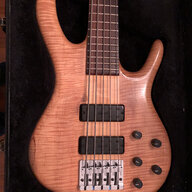
I've always had a natural sense of rhythm, so I never felt a need for a metronome. I played rhythm guitar for almost 50 years, and was often told I should play bass because I have good feel and tempo, but I didn't want to be encumbered by a large bass guitar, forget a double standup bass. In mid 2013 I switched to ukulele, and a year later the leader of my uke group asked if anyone would like to take up the bass to fill in our sound. I discovered bass ukes and went for it. Bass uke (21" scale) is now my main instrument, with tenor uke close behind.

I'm very conscious of keeping tempo, in the pocket at all times, but one member who thinks themself a percussionist, can't keep time, so I have to really make an effort to override that person by raising my volume.
 
  • Like
Reactions: scrubhelmet
Practicing to a metronome lasts about 30 seconds with me and I am done. I get bored easily, and that is a boring way to practice. I use drum patterns instead.

Also, learn to count like a drummer while doing so.
 
In lieu of the metronome, I think that I just have a feel for rhythm and groove...
cool beans!

but if you can play with "feel for rhythm and groove" when using a metronome/click/machine = you're money!
and if you can play with "feel for rhythm and groove" when playing with a competent drummer = you're money!

one without the other = no money for you. good luck! 👍
 
I've been playing drums for over 45 years. I've practiced with metronomes (and I'll include drum machines, MIDI programs, or any other technology that delivers a stable time reference) for almost all of that time, up to and including right before making this post. I record to a click, and sometimes to MIDI bass parts (for a time-stable reference). I practice bass with a met, especially because I'm still very new to the instrument and I've got a lot of physical development to do to improve my playing.

It's a tool. It can be abused (see all the YouTube circus acts playing 300BPM blast beats), but it can make you a much better timekeeper, and more quickly that you might think if you use it well.

Being a musician means having at least some on-demand control over the time domain. Practicing with a met is just using a tool to help with that necessary skill.

If this was a carpentry forum, I'd wince at anyone posting that they always just eyeball things and never use rulers or squares to measure stuff. Would not want the coffee table made in that shop.
 
I can see the need of foregoing a metronome when learning a song for the first few times, remembering notes and getting the overall feel of the song. Then I'd use a metronome to nail down the timing.

For proper "breathing" one needs a solid grasp of the basic timing. Keith Moon was known to speed up a few parts on early Who songs on purpose. It was later (recording to a backing synth track) when everyone realised how precise Keith could be, which their recording engineers had always known.


My impression is a lot of players who argue for the music to breath are basically making an excuse for bad time. There are exceptions of course ;) .
 
Playing to a click (or a metronome), is almost a requirement these days if you are doing recording or playing in bands that use click tracks. I've run across drummers that couldn't stick to a click to save their life. So much for adding some pre-recorded sequence to a live performance.

I honed the skill in my basement studio, recording songs where I played all the instruments. I often recorded drums last, so for the first few tracks, there was not much to follow except the click. It is a skill that you can develop.

Also, as mentioned earlier. setting the click to sound on the 2 and 4, makes it easier to get a less mechanical-sounding "groove".
 
  • Like
Reactions: srosenthal13
A metronome is useful as a way to measure the actual tempo you are playing at. If you need to learn a song and can’t play it as fast as the record, with a metronome you can figure out the tempo. Then set the metronome to a lower tempo to find the fastest tempo that you can play at without making any mistakes. Then pick a slightly faster tempo and work on being able to play with no mistakes, continue until you reach the recorded tempo and even go beyond a bit if you want. This could take a while, especially if you haven’t been playing for long.

There’s a reason people use “metronomic” as an insult when describing a player who is unable to swing, use syncopation, play behind the beat, use dynamics, etc.

You do not need to use a metronome while practicing scales, arpeggios, etc. A metronome can help an absolute beginner to learn how to play steady time but after a few months it’s not really needed.
 
Years ago I worked with a drummer who's tempo always seem to drift around. One day I heard him practicing to a metronome, so I knew the time was stable but it still sounded like he was speeding up and slowing down. From this point I could hear that the problem was with beat symmetry. Basically his placement of beats varied randomly so the shape of each measure was a bit different. He could definitely play with the metronome but it didn't seem to help much.

I want to point out that measures don't necessarily have to be perfectly symmetrical. It can be okay if beats are off a bit, but the pattern needs to be stable and consistent within a section of music. There are lots of songs where it sounds like the drummer is laying back on 2, and the groove is super deep!

Setting the click too slow can cause the problem I described in the top paragraph. Half notes might be okay, but IMHO using one click per bar can definitely be too slow. I worked with one drummer who insisted the best choice was one click every other bar. When he used a click, his time was all over the place. Basically there was too much time between clicks for accuracy. The slower the click the more problematic this tends to be. Here's a relevant video:


Latest posts