• TalkBass has been independent since 1998. Add your voice.
    Create a free account to reply to discussions, view embedded media, and browse with fewer display ads.
    Join freeLog in
    Want zero display ads or expanded classifieds tools? Compare plans.

Basswood vs mahogany

As quantum physics teaches us, the result of an experiment depends on its observer. So if you believe in the religion of Tonewood, the difference will be like night and day. Otherwise, you will probably not hear any difference. I specify that I don't feel concerned or interested in this subject.

That being said, basswood is much lighter, which makes some say it is more resonant. I don't know if it's true, but I notice that my Godin Shifter Classic 4, which has a basswood body, has a very open and lively sound, acoustically. Among the Tonewood fanatics, most of them say that the words "deep, warm darker sound" are the trademark of mahogany, but none of them speak about the difference between humbuckers and single coils, a set neck and a bolt-on neck or a short scale and a standard scale.

Yeah, I just called a meeting of the Religion of Tonewood and we'd all like to know where you found these weirdos who think wood is everything and pickup type, neck joint and scale length don't matter. No one in our esteemed order has ever even heard of anyone that out there, so we're wondering if maybe you've been hanging with some lost tribe of luthiers hidden deep in the mountains of Tibet or something.
 
Absolutely not the case, basswood is 410 on the Janka Hardness Scale (softest wood used for bodies), mahogany is 900+ (depending on where it comes from) on the Janka Hardness Scale.
IMO basswood is too soft to be practical, it dents easily, it does not hold threads very well and it is not attractive so it needs an opaque finish.
It may not be the sexiest wood, I'll give you that, but it can go very well with a transparent finish. ;)

godin-shifter-classic-4-bass-in-cr-me-brulee-hg-inc-gigbag-[3]-17514-1-p.jpg
 
This plus the fact that it strips so easily. I had one basswood bodied bass and I wound up doing the toothpick trick on almost every hole on it. It's kind of made me gun shy about getting another.:wideyed:

I've put together multiple kits using basswood bodies and never encountered this. Maybe people just don't know how to use their tools properly?
 
Martin, Gibson, Taylor, Guild, Collings, Santa Cruz, other boutique acoustic guitar builders....

Not a single acoustic guitar company / builder uses basswood

(Maybe some lower quality / inexpensive models exist, but certainly zero high quality builds are basswood)

Yes there are basswood electric guitars and basses - perhaps the more important the pickups and electronics, the less important the wood ?

Maybe I was better off decades ago when I played what I liked and knew nothing about tonewoods, building techniques, etc

FWIW, probably less than nothing, I do not consider basswood a "musical wood"

No acoustic builders use it because it doesn't have a pleasing visual grain or colour. Nothing to do with the tone quality. Ask one.
 
I've put together multiple kits using basswood bodies and never encountered this. Maybe people just don't know how to use their tools properly?

And maybe you just never really tightened anything down on on your kits? But that aside, my experience is Basswood is soft, dings easily, has no decent grain for looks, and screws all tend to strip (which also happens in harder woods too, but bass wood does it much more) And speaking as a member of the tonewood is real cult, I must say that basswood PASSIVE basses tend to sound "foofy" to me in the tone department. I have three G&L L2500 all in Ash and have compared to basswood versions and was not impressed. Foofy tone.

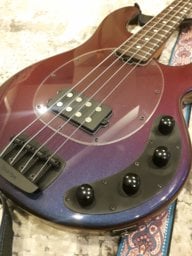
Mahogany (like say my Alembic) is my favorite tonewood but tends to cost more. I especially like mahogany in SR style basses.

But that being said, I now must say that basswood makes a much lighter instrument and that is more important to many people than some barely detectable tonewood difference. And moreover even speaking as a tone is real cult member I also feel that active instruments can totally compensate for any tonal effects of basswood, a Bongo bass being a prime example of a light weight basswood bass with tone to die for.

As always, choice is yours.
 
I have two main Ibanez basses for gigs. One is basswood with a black paint job. The other is mahogany with bubinga/ovankol neck. The black basswood kicks royal @ss and is very agressive when need be. It has in house brand of Nordstrom. The mahogany is very traditional in design and the Bartolini MK-1's sound very thick and deep, with very smooth highs. Can be used for classic rock or country or acoustic. The black bass is definitely a beast even though the body is basswood.

Ibanez has put out a zillion basses and a lot of them basswood. You would not be making a mistake buying an Ibanez bass with basswood.
 
Part of the difference in why Fenders and Gibsons sound brighter/darker is because of the difference in scale length. Then there is the bridge, then there is the pickup position related to all of that.
All true and all of that comes to bear on how a guitar/bass sounds. I think the biggest factor though really is the pickups especially when comparing single coil pickups to humbuckers.

I was surprised when I looked up the hardness of the various woods that that ash that Fender used was so much harder than mahogany.
 
  • Like
Reactions: Iristone
And maybe you just never really tightened anything down on on your kits? But that aside, my experience is Basswood is soft, dings easily, has no decent grain for looks, and screws all tend to strip (which also happens in harder woods too, but bass wood does it much more) And speaking as a member of the tonewood is real cult, I must say that basswood PASSIVE basses tend to sound "foofy" to me in the tone department. I have three G&L L2500 all in Ash and have compared to basswood versions and was not impressed. Foofy tone.

Mahogany (like say my Alembic) is my favorite tonewood but tends to cost more. I especially like mahogany in SR style basses.

But that being said, I now must say that basswood makes a much lighter instrument and that is more important to many people than some barely detectable tonewood difference. And moreover even speaking as a tone is real cult member I also feel that active instruments can totally compensate for any tonal effects of basswood, a Bongo bass being a prime example of a light weight basswood bass with tone to die for.

As always, choice is yours.

I tightened everything down. The key is to not over-tighten the screws.
 
  • Like
Reactions: Bassdirty
The old Japanese basses were made in pressed paper....i've an old one more than 30 YRS old, cheap and bad sounding for poor and old Pups. i think that wood tone in a bass is indicatively 20% at maximum of the rest of sound. Tonal chamber or semihollow increase the tonal clarity of the PUps. The Acer or rosewood neck incides for 5% on total sound or less....

Change strings and you can value how these made in sound.
 

Latest posts