• TalkBass has been independent since 1998. Add your voice.
    Create a free account to reply to discussions, view embedded media, and browse with fewer display ads.
    Join freeLog in
    Want zero display ads or expanded classifieds tools? Compare plans.

Basswood?

If Leo used basswood in the 50's it would be the holy grail of tonewood.

But he didn't, so the internet knows it's a second rate wood ....

Alder and Swamp ash were chosen because they’re plentiful and cheap - not unlike basswood.

If you’re worried about screws stripping, use longer ones, and reinforce the holes with glue. I’ve had basswood bodies, and they stayed in fine.
 
Last edited:
Janka 420 hardness for Basswood.

Too soft to hold bridge screws very well.
Too soft to hold pickguard screws very well.
Too soft to hold strap pins very well.
Not great for a manufacturer to choose a wood that the end customer will have to be very careful of, for the life of the instrument.
If you decide you want to change out your pickguard or bridge or change your strap pins to the strap locks you risk stripping out screws pretty easily, the second or third owner will have to be even more careful.
I have bought used basses (15 to 30 years old) with stripped (bridge, pickguard, strap pin) screws in Alder, Poplar and Mahogany bodies which are all harder than Basswood.

Poplar 540 Janka
Alder 590 Janka
Mahogany 1040 Janka

Dents easy. No grain to speak of and in my opinion gives a kind of "foofy" tone to an instrument.

Pros are it's very light weight and when used in an active bass tone can easily be compensated to give great tone (eg. bongo).
For me super light weight is not important so I prefer alder, ash or mahogany. (and even with those I prefer threaded inserts to keep screws from pulling out.
 
Aerodyne Jazz are among my favorite basses of all time, but there’s no denying they are fragile. The piano black finish looks great, but dents if you breathe on it hard. I’m not a Tonewood believer when it comes to bodies, so other than the light weight, I can’t see much advantage to it. With basswood you either have to baby the guitar or accept that it will get “roadworn” pretty quick. No thanks. Unless it’s an Aerodyne. :D
 
  • Like
Reactions: geezerjazz
One of my main basses is a basswood Spectorcore, and as much as I love the bass for sound, weight, and playability, it has had issues with fragility and screws coming out under use.

I eventually had to install two nuts under the bridge to keep it from pulling from the body.

E917EF71-48C6-4516-BA81-2827353B85F7.jpeg 94021431-C880-4209-AA3C-FBB84A934E52.jpeg
 
Last edited:
To be honest imho wood is relatively cheap whatsoever. I guess that the wood in a guitar impact only for a fraction of the cost.
Regardless of the importance of the wood, its price doesn't make it better suited for guitar bodies. The most expensive woods are pricey because they are rare and beautiful, not because they make better guitars. The industry for guitars or even instruments as a whole consumes far less wood than that which builds furniture, houses, boats or simply claims heating material. Instruments do not command the price of wood, therefore there is no logic in the speculation that a more expensive wood makes a better guitar.
 
  • Like
Reactions: TrustRod and Luigir
Janka 420 hardness for Basswood.

Too soft to hold bridge screws very well.
Too soft to hold pickguard screws very well.
Too soft to hold strap pins very well.
Not great for a manufacturer to choose a wood that the end customer will have to be very careful of, for the life of the instrument.
If you decide you want to change out your pickguard or bridge or change your strap pins to the strap locks you risk stripping out screws pretty easily, the second or third owner will have to be even more careful.
I have bought used basses (15 to 30 years old) with stripped (bridge, pickguard, strap pin) screws in Alder, Poplar and Mahogany bodies which are all harder than Basswood.

Poplar 540 Janka
Alder 590 Janka
Mahogany 1040 Janka

Stripped screws very rarely have anything to do with the wood.

I would put a lot of cash down that those were caused by people not knowing what they are doing.
 
  • Like
Reactions: TrustRod and krovx
Or for anyone with enough brain to realise that weight does not make everything better. Some mobile phone manufacturer is known to have added metal weights to their product only to make if "feel" high quality.

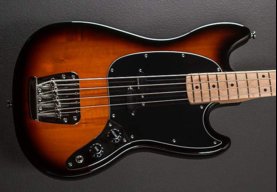
When someone says that an instrument is good, but it "feels like a toy" my ears perk up. That's how I want it to feel! The hard Ash 79 Telecaster that I played when I was first starting out cured me of weight mania. When I got a basswood Tele, I determined that this was living! My band mates adore my basswood Mustang Bass. They don't want me to play anything else, because the "toy" fits right into the mix.
 
When someone says that an instrument is good, but it "feels like a toy" my ears perk up. That's how I want it to feel! The hard Ash 79 Telecaster that I played when I was first starting out cured me of weight mania. When I got a basswood Tele, I determined that this was living! My band mates adore my basswood Mustang Bass. They don't want me to play anything else, because the "toy" fits right into the mix.
"Feels like a toy", to me, means that it warps and squeaks, that the pots or tuners don't turn or do it on their own, that the strings grind the nut down and the saddles move them out of the fingerboard, that the electronics fall apart or the jack gets pushed in after a month. That's a "toy".
Weight has nothing to do with it, only with the prejudices of people who cannot judge things for themselves and grab at the little they can assess: "Oh, it feels light, it can't be really good, can it?"

That said, I have a Jazz Bass with a light basswood body, a big wide 5-string maple neck, a HUGE headstock and spectacular neck dive as a result. I blame it on the fools who designed it. Next time, I'll get an Ibanez.
 
Like it better than alder,low weight.The squire p bass VM 5 is basswood and its great.
I saw some japanese instruments made of basswood and they were amazing.
I have been told in a shop that G&L is offering a basswood p and jazz bodies as an extra.
 
I'll throw my 2 cents in on this one. About 10 or so years ago, I bought a Fender Aerodyne bass in excellent used condition. It was love at first feel: light weight, very well balanced and played like butter...and it was sexy. I had to have it. But the one thing I was never happy about it was the lack of punch and sustain. I switched out the tailpiece twice, upgraded the pup’s, added a preamp, but nothing helped. Finally started doing some research on the body, which is basswood, and decided that replacing it was my last option. I bought a figured maple body (Fender licensed) and what an amazing difference it made in tone and punch, and now it has sustain for days. Sure, it’s a couple pounds heavier, but well worth it.


Basswood is used because it is cheap, and it doesn’t dull the machines and routers during manufacture like harder woods do. Why is this? Because basswood is soft…maybe a smidge harder than pine with a grain that looks like balsa wood. In all honesty, I will never buy a basswood bass again.
 
Last edited:
I have two '85 Ibanez basses with basswood bodies... no structural issues, no screws falling out, no wood issues.
The fretted one I have been beating up for decades with finish damage but nothing functional at fault.

They are not my best sounding basses, but I chalk this up to the somewhat generic-sounding electronics.
 
So...Basswood seems to get a pretty bad rap amongst bassistsand guitarists.

Well...I was at the plant of a very well respected organ builder this week (my son-in-law's church is getting their organ rebuilt by this company).

The owner / founder was saying that he ONLY uses basswood for certain parts of an organ which need to be "stable for 100 years or more"...

He loves the stability and consistency in characteristics of basswood

So.. Why does basswood get such a bad rep?

The owner even said it does effect sound in a good way.

Just curious why and how basswood gets such a bad wrap for guitars and basses?
Basswood dents easily but other than that there’s no reason to shy away from it.
Music Man doesn’t.
Hell, I’d probably buy one if I was into cheap basses.
C3-E44-FCC-3-B8-A-458-C-A78-D-80-BA40-E2850-D.jpg
 
Basswood is fine for electric instruments. ItIt needs finish - it is not a terribly pretty wood, very plain. As the organmaker guy said, extraordinarily stable. Much more important than strength in many applications.

It depends - my Sweet Georgia Brown P-bass had very nice figuring, and even some flame in the 3-piece body. I think the real complaint about basswood is how the available stock can be inconsistent in appearance.

11412041_10153365746211900_705764169416963650_o.jpg


Also, the thing about basswood - it has to be kiln dried thoroughly for it to get more ding resistant. It's a type of wood that loses about 40% of its volume as it dries.

But I've had three instruments with basswood - all of them I find even acoustically sounded great. I wouldn't hesitate to use basswood for an instrument.
 
It depends - my Sweet Georgia Brown P-bass had very nice figuring, and even some flame in the 3-piece body. I think the real complaint about basswood is how the available stock can be inconsistent in appearance.

View attachment 3227078

Also, the thing about basswood - it has to be kiln dried thoroughly for it to get more ding resistant. It's a type of wood that loses about 40% of its volume as it dries.

My basswood Squier Mustang has some nice figuring, too. Mostly on the back, but I don't imagine the people at the Squier factory were sitting around thinking about how to set off the grain.

"Feels like a toy", to me, means that it warps and squeaks, that the pots or tuners don't turn or do it on their own, that the strings grind the nut down and the saddles move them out of the fingerboard, that the electronics fall apart or the jack gets pushed in after a month. That's a "toy".
Weight has nothing to do with it, only with the prejudices of people who cannot judge things for themselves and grab at the little they can assess: "Oh, it feels light, it can't be really good, can it?"

I have an Affinity P-Bass that has a spongy, toy-like feel and a squeaky pickup. It plays and sounds pretty good otherwise. I'm hoping a new bridge and pickup will de-toyify it.