
The strings you have are kinda OK, but they will have a lot of variation in tension. The top 3 will be OK - A 100 E will have a decent amount of tension, and the 75 and 65 will be OK. The 115 as a B will be very floppy. A B string with the same tension as your 100 Gauge E will be a 135.

Enjoy the benefits of a premium membership!
Upgrade Account
-
TalkBass has been independent since 1998. Add your voice.
Create a free account to reply to discussions, view embedded media, and browse with fewer display ads.
Join free Log in
Want zero display ads or expanded classifieds tools? Compare plans.
You are using an out of date browser. It may not display this or other websites correctly.
You should upgrade or use an alternative browser.
You should upgrade or use an alternative browser.
BEAD tuning on a 4 string
- Thread starter JohnJr
- Start date
More options
Who Replied?
What strings are you currently using? That's an interesting gauge. As other have mentioned, you'll likely want a new set of stings (DDT are excellent), a nut cut, truss rod tweak and intonation reset.I would like to detune to BEAD.
I have a peavey dyna 4 string bass guitar with roto sound 65-75-100-115 strings
a Bugera 2000-watt amplifier
and 2, 2-10" speaker cabinets rated at1600 watts.
What are the downsides of doing this.
That's a lot of power going to a (2)210 setup. What cabs are you running?


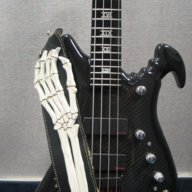
Cool lookin' bass.+1 on the DDTs. I strung my rat rod BEAD using these strings and they work really well.
View attachment 5296575
I would like to detune to BEAD.
I have a peavey dyna 4 string bass guitar with roto sound 65-75-100-115 strings
a Bugera 2000-watt amplifier
and 2, 2-10" speaker cabinets rated at1600 watts.
What are the downsides of doing this.
Welcome @JohnJr !
You're on the right track.
As others have said, maybe a slight loosening of the truss rod to create a little more relief.
It's mainly a matter of set-up, and your personal preference.
I've been using the DR 55-115 DDTs on my BEAD Raiden, successfully, for years now

The 2000 into 1600 part is questionable though

It's doable. You need a light touch if you're sticking with the current strings. If you go to the larger standard string sizes for BEAD, you'll need to do some nut work and probably tighten the truss rod a little. I just tried downtuning my fender Meteora like you are suggesting. I ultimately chose to go all in and get the standard bead string sizes as the lighter gauge strings felt too loose to me. Now it has a tight B that sounds monstrous.
Using standard BEAD gauges are usually less overall tension on the neck (than a typical EADG set),
and need the rod loosened, not tightened

I widened the nut for BEAD strings then went back to regular .045-.105 for the past year and have zero issues. Mt bass has a tilt back headstock so there is good down-pressure on the strings as they break over the nut so that may help.Just be aware that a nut filed for the gauges you would use with BEAD will most likely cause buzzing with the gauges you would normally use with EADG. Which means that filing your current nut for BEAD isn't really reversible if you ever want to go back to EADG. You'll have to get a new nut made.
Of course you can use stuff like baking soda+superglue to fill in the nut slots an re-file them for EADG but personally I see methods like this as a temporary emergency fix. It also has the potential to get REALLY messy if you don't know what you're doing!
Be careful with the volume on that kit, as the Amp is quite capable of destoying those cabinets, whether you're running one cabinet (8 Ohms) or both (4 Ohms).

With two 8 ohm cabs connected, your amp will see 4 ohms, and run at the full 2K.
You'll have a total of 800 watts continuous handling (read as the speaker's max limit),
but there's still quite a bit of watts left in the amp,
like 1200 more

So you're going to have to be real careful on how you push it.
That 1600 and 400 offset sounds weird to me, but I'm kinda not in my yard right now

That 1600/400 seems odd to me, too. I tried to get some details/specs on both Cab & Head ("Peak"/"Program"/"RMS"), but didn't get very far. After some reading, it sounds like the BT210TS is designed to handle the power of the Amp, so it's probably fine.
Bugera | Product | BT210TS
Bugera | Product | BT210TS
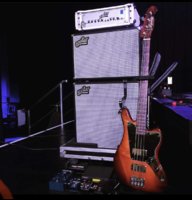
All of my 4 string basses are BEAD. With a good setup and nut file, it really just opens up a new world of available basses to play if you are set on having that low B. I love it because I used it on a CS fender in Nashville for years. Good way to ditch some s*** talk from some 5 string haters while playing classic looking and sounding basses. I also had some input on the design of a bass I had built for me by Ben Lambdin and we made it a 35" 4 string tuned BEAD. I've gotten more compliments on that thing than I ever did with any fodera, dingwall, fender….etc. the 35 with the thunderbird pickups on it are thunderous. I also love that I get to play vintage basses while keeping the low B.
The only "downside" that I've rarely run into is that they absolutely suck for slap. So….for all those gigs you have to play tons of slap bass on…..which I'm assuming are not many, I'd take a 5.
The only "downside" that I've rarely run into is that they absolutely suck for slap. So….for all those gigs you have to play tons of slap bass on…..which I'm assuming are not many, I'd take a 5.


Rock it!...these pics are from the backs.
these pics are from the backs.
Yeah, it does say 1600 peak, 400 continuous.
So either with one cab connected, and running at 1K,
or both cabs connected, running 2K,
you should be alright...
unless you're slamming away on a Lemmy style B chord for about minute,
and things start to sound funky, then you may have to back off a few Vs
Does Bugera still do repairs

My low tuned bass is either BEAD (DR Hi-Beams 65-125) or CGCF (DR DDT 65-125). Same gages. I can go back and forth np. Haven't for a bit. I messed with widening the nut on a guitar, so, less work/material to remove, but using a string as a file isn't a bad idea.
D
I widened the nut for BEAD strings then went back to regular .045-.105 for the past year and have zero issues. Mt bass has a tilt back headstock so there is good down-pressure on the strings as they break over the nut so that may help.
Yeah, a tilted headstock certainly helps. Getting the width and the angle/slope of the nut slots 100% correct is FAR more critical on a Fender-style headstock (especially the A-string where the poor break angle can only be described as a serious design flaw IMO).
But you can definitely experience problems with tilted headstocks too. Not always, it obviously depends on how precisely the nut slots have been cut, especially the angle of the downwards slope towards the tuners. You clearly did a very good job with it!

It can also depend on what type of nut files you use. Some nut files make kinda V-shaped nut slots while others make more U-shaped nut slots. The "V-shaped" ones are generally a lot more forgiving (and with other stuff too, like strings getting stuck in the nuts slots, affecting tuning stability).

Not a downside but you'd need to cut the nut accordingly for bigger gauge strings. No biggie, just a setup.
Your current EAGD strings will flap loosely if that's what you're asking. You need proper strings too.
I did it both ways ‐ detuned my beater, original strings, no setup adjustment, to see if I was actually interested. It was definitely floppy.
Then ordered a bass specifically to convert. Replaced the strings, filed the nut and adjusted the truss rod. It plays great now.
BTW. I used the new strings to file the nut, worked great.
I did it both ways ‐ detuned my beater, original strings, no setup adjustment, to see if I was actually interested. It was definitely floppy.
Then ordered a bass specifically to convert. Replaced the strings, filed the nut and adjusted the truss rod. It plays great now.


