You're not flirting with my rath, but I must respectfully disagree.
To your point about Macca in the polls, you're undoubtedly right that his status as a Beatle was a huge factor. It was primarily the Playboy polls in which he repeatedly scored at the top, IIRC. I don't remember the Downbeat polls ever placing him ahead of Ray Brown or Ron Carter or Paul Chambers.
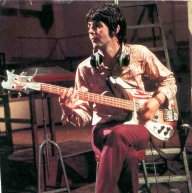
I don't know how old you are (though your infleunces suggest you may be older than a teenager), but Mccartney's work--like anyone's work, IMO--should be viewed in its historical context. When the Beatles emerged in the US in 1964, Bill Black's 2/4, root-fifth bass parts were still ringing in our ears from Elvis Persley's recordings. Paul's bass playing was pretty similar on the early Beatles albums, but it changed rapidly throughout the 60s--and with more melody and creativity than we'd heard from a bass player. When "Meet the Beatles" was released in 1964, the only hint of that melody and creativity was Paul's bass part in "All My Lovin' ". (It also displays Paul's predeliction toward descending, walking lines.) In less than two years, we have Paul's bass lines on "Dr. Robert" and "Drive My Car", followed closely by "Rain". Within five years, he's evolved all the way to "Something".
Additional factors that I believe overshadows McCartney's recognition as a bass player are his well-deserved reputations as a songwriter and as a singer (IMO, one of the five best ever in rock/pop). That, and his accomplishments as an all-round musician (singer, songwriter, keyboards, guitar and even occasional drums, in addition to bass).
Did McCartney have a great influence as a solo bassist? Admittedly not; but the concept of solo bass didn't really exist when Abbey Road was recorded. Jaco Pastorius didn't emerge until 7 years later and Victor Wooten 20 more years after that (though Victor could be heard with Bela Fleck at least as early as 1990).
Taken in its historical context, I think it's difficult to overestimate McCartney's contributions as an ensemble bass player (essentially the only kind in the 1960s). I agree, however, that he doesn't always receive the recognition he deserves for his achievements in that role.
Just my view.
This is a very spot on reading of Macca, but I don't agree that Paul was just a root-fifth player in the early years. It is true that he approached the bass as a guitar player, although I wouldn't say he was a
very good guitar player early on either. He was a good rhythm player and a definite front man, along with John. It must be remembered that the reason John allowed the much younger George into the band was because he was the only one that could tune his guitar by ear and pick out melodies. Not John or Paul was that advanced as a guitar player. When Stu left the band after the Hamburg gig, leaving them without a bass player, Paul didn't even own a guitar and he was mostly playing piano for there gigs. George wasn't a candidate for bass because he was already established as the lead player, and John had just bought a new Rickenbacker and he wasn't going to switch, so Paul was it by default. And the Beatles became a foursome.
He did approach the bass as a guitar player and you can hear it early on as he sort of bounced the pick off the strings, attacking very much like a guitarist. Later on he "plucked" the strings, resting the pick on the string before plucking it. But you can hear him getting out of the root-fifth method as early as the stuff they did with Tony Sheridan. Listen to "Cry For A Shadow" at the end of the chorus's he does this slick little run up the neck. Not something many bassists did unless they were named Jamerson. Another thing he did, probably in self-defense was to drive his amp to the edge of distortion, probably in order to cut through the mix but it drove the tension in there music. Not something the bassist did, listen to Duck Dunn back then, laying behind the beat and just establishing the groove, not driving the "bus" like Paul did. Bass amps were very under driven back in the early sixties, but bass players usually just laid back and almost could go unrecognized no matter how good they were as musicians.
But from the very start, listen to All My Loving, Paul is hammering away with eighth notes, not laying down a 2/4 groove which was the main stay of the bassists in rock n roll. His ensemble playing, and indeed the Beatles as a wholes playing really brought a "band effort" feeling to these early tunes, no matter how simple the arrangements were, each piece was a "star" on its own but never lost sight of playing as a part of the whole. Then, on the second album, With The Beatles, you start to hear ROCK bass playing like no one ever had. Until then, bass player, whether rock or jazz tended to mimic the "horn" lines. Not here, Pauls bass is brought to the front. The playing is rock solid and wild (for the times). Paul and Ringo really locked, and even though they didn't get to showy, it was a different approach to the rhythm sections job until that time. Take a listen to "All I've got to do". That may be the first time in rock that a bassist is playing chords! And that is the heart of the tune. The the walkig line in "All My Loving." Another bass player WOULD have played the 1-5 on the chords, but Paul threw in the walking parts and it made the song great.
So, very early on, Paul started becoming probably the first bassist in Rock n Roll who was creatively making the bass more than just a part of the rhythm, he was driving the tunes and what tunes they were. I remember reading somewhere back then, probably in a rag like Tiger Beat, that DJ's were having a hard time playing some of the Beatles stuff, because the bass was so strong it would make the tone arm on record players jump and skip! He only got better from there and so did the turntables.
Out side of Jamerson and possibly Brian Wilson (Paul love his playing in the early Beach Boys), Paul from 64 on was at the forefront of what a rock bassist could and would be. Before JPJ, before Noel Redding, John Entwhistle, Jack Bruce. Paul was inventing rock bass playing.

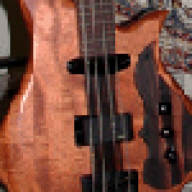




 i shall buy it soon..