
Enjoy the benefits of a premium membership!
Upgrade Account
-
TalkBass has been independent since 1998. Add your voice.
Create a free account to reply to discussions, view embedded media, and browse with fewer display ads.
Join free Log in
Want zero display ads or expanded classifieds tools? Compare plans.
You are using an out of date browser. It may not display this or other websites correctly.
You should upgrade or use an alternative browser.
You should upgrade or use an alternative browser.
begginer bassist, what does amp heads work for
- Thread starter primus fan
- Start date
More options
Who Replied?

A combo is an amp head and a cabinet combined into 1 unit. What you have now is a combo. A separate head (electronics part) and cabinet (speaker part) lets you mix and match what you want. This is a more flexible option and allows you to tailer your setup to what you neeed for a gig, etc. To confuse the issue more, many combos allow you to attach a separate cabinet to increase your volume. The PRIMARY thing you need to start making decisions is a budget amount you want to spend. Otherwise you will be getting recommendations all over the place! 
Last edited:
Welcome to the party! 
Yes, a head is only half of a “rig” you’ll need a speaker cabinet also. Or you could get a bigger combo.
pros of combos are affordability and convenience (easier to set up, more idiot proof.) pros of separates (head and cabinet) are mixing and matching; and down the road, replacement when something fails.
Tone is largely subjective. Best thing to do is listen to demos, look up the rigs of your favorite players, and go try stuff out.
big question here is budget, and goals. Big spectrum of options from home player, to jams and small gigs, to bigger gigs.
have fun!
Yes, a head is only half of a “rig” you’ll need a speaker cabinet also. Or you could get a bigger combo.
pros of combos are affordability and convenience (easier to set up, more idiot proof.) pros of separates (head and cabinet) are mixing and matching; and down the road, replacement when something fails.
Tone is largely subjective. Best thing to do is listen to demos, look up the rigs of your favorite players, and go try stuff out.
big question here is budget, and goals. Big spectrum of options from home player, to jams and small gigs, to bigger gigs.
have fun!

Also depends on your future goals such as eventually being in a band or just bedroom noodling. IMO a band setting needs around 300-500 watts. This can get pricey. For home use a "pre-amp" with a headphone-out works well. A "pre-amp" is a pedal that has e.q. functions but will not run a bass cab, and is usually a cheaper way to go, but you dont get to "feel" your bass tone through headphones. I would suggest going to "Sweetwater.com", an online gear retailer and browse to get a feel for all the different options. They also have some useful "help" sections.
The most important thing to remember about buying amps is that its not a marriage. You can ditch an amp and get another as often as you like and no-one will look down at you. Hell, there are people here who've been changing amps every six months for the last 30 years! For first serious amp I suggest that you get something second hand that turns up a lot in the local for-sales. That way you can figure it will be easy to sell on should you want to. The usual answer to that is Fender Rumble, which is kinda plain sliced bread of amps, but half the west lives on sliced bread for a reason. The other good option second hand is old and heavy, typically Peavey, 'cos us old b****tards don't want to heave that **** round any more and have to sell it off cheap. Heavy is crap if you don't have suitable transport though. It's no fun going to gigs by public transport with a big amp and cab. Trust me, I've been there.
Now amp size. You've got the advice 300-500 Watts. If you look at the poll results in the link in my sig you'll see that actually many of us don't play with anything that big. I've never needed anything like that. However judging by your screen name you're liable to end up with two overloud guitarists and a drummer who beats the hell out of the kit. In that case you probably will, but for goodness sake invest in ear defence or your ears will end up whistling at you all the time like mine do. However if you do need volume watts are all very well, but its speakers that make the big difference. 100W through an 8x10 is a lot louder than 300W through a 2x10. But you have to cart and store the 8x10. So don't buy a big lump in case you need it. Wait until you actually do.
Now amp size. You've got the advice 300-500 Watts. If you look at the poll results in the link in my sig you'll see that actually many of us don't play with anything that big. I've never needed anything like that. However judging by your screen name you're liable to end up with two overloud guitarists and a drummer who beats the hell out of the kit. In that case you probably will, but for goodness sake invest in ear defence or your ears will end up whistling at you all the time like mine do. However if you do need volume watts are all very well, but its speakers that make the big difference. 100W through an 8x10 is a lot louder than 300W through a 2x10. But you have to cart and store the 8x10. So don't buy a big lump in case you need it. Wait until you actually do.
Last edited:

The way to know which amps are recommendable is to do research. My perception is the Mesa Subway line is currently the most popular. They are also regarded as reliable. They are not however super inexpensive.
Whether you would like a Mesa Subway rig will depend on your persona taste. Keep in mind the is a range of Subway models and they don't all sound the same. The best way to find out is to try the amps you are interested in. This is not always practical, but unfortunately buying gear entirely based on what other people think will not guarantee you get a rig that you like. The first rig I ever bought was a new Ampeg SVT and 810. I based the purchase completely on research and had the rig special ordered. Millions of people think this is the ultimate bass rig, but it didn't work very well for me.
Whether you would like a Mesa Subway rig will depend on your persona taste. Keep in mind the is a range of Subway models and they don't all sound the same. The best way to find out is to try the amps you are interested in. This is not always practical, but unfortunately buying gear entirely based on what other people think will not guarantee you get a rig that you like. The first rig I ever bought was a new Ampeg SVT and 810. I based the purchase completely on research and had the rig special ordered. Millions of people think this is the ultimate bass rig, but it didn't work very well for me.

If you’re young and don’t have a big budget, but can handle toting heavier gear, the stuff from the 90s can often be found used for comparatively low prices and sound great. Get a Trace Elliot or Eden 4x10 cabinet and a peavey mark VI head and you’ll have tone and volume pretty inexpensively.
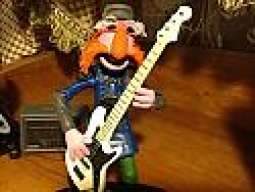
New bass player only playing one year, I recommend this:
The one on the left.
The one on the right is just a meh setup.
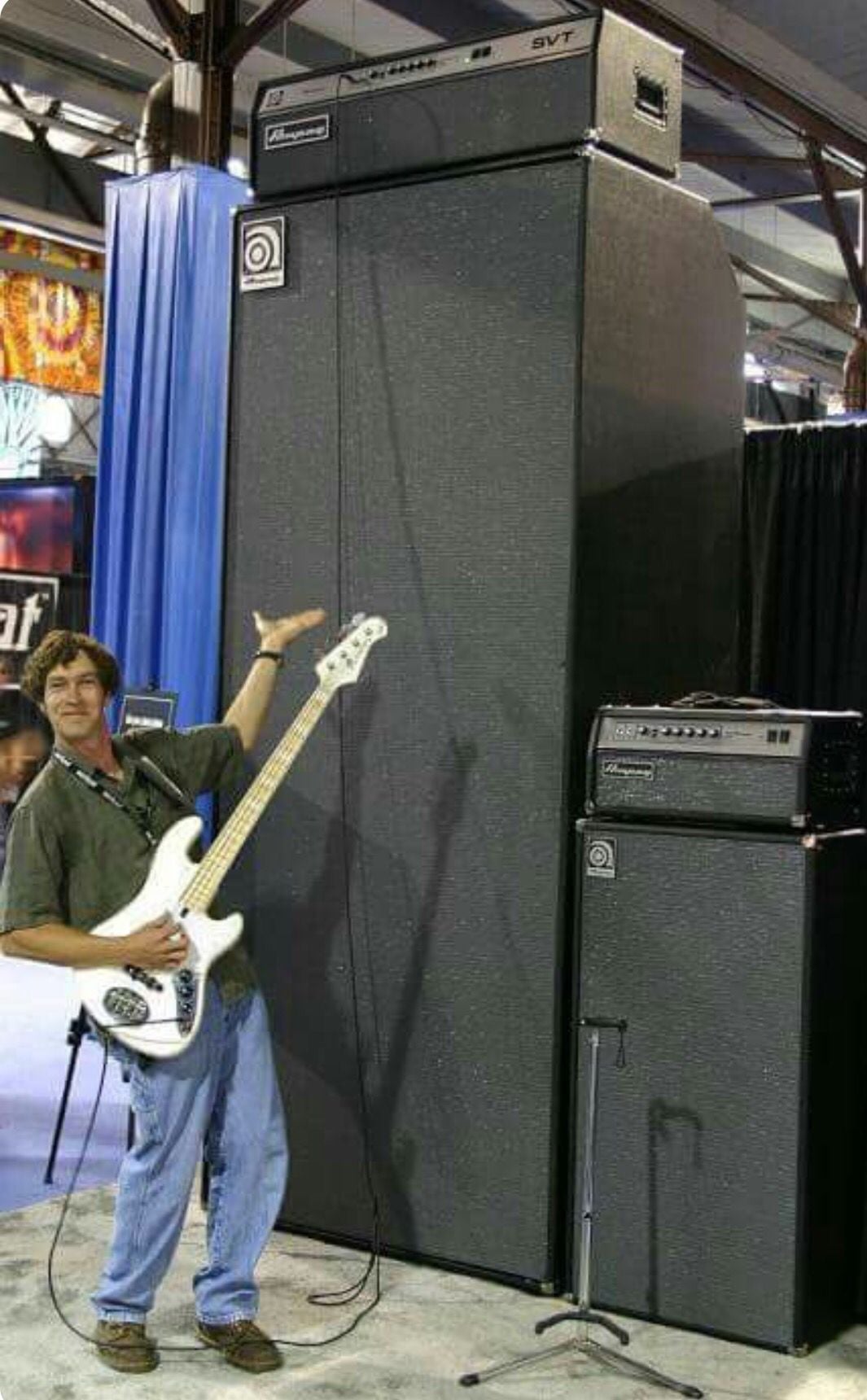
The one on the left.
The one on the right is just a meh setup.
A lot of great bass players started off with a Peavy combo amp and those are dirt cheap used and you cannot kill them. Throw them down the stairs and drag ‘em behind your truck and they still work. In the most basic sense, you probably need a 15” speaker or a 2x10 cabinet to play in a band setting (see wattage recommendations above). A combo amp is a good way to start and then you can get into heads and cabinets as your sense of tone develops. Right now, you just need something that sounds decent and makes you want to play more. Brands to check out: Ampeg, Peavy, Ashdown (less common these days, but they can be found cheap and are good, solid amps), Mesa Boogie, GK).
I'd consider how heavy the thing is to lug about.
No bass player would be unhappy to be given an Ampeg SVT and 8x10 to play through, but they'd be grumbling if they had to move it themselves.
Trace Elliot kit is great but out of fashion and so can be had cheap; however, it is older and more solid (ie. heavy).
Back in time I used to have two Marshall 4x12 cabs and a Burman valve amp; that was a workout to get set up.
More modern kit, typified by Markbass, tends to be much more luggable (ie. lighter) and can still sound good.
Various people will have their own preferred brands and some can get rather expensive.
A lot of folks like a Fender Rumble, but I've never had one.
Also beware of power ratings, as they are not linear, so the rule of thumb is that 10x Watts is twice as loud (ie. to double a 100W amp you need a 1000W one).
No bass player would be unhappy to be given an Ampeg SVT and 8x10 to play through, but they'd be grumbling if they had to move it themselves.
Trace Elliot kit is great but out of fashion and so can be had cheap; however, it is older and more solid (ie. heavy).
Back in time I used to have two Marshall 4x12 cabs and a Burman valve amp; that was a workout to get set up.
More modern kit, typified by Markbass, tends to be much more luggable (ie. lighter) and can still sound good.
Various people will have their own preferred brands and some can get rather expensive.
A lot of folks like a Fender Rumble, but I've never had one.
Also beware of power ratings, as they are not linear, so the rule of thumb is that 10x Watts is twice as loud (ie. to double a 100W amp you need a 1000W one).
What's your budget?
What do you plan to do with your rig? Bedroom practice? Join a band?
There are great products at all price points and power levels. You need to
know your purposed use.
And lastly, what's your budget?
(sorry, I already asked that...)
What do you plan to do with your rig? Bedroom practice? Join a band?
There are great products at all price points and power levels. You need to
know your purposed use.
And lastly, what's your budget?
(sorry, I already asked that...)
When in doubt, Fender Rumble 100 is a good option in my mind. Lightweight, not expensive, you can always go directly into the FX-Return if you want to use another preamp (that's what giving the "character" to an amp) and you can slave a second one if you want to step it up. Or switch to the 500-version. And then slave a second 500. Selling it used shouldn't be a problem when you decide it's time to let it go. As a beginner, I wouldn't buy anything too exotic, there are a lot of people out there using it, so help is easily found when questions arise and to me, Fenders are in the category of being somewhat neutral.
So, forget about my specific recommendation, get something that is commonly used and fits your budget.
So, forget about my specific recommendation, get something that is commonly used and fits your budget.
1 define your intended use, in a heavy metal band, in a polka band, basement jamming with friends, etc.
2 any particular style?
3 how is this amp going to be transported, car, truck, van,?
4 funds available
5 new or used
6 how heavy do you care to go
7 ask someone more experienced to look at amps with you
8 ask local TBers to help look
9 the hunt is half of the fun, have fun
Your needs will change.
Right now I have two amps that work well for me that I never would have looked at a few years ago, probably would have sneered at.
2 any particular style?
3 how is this amp going to be transported, car, truck, van,?
4 funds available
5 new or used
6 how heavy do you care to go
7 ask someone more experienced to look at amps with you
8 ask local TBers to help look
9 the hunt is half of the fun, have fun
Your needs will change.
Right now I have two amps that work well for me that I never would have looked at a few years ago, probably would have sneered at.
A good tone for what types of music?... have a good tone ...
I see you're 'Primus fan' so maybe have a look at what brands Les Claypool has used over the years.

So...
You go to GC and plug a bass you kinda dig into every half stack and combo they have. I recommend setting them flat (every pot at 12:00) and seeing which one sounds best {and has Booty Power}).
After a 30 year gigging career I've stepped down to a Markbass CMD 121 combo. It's more than enough for this almost ampless world we live in now.
You go to GC and plug a bass you kinda dig into every half stack and combo they have. I recommend setting them flat (every pot at 12:00) and seeing which one sounds best {and has Booty Power}).
After a 30 year gigging career I've stepped down to a Markbass CMD 121 combo. It's more than enough for this almost ampless world we live in now.

A combo with a 12" woofer is the bare minimum for me.
Tons of used available at a good price quite often.
A Peavy combo with a 15" speaker can be bought for little money and is always a good start.
Tons of used available at a good price quite often.
A Peavy combo with a 15" speaker can be bought for little money and is always a good start.

JeezyMcNuggles
Inactive
- Feb 23, 2018
- 14,723
- 20,970
- Disclosures
- I suck, but nobody really notices
Amp heads amplify your bass into whatever speakers you hook up to them.I started a bit more than one year ago and i have a really trashy amp that came with my bass, how do i know which amps are recommendable and if they have a good tone, what do amp heads do, mostly idk anything about gear
Combo amps have a speaker already hooked up to them.
Peavey is tough but I totally killed mine. Made the magic smoke come out and everything.A lot of great bass players started off with a Peavy combo amp and those are dirt cheap used and you cannot kill them. Throw them down the stairs and drag ‘em behind your truck and they still work. In the most basic sense, you probably need a 15” speaker or a 2x10 cabinet to play in a band setting (see wattage recommendations above). A combo amp is a good way to start and then you can get into heads and cabinets as your sense of tone develops. Right now, you just need something that sounds decent and makes you want to play more. Brands to check out: Ampeg, Peavy, Ashdown (less common these days, but they can be found cheap and are good, solid amps), Mesa Boogie, GK).
OP I am going to dive deeper than perhaps needed. But who knows, maybe this will be useful to you.
The standard bass or guitar “head” is an integrated amplifier: it has both a preamp and a power amp internally. It does not have speakers, and thus does not make sound. It needs to be connected to a speaker cabinet to make sound.
A speaker cabinet is a transducer designed to take an amplified signal as input and put out sound. The speakers, called “drivers” in cabinet-land, drive the acoustic output, but they interact mechanically with the air space in the speaker cabinet. So a speaker cabinet is the combination of the drivers in a box sized and designed to get the most out of the drivers.
A “combo amp” combines an integrated amp and a speaker cabinet together to produce a single solution for bass/guitar amplification.
There are solutions where the preamp and power amp are separate. This is common in PA applications, but also some bassists prefer this approach for their rigs.
Nowadays there are many “preamp” pedals that can be used as effect pedals before an integrated amp, or you can replace the head’s internal preamp by patching your stomp box preamp into the “power amp input” or “effects return” jacks on the integrated amp head.
There are also rack mount preamps that are generally useful for a lot of different inputs, all the way from bass to vocals. These usually have better outputs to directly drive a stand-alone power amp.
Stand-alone power amps usually at rack mounted and quite powerful; in general they are intended for PA use in larger scale PAs, but they can be used as part of a bass rig.
The standard bass or guitar “head” is an integrated amplifier: it has both a preamp and a power amp internally. It does not have speakers, and thus does not make sound. It needs to be connected to a speaker cabinet to make sound.
A speaker cabinet is a transducer designed to take an amplified signal as input and put out sound. The speakers, called “drivers” in cabinet-land, drive the acoustic output, but they interact mechanically with the air space in the speaker cabinet. So a speaker cabinet is the combination of the drivers in a box sized and designed to get the most out of the drivers.
A “combo amp” combines an integrated amp and a speaker cabinet together to produce a single solution for bass/guitar amplification.
There are solutions where the preamp and power amp are separate. This is common in PA applications, but also some bassists prefer this approach for their rigs.
Nowadays there are many “preamp” pedals that can be used as effect pedals before an integrated amp, or you can replace the head’s internal preamp by patching your stomp box preamp into the “power amp input” or “effects return” jacks on the integrated amp head.
There are also rack mount preamps that are generally useful for a lot of different inputs, all the way from bass to vocals. These usually have better outputs to directly drive a stand-alone power amp.
Stand-alone power amps usually at rack mounted and quite powerful; in general they are intended for PA use in larger scale PAs, but they can be used as part of a bass rig.


