• TalkBass has been independent since 1998. Add your voice.
    Create a free account to reply to discussions, view embedded media, and browse with fewer display ads.
    Join freeLog in
    Want zero display ads or expanded classifieds tools? Compare plans.

Berklee Auditions

I played in the Army and the Air Force. Great gig, killer musicians. I've retired, own my house outright, my kid went to college on my benefits, and I get a check and health care for the rest of my life. Any other gigs offer that?

Not even close. Thank you for your service, and let your family know of my appreciation of their support of your career. Merry Christmas!
 
  • Like
Reactions: Pacman


This is an interesting video. Berklee sounds like a great school for someone who wants to be a working musician.


Seems like musically and school environment, yes it seems like a great school. I'm sure students learn a lot there.

Money wise though..

$50kUSD per year... 4 years... graduate with $200k USD school debt at maybe 6% loan interest costing $12k USD/year and growing every year?

Graduates will pay that off with a musicians' salary in 2020s-2040s??

oof. More like you have to come from a wealthy family to go there, or get accepted for scholarships that pay for most everything.

Too expensive.

With that kind of money, you could hire the teachers and take private lessons, buy the books the gear, etc and make it work. Even hire people to rehearse with, and still pay less $ over 4 years and have no 6% interest loan to pay for either. Make your own school with you as the Provost and the sole student. ;-). Motivation, plan, budget.

Many schools have quality courses and lower tuitions. However, yeah, many of them use older fashioned conservatory models that won't teach electric bass guitar.
 
Last edited:
  • Like
Reactions: Whousedtoplay
Seems like musically and school environment, yes it seems like a great school. I'm sure students learn a lot there.

Money wise though..

$50kUSD per year... 4 years... graduate with $200k USD school debt at maybe 6% loan interest costing $12k/year and growing every year?

Graduates will pay that off with a musicians' salary in 2020s-2040s??

oof. More like you have to come from a wealthy family to go there, or get accepted for scholarships that pay for most everything.

Too expensive.

With that kind of money, you could hire the teachers and take private lessons, buy the books the gear, etc and make it work. Even hire people to rehearse with, and still pay less $ over 4 years and have no 6% interest loan to pay for either. Make your own school with you as the Provost and the sole student. ;-). Motivation, plan, budget.

Many schools have quality courses and lower tuitions. However, yeah, many of them use older fashioned conservatory models that won't teach electric bass guitar.

I don’t think it is that hard to find schools that take bass guitar seriously these days. I know the university where I teach (history) has turned out a lot a of accomplished bass guitarists. Heck, Tom Kennedy was hired in an adjunct capacity and taught students private lessons there back in the Nineties. My school is a regional university that mainly goes up to the MA lev except for the dental, pharmacy, education programs.
 
Ed Friedland, The Bass Whisperer, was Berklee bass faculty.

I wanted to go there in the 80's but my parents wouldn't support it. I know quite a few who did and made decent careers in music.

I think part of the "fails" might be related to where a graduate insisted on living. It's hard to make a great performance living in certain areas vs. others. A recent graduate of any music school needs to live where the work is. A music degree can at least get initial auditions, as in the foot in the door, in areas where it's possible to make a decent living playing. In some of the fringe areas, a music educator playing side work can do quite well.

However, not everyone with a music degree can really fit into the "work" that is music. Some need to show their unique art, and it will or will not bring dollars.

There was/is so much competition for positions in the music department at the college from which I retired that a PhD was considered a prerequisite.

Teaching remains one of the few ways professional musicians can have a steady gig, with comprehensive benefits.
 
Considering what it costs to attend there now, I would have to say a Berklee education is a terrible financial investment. But I'm not sure there's anything out there quite like Berklee. You go to Berklee because you have to go to Berklee.

If you want a good return on investment, you find a state school with a good music program (or, as others have noted, just find good private instructors), make a plan, and apply yourself.

I say this as someone who attended Berklee for two years, and transferred and got my Bachelor's of Music somewhere else.

Might reversing the process make more sense?

Master basic skills at a local college or university, and then "transfer to" Berklee to get from them what a local college can't provide, including specialized training, networking, and a Berklee diploma.
 
Might reversing the process make more sense?

Master basic skills at a local college or university, and then "transfer to" Berklee to get from them what a local college can't provide, including specialized training, networking, and a Berklee diploma.

I imagine many that leave early mastered the playing before they got there and they only needed the networking.
 
  • Like
Reactions: Jazzdogg
It's probably worth noting that Berklee's entrance requirements have changed dramatically over the years. When I attended (1978-1982 ...and yes, I graduated, with a Bachelor of Music degree) there was no entrance audition: You could show up with crummy technique on your instrument of choice ...you could literally suck* -- and they would take your money, accept you as an incoming freshman, then hold a placement audition to make sure you were getting the appropriate lessons and surrounded by equally good (or sucky) ensemble-mates. And then if you continued to suck you'd probably wash out, but at least by then they'd made their nut off your first semester tuition.

That all changed in (I believe) the mid-1980s, when Berklee realized that in order to get the funding they needed to be the type of college they wanted to be, they had to up their game, raise their standards. And so sometime after I graduated they instituted actual entrance auditions, and became much more of a "real" music college.

...which included a commensurate increase in tuition. You do not wanna know how little I paid for tuition in 78-82! :)


*True Story: My first day at Berklee, standing in line at the registrar's office to pick up or drop off some documentation, I get in a conversation with the guy standing in front of me. He told me he'd only been playing guitar for 6 months, and had no idea what he wanted to do with his life, but his parents basically told him to go to college or get a job so he figured out he could get into Berklee. 6 months!!!!

I was in the last freshman class that did not require in-person auditions. I started in 2005. All they wanted was a couple recommendation letters and a CD demonstrating some scales, arpeggios, and a couple prepared pieces. In 2006 the in-person auditions started.
 
  • Like
Reactions: Bob_Ross
Might reversing the process make more sense?

Master basic skills at a local college or university, and then "transfer to" Berklee to get from them what a local college can't provide, including specialized training, networking, and a Berklee diploma.

I was not suggesting that starting out at Berklee and then transferring was the ideal route to take. Again, from a financial perspective, most people are better leaving out Berklee altogether.
 
Link-
if anyone wants to see a short clip
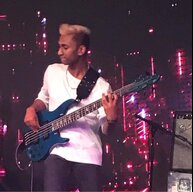
Here is my brother at 9 years old in 2016 playing in the “master class” Kim held for the drum work shop along side the same time the bass workshop

And we had the n’th power playing with victor and Steve Bailey F8EE12DA-9C76-4168-A084-27B1A40BF0EA.jpeg7FB728BC-4DA1-4C9A-8ECE-F1E007343290.jpegF121A2AB-4AB6-407C-8C20-5C63E0C4C5D6.jpegC0A6D227-7237-4E17-915E-239228380868.jpegC0B95901-4EDC-4B13-B95D-419337A5821D.jpeg

back from my trip
 
Seems like musically and school environment, yes it seems like a great school. I'm sure students learn a lot there.

Money wise though..

$50kUSD per year... 4 years... graduate with $200k USD school debt at maybe 6% loan interest costing $12k USD/year and growing every year?

Graduates will pay that off with a musicians' salary in 2020s-2040s??

oof. More like you have to come from a wealthy family to go there, or get accepted for scholarships that pay for most everything.

Too expensive.

With that kind of money, you could hire the teachers and take private lessons, buy the books the gear, etc and make it work. Even hire people to rehearse with, and still pay less $ over 4 years and have no 6% interest loan to pay for either. Make your own school with you as the Provost and the sole student. ;-). Motivation, plan, budget.

Many schools have quality courses and lower tuitions. However, yeah, many of them use older fashioned conservatory models that won't teach electric bass guitar.

All of what you say is not untrue.
 
There was/is so much competition for positions in the music department at the college from which I retired that a PhD was considered a prerequisite.

Teaching remains one of the few ways professional musicians can have a steady gig, with comprehensive benefits.

How much is the following statement about Leland Sklar true in regard to Berklee?

"Between 1965 and 1970, Leland Sklar attended San Fernando Valley State College (now CSUN - Sea Sun - California State University, Northridge).
He began as a music major, but became disillusioned in the music department after two years when he realized the curriculum was geared more toward producing music teachers than towards performance."
 
  • Like
Reactions: Jazzdogg
How much is the following statement about Leland Sklar true in regard to Berklee?

"Between 1965 and 1970, Leland Sklar attended San Fernando Valley State College (now CSUN - Sea Sun - California State University, Northridge).
He began as a music major, but became disillusioned in the music department after two years when he realized the curriculum was geared more toward producing music teachers than towards performance."

Not much. Most music departments within state colleges/universities are geared toward producing public school music teachers, because that is how 90+% of the graduates are going to make their living. Especially smaller music departments where there are not numerous music majors from which to choose.

At Berklee, yes, they will try to make you somewhat well-rounded; but if you are a performance major, you will be primarily prepared for music performance.
 
Teaching remains one of the few ways professional musicians can have a steady gig, with comprehensive benefits.

Likely to be true. However, the question then becomes just how many music faculty positions exist, how many on average are actually open positions in any given year, and how many of those open positions are open for applications from new grads. I doubt those numbers are very promising. Especially considering the number of schools which are currently in the process of drastically reducing or entirely eliminating their art and humanities departments - or already have.

I don’t know what the average pay scale is for university level faculty currently is. But below that level compensation for teachers is pretty low considering the education and experience requirements for a teaching certification. I know several full time K-12 teachers who have taken second jobs or offer private instruction and coaching just to make ends meet.

Bottom line: the economic outlook for a newly minted BA or BFA in music is pretty dismal and begs the question: “Why bother with a degree at all?” when it comes music college.
 
Last edited:
Likely to be true. However, the question then becomes just how many music faculty positions exist, how many on average are actually open positions in any given year, and how many of those open positions are open for applications from new grads. I doubt those numbers are very promising. Especially considering the number of schools which are currently in the process of drastically reducing or entirely eliminating their art and humanities departments - or already have.

I don’t know what the average pay scale is for university level faculty currently is. But below that level compensation for teachers is pretty low considering the education and experience requirements for a teaching certification. I know several full time K-12 teachers who have taken second jobs or offer private instruction and coaching just to make ends meet.

Bottom line: the economic outlook for a newly minted BA or BFA in music is pretty dismal and begs the question: “Why bother with a degree at all?” when it comes music college.

So few openings, and so many applicants, that a PhD is needed to get one's foot in the door. Many positions are adjunct, offering few hours and no benefits. Once full-time, salaries are six figures with full benefits. But, there's very seldom a guarantee of a FT position at time of hire.

In many respects, job prospects for a musician holding a bachelors degree are no better than for someone with a degree in art history or archeology.

A college degree has become largely meaningless, and with student debt, has more in common with a pyramid scheme than an education or path to employment.

In many ways, it's better to become an electrician, plumber, or learn another skilled trade, than to go into debt to gain a diploma of questionable value.
 

Latest posts