• TalkBass has been independent since 1998. Add your voice.
    Create a free account to reply to discussions, view embedded media, and browse with fewer display ads.
    Join freeLog in
    Want zero display ads or expanded classifieds tools? Compare plans.

Best bass for studio work

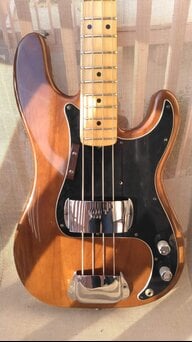
All that said, I still think the engineers will be happier if you just show up with a P bass.

If you've just time travelled to the 1950's or 1960's, that's certainly true. I don't think Engineers nowadays are that limited in their thinking - I've worked with a lot of different engineers (including myself), and I've never run across one with that mindset. I've never been asked to play a P bass, or indeed any bass with flats. That legend is from a time when there was no EQ on the recording console, the studio had one kind of mic or 1 DI to use for bass, and they were doing a LOT of sessions in a day. None of that applies today.

However.....

If you're doing Motown-esque stuff, then a P bass with flats is certainly a very good suggestion - not because the engineers want you to, but because that is the gear that Motown was played on.
 
Last edited:
Any mention of Yamaha grabs my attention. I own a bunch of Yamaha BBs and proudly record with any one of them. Tell us more about yours and I'm sure there are people here who will eagerly help you get the electronics in shape if that's what you perceive the problem to be.

It's a really old, low cost Yamaha that I started with when I first switched from Keys to Bass in my band back in like 1997 or somewhere around that time. Not really sure about the date. It's a Yamaha RBX 250, the light brown wood finish version. Just figured it was too old and low quality to bother with. It's been hanging on my studio wall for years.
 
It's a really old, low cost Yamaha that I started with when I first switched from Keys to Bass in my band back in like 1997 or somewhere around that time. Not really sure about the date. It's a Yamaha RBX 250, the light brown wood finish version. Just figured it was too old and low quality to bother with. It's been hanging on my studio wall for years.

Get that thing set up and drop a new pickup in it and it'll be a really good P-bass substitute. Seriously. If it's playable and in tune, spend $100 on a pickup and put it to use!
 
I think the RBX was one of Yamaha's low-cost, entry-level basses, but even having said that I've heard some great ones. The next step up was the TRB series, and Yamaha blended the two a few years ago into the TRBX series, which is quite good. I guess I can't be of any direct help to you, and I trust your judgement about the sound of yours. If it isn't making it for you, it probably isn't worth upgrading.
 
Get that thing set up and drop some new pickups in it and it'll be a really good P-bass substitute. Seriously. If it's playable and in tune, spend $100 on a pickup and put it to use!

I'll look into that also. I have 4 basses now. 1) The new Fender Player Plus Jazz I just dropped $1300 on 2) The Korean Ibanez ATX clone 3) My Harley Benton JB-75MN NA Vintage Series and 4) my old Yamaha RBX 250.

I'm thinking about getting rid of the Ibanez ATX clone and the Harley Benton. I also have 2 Harley Benton Guitars and a Peavy Guitar I can sell. Maybe I can put that money towards electronics.
 
Having worked in studio recording for years, I can attest that what you say is correct. We can use whatever we want, however, it is always best to start with the right tones or at least as close as possible so you don't have to do too much when it comes to sonic and tone balancing later. Kind of like having a vocalist singing through a low quality dynamic mic in a room with untreated acoustics. Yea, you can do it, but the amount of work you are going to have to do post during the mixing process is gong to be extreme.

Having said that, I think a bass is easier to force fit than other recorded tracks.
I agree. I don't make extra work for myself on purpose. But because I'm working by myself and not on a set schedule, I like to sometimes experiment with odd recording combination.

I wouldn't do this for vocals for several reasons.

1) The voice tires out easier than a bass player's fingers. So it's best to get the right sound as quickly as possible.

2) For bass, I'm going D.I. and adding processing after. This means that the sound is very clean to begin with. With vocals, you have the variable of the mic and the room. You can't get as neutral a signal. So it's better to get what you want up front (though of course you still make it better later).

I'm not suggesting anyone show up to a metal studio session with a Hofner with flats or to a Motown session with a Dingwall. At the very least, it sends the message that you don't know what you're doing. It's a bit different if you're already in a band. But if you're showing up to play with strangers for money, you have to wear the right uniform for the job, so to speak.
 
Welcome to Talkbass.

decided to go ahead and grab the Fender Jazz Player Plus Bass with Noiseless pickups.
Any suggestions?

Congrats on the Jazz. As far as suggestions for another bass, perhaps a line 6 Variax 700? They have 24 onboard modeled/sampled sounds from flat back upright to synth bass. Plus a digital jack for future updates and additional sounds.

There are a few listed on reverb, here's link (no affiliation)
Gear | Reverb
 
What type of bass should I be looking at for recording purposes.
any competent ax will do (competency includes: no/low noise). fret noise is mostly about setup and technique: makes me think your HB ax could use some attention in both of those areas.

buying a certain brand/model and getting exactly what you want/need requires luck! good luck! :thumbsup:
 
  • Like
Reactions: legalbass
Hi again ladies and gents. I am a musician that did at one point do a lot of gigging but I find myself now doing almost all studio recordings and songwriting. I finally upgraded and got the Fender Strat that I always wanted and my studio recordings are definitely much better. Now, I want to upgrade my bass. Since I was never a regular bass player I never put any money into that other than an old 25 year old Yamaha 4 string and a cheap Harley Benton bass.

Now I want to upgrade my bass. I write mostly R&B, Soul and Country while doing some old Motown covers. What type of bass should I be looking at for recording purposes. I need something with not a lot of fret noise, thats for sure and low hum if thats possible.

Thanks

Jessie
If your budget will allow I’d suggest a 5 string Fender Jazz bass and 4 string Fender P. You’ll have most bases covered.
 
As far as I can remember, I think I can only think of one time that I was requested to use a P Bass and that was only for one song, not the entire project.....I soloed the front pickup on my G&L ASAT, put it in Series, put it in passive ( like I always did back then when I felt like I needed a P tone) and problem solved

I think its kind of sad how many folks think the player, the players experience, and plain ol physics ( a series wired humbucker in the P position) are all interchangeable but the P Bass isnt
 
Hi again ladies and gents. I am a musician that did at one point do a lot of gigging but I find myself now doing almost all studio recordings and songwriting. I finally upgraded and got the Fender Strat that I always wanted and my studio recordings are definitely much better. Now, I want to upgrade my bass. Since I was never a regular bass player I never put any money into that other than an old 25 year old Yamaha 4 string and a cheap Harley Benton bass.

Now I want to upgrade my bass. I write mostly R&B, Soul and Country while doing some old Motown covers. What type of bass should I be looking at for recording purposes. I need something with not a lot of fret noise, thats for sure and low hum if thats possible.

Thanks

Jessie
Precision Bass, or a G&L L-1000. Maybe both, one with flats and one with rounds.

John
 
Hi again ladies and gents. I am a musician that did at one point do a lot of gigging but I find myself now doing almost all studio recordings and songwriting. I finally upgraded and got the Fender Strat that I always wanted and my studio recordings are definitely much better. Now, I want to upgrade my bass. Since I was never a regular bass player I never put any money into that other than an old 25 year old Yamaha 4 string and a cheap Harley Benton bass.

Now I want to upgrade my bass. I write mostly R&B, Soul and Country while doing some old Motown covers. What type of bass should I be looking at for recording purposes. I need something with not a lot of fret noise, thats for sure and low hum if thats possible.

Thanks

Jessie

P bass is always good for plain and simple thump.

BUT. I will say that the L2500 tribute I bought kind of on a lark, plugged in raw to a DAW knocked my socks off with clean, hi fi tone that I had previously worked very hard to even get near with a Fender. Couldn’t believe what I was hearing and spent more than a few minutes thinking about how I had chased that kind of clarity for years with my other basses.
 
Last edited:
09&ccb=1-5&_nc_sid=8bfeb9&_nc_ohc=1xXYAqJGeV4AX8UU_Gi&tn=XmLLQZHF5OuOiinY&_nc_ht=scontent-lax3-1.jpg

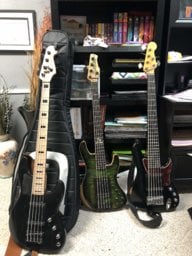
Not suggesting you try finding an American Standard 2015 Jaguar (not a common bass), but this is my current home studio set up for strings.
The bass can do P, and PJ, and J (bridge only), and series/parallel, and active/passive. Covers a lot of territory for one instrument. Any nice PJ should get you close.
Guitar can do Strat, and MIDI.