The best I have ever seen were these titanium rods from KTS. Sadly they stopped making them. View attachment 4115451
Those truss rods are a thing of beauty! I would buy one in an instant if they were available.


TalkBass has been independent since 1998. Add your voice.
Create a free account to reply to discussions, view embedded media, and browse with fewer display ads.
Join free Log in
Want zero display ads or expanded classifieds tools? Compare plans.
The best I have ever seen were these titanium rods from KTS. Sadly they stopped making them. View attachment 4115451
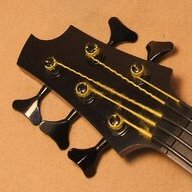
I have two left for another six string build. I would also buy more if they were still making, even though these cost me $50 US each. Two of these rods weight less then one steel.Those truss rods are a thing of beauty! I would buy one in an instant if they were available.
I have two left for another six string build. I would also buy more if they were still making, even though these cost me $50 US each. Two of these rods weight less then one steel.

Seems like a silly item to try to save a few bucks on. It's a critical item that can cause so much trouble when it doesn't work properly. Go for quality.

It'd be supremely ironic (but also extremely cool) if you were to go for a dual rod setup like Alembic or Rickenbacker on this buildI used BBG DA rods on my two last builds. The first one worked fine, the second had a sloppy adjuster nut, a little too loose for 4mm and too tight for 5mm, which makes me think the QC isnt great on these. Im trying to find a 4.5mm hex, or maybe just file down a 5mm, but I shouldn't have to. The blue plastic wrapped rods are common on a lot of sites, they look identical, but I dont know if quality varies by manufacturer. They average $15-20.
Bass Truss Rod - Best Bass Gear
Stewmac products are pretty universally good quality, but I loathe their deceptive "Free Shipping" claims on Amazon. They sell their "low profile" rods for $12 plus $10 shipping on their site and.....you guessed it, $22 with "free shipping" on Amazon.
Amazon.com : stewmac low profils trussrod 24"&ref=nb_sb_noss
Invalid Link Removed
rods/stewmac-red-low-profile-truss-rod.html
They also make the "Hot Rod" versions with threaded brass blocks at both ends. These look very well made, but require a special router bit to cut the slots for (which they sell separately, of course) These look like they require a lot more wood removal than the low profile rods.
[Invalid or Expired Link Removed]
Then there are the DA rods by Luthiers Mercantile and Allied Luthiery. They are the most expensive of the lot, the question is, are they worth the extra cost?
Truss rod double action welded, 22 3/4" x 3/8" (overall length 23 3/4")
FlexStrong Dual-Action Bass Truss Rods
Since the repair for a broken or stripped truss rod is so onerous, truss rods seem like the one place NOT to cheap out. What's the collective and Pro opinion on the available options, whats the best bang/buck? I dont mind paying more for something truly better quality, but like most amateur builders, I feel like I've overpaid for mediocre products just because they feature the word "Luthier".

Yes that price was 8 years ago with a discount for buying 6 pcs. Wonder what they would charge now if they made them?That's not outrageous, the Allied Lutherie ones are $44.00 but they are Stainless, not Titanium!
Just to give you an idea of the price of the materials used to make truss rods:
Right from McMasters, the cost of 3/16" diameter rod stock, 3' long:
4140 steel: $13.82
O-1 tool steel: $4.52
12L14 steel: $5.97
304 stainless steel: $4.66
7075 aluminum: $29.56
Grade 2 titanium: $18.60
Grade 5 titanium: $33.16
Obviously, these prices are high, because they are for a single 3' length. But this shows the ratio of prices for different metals. I have made truss rods from all of these metals.
These days I make all of my truss rods from 304 stainless. I buy 3/16" 304 stainless rod stock in 12' lengths from Industrial Metals, for about $6 each.
Looking at my standard Double-Acting Single-Rod truss rod, the cost of all the materials is about $5.50, and the labor is about $10. That's to make up each kit of the rod, anchor, and rotating head assembly, in batches of 5-10 at a time. Installation in a neck, in a bed of epoxy, is $15 labor. I charge most of my clients $30 to put one of my truss rods into their neck blank.
that sounds like quite the device. what's it look like?

Yeah, the difference though, @Bruce Johnson, is that your truss rods are designed to affect or enhance the performance of the neck. In theory, you'd think that a luthier would want to spend extra money for a better truss rod. That's right there is a smart allocation of overall production costs.
Those titanium rods, while they are beautifully crafted, are functionally the same as the steel rods. Unless you're trying to save weight or you're worried about ambient moisture penetrating the neck enough to rust out the truss rod or if you're building a concept bass out of aerospace-grade wood, it just isn't a practical expenditure for a part that is functionally exactly the same and is hopefully never going to see the light of day.
What doesn't make sense to spend $30 on a truss rod from LMI if you can buy basically the same mass-produced truss rod for $10. If it's spot-welded in China or the US, it doesn't really make much difference. Don't get me wrong - I'm all about supporting USA labor seeing how I am USA labor myself. For that extra $20, I should expect that the truss rod will be significantly better.
Those Allied Lutherie rods seem to be the best compromise - for the roughly the same price as the LMI rods, you're getting a USA-crafted product that at least looks like it's better-made.
Just as an FYI, I've only used a few LMI rods and they are NOT spot-welded, and they look entirely different than what was shown in the #16 post. Both sides of the LMI blocks had continuous welds down the sides and they worked smoothly.
I'd be so incredibly ***ed if I even spent $10 on a rod that resembled post #16. I'd also be ashamed to send an instrument out to someone else with one of those rods because I would have a strong suspicion what would happen a few years down the road. Maybe some would be OK with taking the "nobody's gonna see it.." path, but I personally wouldn't choose to do that.
It's good to hear that the LMI rods are better than the Bitterroot or All Parts rods.
I've done a lot of different versions: headstock access, heel access; spoke wheel nut; steel, stainless, aluminum, titanium, different anchor ends for special applications, etc.
Here's the most common version: Double-Acting Single-Rod, headstock adjust, set into a maple blank for a tilt-back headstock. I've done at least 800 of these for Luthier clients.
Here's the components laid out before assembling into the neck: The rod, the head assembly, carbon fiber TOW for the backstrap, maple filler strip.
View attachment 4117877
The slot is partly filled with West Systems epoxy, The TOW bundle is laid in the bottom, the rod and head assy are waxed and fitted in, more epoxy, filler strip. The brass mandrel plugs the access hole.
View attachment 4117878
After curing, the filler strip is trimmed off and the top surface is re-surfaced. This is the completed installation as it goes to my customer.
View attachment 4117879
Here's the same DASR truss rod installed in a vertical strip of maple. Ready to be laminated into a neck.
View attachment 4117888
View attachment 4117889
And here's the cartridge truss rod prototypes. A DASR truss rod, heel access, spoke wheel version, assembled into a cartridge with aluminum reinforcing plates. An all-in-one neck core structure, designed to glue down into a simple routed slot.
View attachment 4117896
View attachment 4117897
The components that make up the assembly.
View attachment 4117894
Gluing one up in the special fixture. All filled with epoxy, no air gaps inside.
View attachment 4117895
The cartridge truss rods were a cool idea, and the few that I tested in Luthier customers' basses worked beautifully. But they were too expensive to make and it would have been tough selling them. The project got shelved.
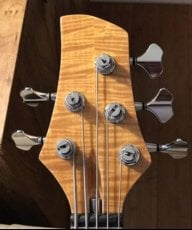
The last couple builds I've done have been using LMI rods and I like them a lot. They are more expensive, but the shipping is free if you get a couple of them.
You can see an example of their use in my last "Short Scale P Bass" build, stating with post #29.
Building A Short Scale P Bass
I used the other in a slot head acoustic guitar. One thing I liked about both of these builds was it only required a straight through 1/4" route. The slot head acoustic adjusts from the head stock end and the bass by way of access pocket at the heel end of the neck. They were configured so the rods could be easily removed and replaced should it ever become necessary.
The LMI instructions specifically state that the rod MUST to be tested in both directions before installation. I think the StewMac Hot Rod instruction sheet has the same precaution featured prominently.
Yes, The LMI rods come in standard lengths as well as custom lengths for no additional charge. The fit in a 1/4" slot, the only thing you have to do is a few file strokes over the weld area to make sure that any small parts of the weld that protrude are leveled off. Here's an example of sliding the rod into a channel for a slot head 6 string guitar.Hey Rudy,
Is this the LMII truss rod you were referring to?
Truss rod double action welded, custom length
It's definitely appealing to have a straight thru 1/4" route rather than the extra width route at the end
I may go this way on a future build.
Thanks!
I'm not sure a sweeping statement like that is accurate. I think we need to be careful about drawing conclusions. The many bitterroot rods I've bought and installed have all had clean, correct, surprisingly-good-looking-for-a-cheap-product welds. Not the messy welds in the earlier posted photo. I've handled more than two dozen of their rods across 4 lengths and all three of the styles they've carried (the blue wrapped two way and dual action, and the no longer available black wrapped) and the welds have been consistently good like this every time. I know there were indications earlier in the thread that these imported blue and black wrapped rods may all come from the same factory, and that may or may not be correct, but there are absolutely differences between at least some of them. It is very clear to me that the rods bitterroot carry are different than the ones in the earlier photo. Besides the weld quality, the threaded blocks look like they're different sizes (longer on the bitterroot rods).
I don't want to sound like I'm promoting their product or trying to imply that other products are, or are not, good. I'm just trying to share facts as I've seen them personally, and people can make up their own minds. It's always a challenge when there are a number of vendors selling similar looking products.
Yes, The LMI rods come in standard lengths as well as custom lengths for no additional charge. The fit in a 1/4" slot, the only thing you have to do is a few file strokes over the weld area to make sure that any small parts of the weld that protrude are leveled off. Here's an example of sliding the rod into a channel for a slot head 6 string guitar.
View attachment 4120211