Don't misinterpret what I implied. I am in the camp that different wood types do make a difference in tone, along with lots of other variables.
What did misinterpret?
List your variables, please.

TalkBass has been independent since 1998. Add your voice.
Create a free account to reply to discussions, view embedded media, and browse with fewer display ads.
Join free Log in
Want zero display ads or expanded classifieds tools? Compare plans.
Don't misinterpret what I implied. I am in the camp that different wood types do make a difference in tone, along with lots of other variables.

Lighten up Francis........ Don't take life so seriously!What did misinterpret?
List your variables, please.


Lighten up Francis........ Don't take life so seriously!

ur dealing with art, not science. many portraits are on canvas but others are on other media. Some are charcoal, some are oil... You get the picture.Until someone can come up with something a bit more substantial than " but my ears can hear the difference" (which is the only anecdote being provided), I still don't believe the type of wood makes much of a difference in tone for an electric bass. There are other factors besides the wood that effect tone much more.
Ads and PR videos from guitar companies aren't the best source for impartial information. They are just trying to sell their guitars and to justify their prices. But if you think the wood of your electric bass is giving your bass a great tone, more power to you. Peace.
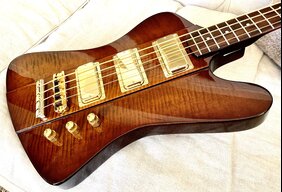
Beautiful! I've always wanted to try an ironwood neck. Can ironwood be left unfinished or does it have to be sealed?My favorite wood combination is a 40 year old alder body, jet black gaboon ebony fingerboard, and a Brazilian walnut neck otherwise known as Ironwood (jokingly referred earlier as the best for metal).
I built several necks and bolted them to a few different bodies using all of the same electronics until I finally came up with this particular magical combo. Put me in the "wood matters" camp.
View attachment 529019
What did misinterpret?
List your variables, please.


Beautiful! I've always wanted to try an ironwood neck. Can ironwood be left unfinished or does it have to be sealed?
That's some beautiful wood!I sanded the neck in increments all the way down to 1400 grit, then used boiled linseed oil. It's best if you don't seal it with poly or coating, just rubbed oil. The natural wood can be polished to a glass-like finish. It's tough on tools and you have to be patient but I think the two woods sound and feel amazing together. I spray lemon oil on the ebony once in awhile, maybe twice a year.
The finish colors are different depending on what board you start with. Here's a shot of 2 other Ironwood necks I made along with the one installed. Granted the one on the right has been sanded and polished much more with the BLO along with many hours of oil from my hands but the color is the same as when I first made it.
View attachment 529081


A guy I knew back in the '70s made a guitar with a nice chunk of ironwood for a body; his father was a sculptor and had lots of cool stuff around the shop we'd use for projects. The neck was from a Telecaster he had and the pickups were Gibson humbuckers from.......I don't recall where we got those! Hmm....... It was a heavy but very toneful monster.

Sounds like a great topic - for a different/new thread. Go for it.I was talking to the luthier at my local shop a few years back when I was buying an acoustic guitar. I found one That I really liked the sound of. He was saying how interesting it was to hear the slight tone difference due to the player. Not just the style, but the actual person. A fat guy with stubby fingers might sound different than a skinny girl with slim fingers. I'm sure it is more noticable on an acoustic instrument, but I bet there is something there on an electric as well. I wonder if there is some science on the effects of bodyfat on tone?

Best wood for bass?
You're welcome. Glad to have helped you be a bit more precise with your decriptions.
Not to pile on, but I can't seem to find the pronoun in your first sentence.What did misinterpret?
List your variables, please.
...There are amateurnouns as well as pronouns that post here.
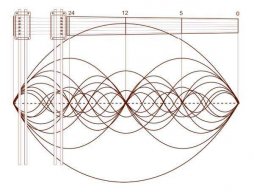
There's theory and there's reality, sometimes the two don't align perfectly. Usually when that happens it's because the theory is based on incorrect or incomplete data. My actual first hand experience (which is data you don't have) indicates that different woods can impact the tone of a bass. Therefore, I'll continue to believe in my reality vs your theory. But thanks anyway!As far as the science goes, when you adjust the tension on a string you are setting it's resonant frequency i.e. the the frequency that a material vibrates at, different materials have different resonant frequencies, and will only vibrate through eachother if the frequencies are the same. These vibrations create two types of waves, Transverse waves and Compression waves. Compression waves are what everyone hears, they are the soundwaves exiting through your amp or cabinet or whatever is producing your sound, bouncing off the walls of the room (and in the case of acoustic instruments, through the body) and into your ear drum where it is interpreted, but pickups aren't microphonic, they only measure the movement of the strings (transverse waves), which are the way the strings vibrate. So even if the body wood does have the same resonant frequency as the string your are plucking (which you realistically couldn't control) then it most likely wouldn't even get through the bridge or nut. If it did, it would only affect one specific frequency or overtone (perhaps not a good thing.)
On top of all of that there usually hundreds of variables that affect the way a tree grows, i.e. species, weather, nutrient/resource levels, etc. that affect the way that the grain forms. So even if you wanted specifically alder for example you could only get a general set of almost random characteristics.
That's not to say wood doesn't matter though, players can feel the way that different woods vibrate (although from compression waves), the weight of the body wood does matter, there is a strong argument for psycho-acoustics (I feel that it is different, therefore it is), and hell, perhaps the minimal acoustic sound of the instrument you are playing flavors the electric sound in some way (depending on the scenario of course.)
So really the bottom line for looking at basses, is whether or not it sounds and feels good, and whether or not you could realistically stand while holding it for an extended period of time (at least for players who play/gig standing up.)