• TalkBass has been independent since 1998. Add your voice.
    Create a free account to reply to discussions, view embedded media, and browse with fewer display ads.
    Join freeLog in
    Want zero display ads or expanded classifieds tools? Compare plans.

Double Bass better tone tranferring bridge wood

Carl H.,

The King Doublebass company that makes the Rockabilly basses specifically for amplification, sets their basses soundposts directly beneath the G - side bridge foot. This DAMPENS the vibration of the top, and helps to quell feedback when amplified. The flipside is a big reduction in acoustic volume.

So, which is it, more volume or less? :eyebrow:

Many King Doublebass owners have their soundposts reset to the traditional / optimal location to get their acoustic volume and tone back, when playing at rock-concert volumes is not an issue for them.
 
Carl H.,

The King Doublebass company that makes the Rockabilly basses specifically for amplification, sets their basses soundposts directly beneath the G - side bridge foot. This DAMPENS the vibration of the top, and helps to quell feedback when amplified. The flipside is a big reduction in acoustic volume.

Technically it is not damping, it is transferring more energy to the back plate. This transfer of vibrational energy away from the top/pickup is NOT damping.

Go ahead and pick fun on Willmar. I haven't always lived here, but I chose to raise my family here. My family chose NOT to be in a big city for the quality of life.

For the record, my King bass is an [Invalid or Expired Link Removed] that predates WWII, where it saw action in the south pacific. It was left behind when the Japanese over-ran the Island the band was stationed on. When allied forces re-took the island an AF lieutenant found the remaining pieces and had it rebuilt and brought it home after the war. It was brought to my Father's shop and traded on something or the other. I took it in 97 and gigged with it for a while. My fathers shop sells and repairs high end stringed instruments of the orchestral variety, only. This bass was an interesting historical oddity. My Father retired and closed up shop in 97 but I still do occasional work on the side repairing and setting up instruments. You guys have never heard of me and I'm fine with that. I have nothing to prove to anybody. But don't write off anyone who isn't in a large metropolitan area as some rube crackpot.

Hopefully someone here has tried things themselves and can speak from first hand experience, which is where my posts have come from.
 
Same principle as hollowing out the bridge - reduction of mass in the transmission of vibrations. Reducing the mass of the bridge transmits more vibrations to the top. Placing the sound post closer to the foot removes the mass of the top and diffusion of sound waves through the top so more vibration is transmitted to the back of the instrument. This also gives a very harsh tone and it not particularly desirable in most instances, however I have set up one instrument for playing solo outside, un-amplified. It is not a pleasant sound, but it projects like there is no tomorrow.

Look it up.

Above is your warm and respectful response to one of the most experienced and respected double bass luthiers in the world.
You've also insulted by calling these people "non-industry folk" and something about "unknown sources".
Arnold is a friend of mine and when someone orders him to "look it up" I tend to get edgy.
I looked in your profile. In terms of the double bass....you own a King. That's about it. Big deal.
 
Technically it is not damping, it is transferring more energy to the back plate. This transfer of vibrational energy away from the top/pickup is NOT damping.

But Carl, I don't know where you get off, because it IS damping, as it is REDUCING the energy transferred to the TOP plate. You should maybe look it up. Wiki knows all about it.

A top plate is designed to vibrate, to be as flexible as possible while still supporting the pressure of the strings. It isn't called the soundboard for nothing. The vibration of the TOP plate produces the sound, the back absorbs and reflects it. So anything that reduces the vibration of the top plate is "damping" it!

And the back of a bass is not usually designed to vibrate, which is why a flatback has braces and a roundback has a strong stiff arching.

Hopefully someone here has tried things themselves and can speak from first hand experience, which is where my posts have come from.

They have, but you haven't really been listening, have you?
 
Technically it is not damping, it is transferring more energy to the back plate. This transfer of vibrational energy away from the top/pickup is NOT damping...

Transferring all of the energy to the back plate might make the bass seem louder to the player. It would also provide a certain visceral effect which might be especially appreciated by small town dwellers whose visceral opportunites might be otherwise limited:p
 
OK OK I give.
I'll throw my bass fiddle in the back of my pickup and go muck the barn for a while.:p


I'm not as experienced on Bass as most of you, but I do have experience. If I offended, I am very sorry, it was not my intent. I started with a simple honest question for which I was hoping for a response.

Is going away what I should do now? - seriously, I can take whatever insults you care to throw at me, but I had hoped for a bit better.
 
OK OK I give.
I'll throw my bass fiddle in the back of my pickup and go muck the barn for a while.:p


I'm not as experienced on Bass as most of you, but I do have experience. If I offended, I am very sorry, it was not my intent. I started with a simple honest question for which I was hoping for a response.

Is going away what I should do now? - seriously, I can take whatever insults you care to throw at me, but I had hoped for a bit better.
Please stay and participate. I agree with you these guys here can be a bit rough, but stick it out. There's nothing wrong with a good argument now and then! Peace...
 
For a while I though you guys were destined for the Springer Show. :hyper: You could thrash and wrestle about, bust up each others basses, throw the scraps at the heckling audience. And of course tear at each others clothes (bib overalls vs black tie). But NO, you had to mend fences . . .

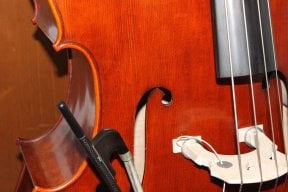
Personally, I still think that bridges should have ball and socket joints in the legs. :hiding: Lighten the mass, reduce friction loss, and power degradation due to tipping.
 
. . .

Personally, I still think that bridges should have ball and socket joints in the legs. :hiding: Lighten the mass, reduce friction loss, and power degradation due to tipping.

It's actually been done. I don't know who makes them, but my guy has a drawer full of adjusters which do this exactly. He doesn't put them on the rentals, as you can imagine:hyper:
 
Here ya go....hard to see, but the feet are let in to the legs with a ball and socket kind of deal. All maple and allows the feet to automatically adjust to the arching of the top plate. They seem to be fine, I've played basses with them on. Sorry g, good idea, really....but as they say " A day late and......."
 
And the back of a bass is not usually designed to vibrate, which is why a flatback has braces and a roundback has a strong stiff arching.


Can I re-route this thread for a bit?

Is the above quote really so? It seems to imply that a bass (or other string acoustic instrument) is like a loudspeaker cabinet, where the sound comes from the cone (top plate) with the back and sides needing to be stiff and rigid to support the cone and allow it to vibrate without dissipating the energy by vibrating themselves.

But then returning to the above quote, would not a hybrid DB with a solid top and laminate sides and back be sonically superior to an all solid wood DB? Would it not be true that the laminate woods will not vibrate as easily as the solid woods and therefore more energy would be kept to the top plate?

(And what's the balance of the above concept, to the stiff swelled-backs and braced flat-backs function to prevent structural implosion under string stress? ie. if a flatback did not have bracing, or a roundback lacked strong stiff arching?)